
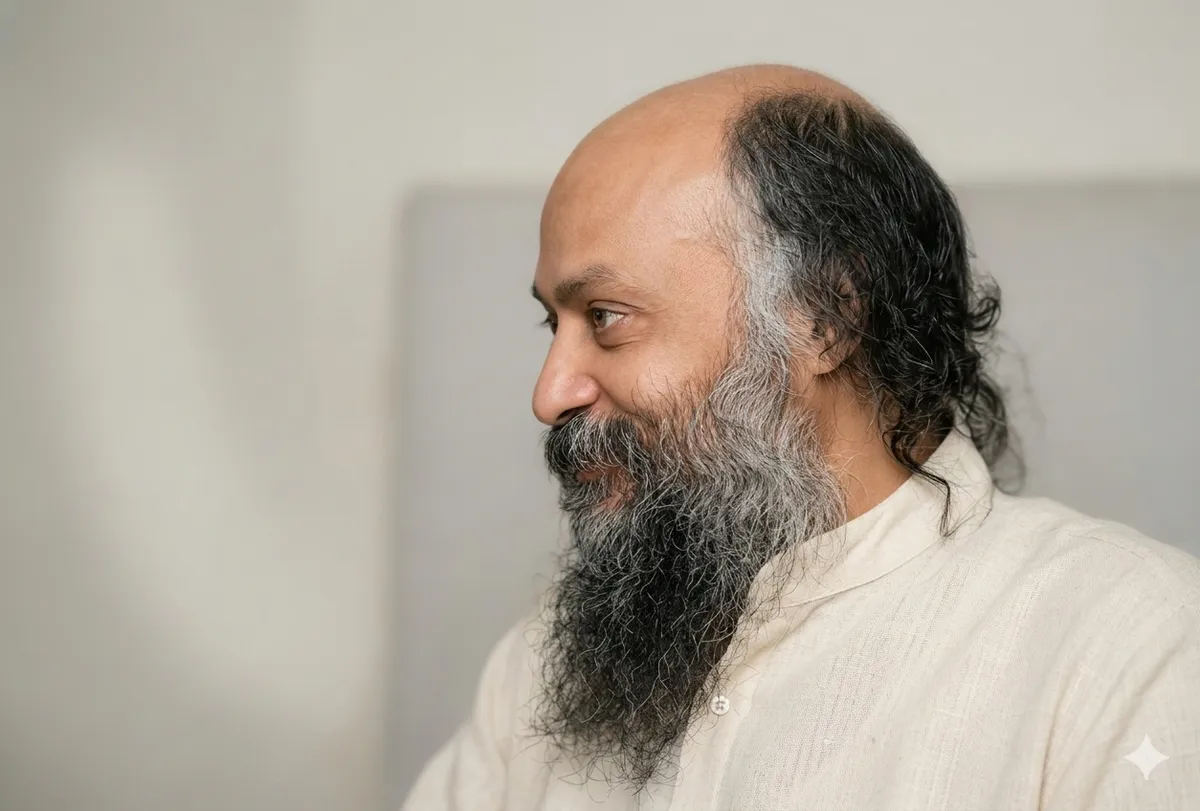
Wake up inside first, and then being good happens naturally instead of pretending to be good for rules or approval.
From the Discourses
Passages where Osho speaks to this question — each links to the complete discourse.
What do you think of ethics -- lying, cheating, stealing, idle gossip, begging, trying to bum off others who do work? Most religions have a code of ethics for the benefit of all. Does righteous conduct have nothing to do with enlightenment? I think "if you don't work, you don't eat" is a very good motto.
There are a few people who will not feel like working at all. In a better human world they have to be allowed their lousiness, their laziness. We should be at least that much human. If somebody does not feel like working, then can't we be human and generous enough that he should be allowed? He is not asking for much -- just bread, a shelter. 'In a religious world we will appreciate him, we will not condemn him. There is a possibility -- a few people ARE that way, made that way. Don't impose. Rarely are there such people, and if you accept them without any condemnation and you don't make them feel guilty, you are religious, you are righteous, you are really a moral person. There is no need to make them feel guilty. What wrong is there? What is going to happen by all the work that…
Morality is a phony lie, because the ideas are given by others and you are living them -- you are just an imitator. I am against all morality -- that does not mean that I am for immorality. In fact it is morality that creates immorality too. I am for transcendence, transcendence of the very idea of morality -- and of course, this implies immorality too. I am for consciousness, not for conscience. I don't want to give you any shoulds or should nots. I simply want you to become more aware, alert, watchful, clear, unclouded. When you are like a flame without smoke, whatsoever you do will be right. In a state of clarity the wrong is impossible, but then your character comes from your consciousness, not from your conscience, then it comes from yourself.
What constitutes the behaviour of an enlightened man?
An enlightened man is all emptiness. What constitutes an emptiness? It has no 'constitutes' in it; hence it is empty. A man who is enlightened has no character. Let me repeat it: an enlightened man has no character at all. He lives from moment to moment. He has no character to follow; he has no structure around him. A character is a structure, a character is an armour. An enlightened man has no character. Let me say he is characterless. But try to understand me -- because he has no structured consciousness. He HAS consciousness but the structure has been dropped. He's neither Hindu nor Mohammedan nor Christian. He is neither good nor bad, neither moral nor immoral, neither this nor that. He simply is. All duality has disappeared. You cannot evaluate him; you cannot categorize him; you cannot put him into any pigeon-holes of your logic. He exists like…
216. What is the method of realizing the self? At the outset, know the non-self in the self and recognize it. In doing so, when eventually nothing like the non-self remains, that is the self. That void is the self, because that which is void is full. 217. What is good conduct? The conduct behind which there is evil longing, a preconceived opinion, an ardent desire for some fruit, for the outcome, is certainly not a good conduct. Such an activity is impure and incomplete. It is impure because it is mixed with something other than itself. It is incomplete because it has to be filled up from outside, whereas good conduct is pure and complete. Good conduct is such an action as is complete in itself No future thing is necessary to complete it. Good conduct is bliss in itself. Its mere coming into being is its bliss.
Beloved Osho, what is the relationship between meditation and witnessing? In what way are mind and ego dissolved by them? Is surrender possible without attaining complete egolessness? To what extent are orange clothes and the mala helpful for meditation and witnessing? Also please explain the difference between witnessing, wakefulness and right remembering.
Then there are some who say doing has no attraction for them, but thoughts come rushing in waves. They are thinkers-they have no juice for doing. They have no interest in the outer, but great waves arise within, a great tempest. And they cannot be inside for a single moment without thoughts. They say, "If we sit silently more thoughts come. When we sit silently more thoughts than usual come. Just mention worship, prayer, meditation, and a great deluge of thoughts -- -armies -- come in wave after wave and drown us. What should we do?" The master says, "Drink meditation mixed in with your thoughts. Don't stop your thoughts, but when thoughts come observe them. Don't get lost in them, stand a little apart, at a distance. Calmly watching your thoughts, you will gradually attain witnessing. Add meditation to your thoughts." Then there are some who say, "We have…