
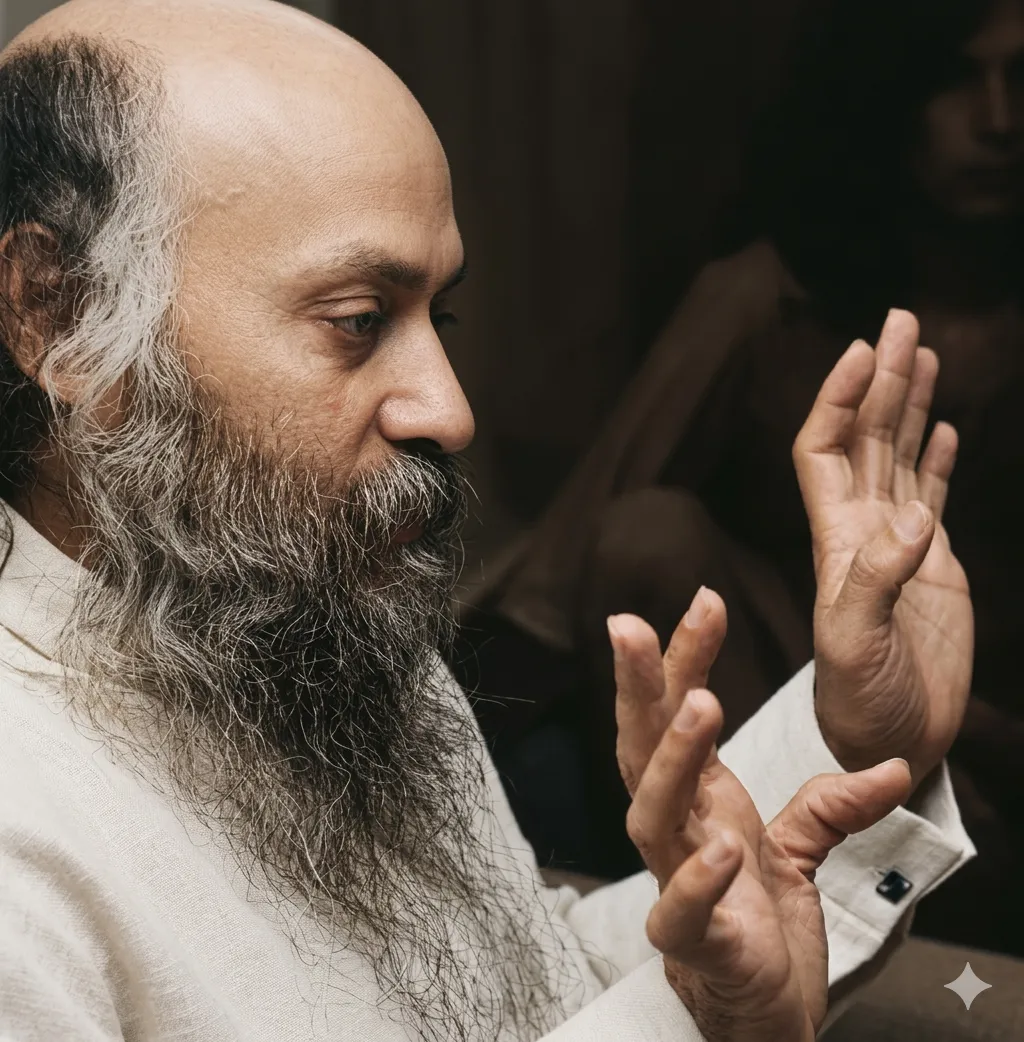
Clothes began as control; the new person uses them wisely, not to copy others.
From the Discourses
Passages where Osho speaks to this question — each links to the complete discourse.
Beloved master, nijinsky was once asked why people of the same century all seem to be alike. He answered: "it is the result of their clothing, because the clothes dictate our movements." could you please talk about clothes and the new man?
I am not in favor of nudism, I am in favor of natural living, according to the circumstances. In your home when you are playing with your children, there is no need for any identity. You don't have to be a supreme court judge, you don't have to be a great doctor, you simply have to be a human being. Eating, there is no need for clothes. And when your houses are well air-conditioned in summer, you can be nude; well heated in winter, you can be nude. And once in a while you can enjoy being nude in the park, in your garden. And in every commune the new man will create a place where people are not expected to have clothes, like swimming pools. Just in formal places, Rotary Clubs, Lions Clubs, you can have beautiful clothes. To wear clothes once in a while means you will enjoy…
A friend has asked: Osho, your attire is like that of a monk—what is the reason for this? Can’t you wear trousers, shirts, and so on? You believe in science and preach throwing out the old.
The monk has nothing except his attire; so I have chosen that from him, and the other things I have chosen from those who have them. The monk has nothing but clothing. But clothing he does have. And remember, it is very scientific attire. Trousers and ties are not scientific. In fact, the best garments are those that do not erase the sense of nakedness. The best garments are those that do not tighten, do not bind, do not turn into a prison. The best garments are those that do not fasten you anywhere, that keep you always open and free. But we are used to living in cages, so we build our houses like cages. Then we are not satisfied with the house—because how will we carry the house around outside?—so we make our clothes like cages too, tight from all sides. And when nothing else is left, we…
एक मित्र ने पूछा है: ओशो, आपकी वेशभूषा साधु के जैसी है, इसका क्या कारण है? क्या आप पतलून, शर्ट वगैरह नहीं पहन सकते? आप तो विज्ञान को मानते हैं और पुराने को निकालने का उपदेश देते हैं।
साधु के पास सिवाय वेशभूषा के और कुछ भी नहीं है। इसलिए वह मैंने उससे चुन ली है और बाकी चीजें जिनके पास हैं वह उनसे चुन लिया है। साधु के पास सिवाय वेशभूषा के कुछ भी नहीं है। मगर वेशभूषा उसके पास है। और ध्यान रहे, बहुत वैज्ञानिक वेशभूषा है। पतलून और टाई वैज्ञानिक नहीं हैं। असल में वस्त्र वे बढ़िया हैं, जो नंगेपन को मिटने न दें। वस्त्र वे बढ़िया हैं, जो कस न लें, बांध न लें, कटघरा न बन जाएं। वस्त्र वे बढ़िया हैं, जो कहीं बांधते न हों, सदा खुला और मुक्त रखते हों। लेकिन हम तो कटघरों में जीने के आदी हैं तो मकान भी कटघरों जैसा ही बनाते हैं। फिर मकान से तृप्ति नहीं होती--क्योंकि बाहर मकान को लेकर कैसे जाएंगे--तो कपड़े भी कटघरे जैसे बनाते हैं कि सब तरफ से कसे रहें, बंधे रहें। अब कुछ नहीं बनता तो टाई भी बांधते हैं। टाई का मतलब समझते हैं? टाई का मतलब होता है फांसी। उसको कहना चाहिए गलफांस, नेकटाई, गले की फांसी। उसको भी लगा लेते हैं। हम बंधन के आदी हैं। तो सब तरफ से बंधे हुए होना चाहिए। …
Osho! Recently, the English magazine “New Delhi” published several photographs related to the group-psychotherapy groups running in the ashram. There has been a lot of discussion about them in newspapers and elsewhere—along with some misunderstandings. While I was in Delhi, many editors asked me, “What do you have to say about this?” Kindly say something about it.
Krishna Prem! Nakedness is man’s birthright. Existence created man naked. Clothes are man’s invention. To deny nakedness is to deny existence. If clothes are invented for convenience, that’s fine—if it’s cold, wear something to protect yourself from the elements. But the fundamental invention of clothing is not to protect from nature; it is to hide oneself. Behind clothes there is hypocrisy. That’s why whenever someone stands naked, your hypocrisy gets hurt. When Mahavira was naked, there was great opposition. There was even more when Lalla, the woman mystic of Kashmir, chose nakedness. But they were isolated cases; somehow we tolerated them. In my view, nakedness should be natural and effortless. Whenever convenient, people should have the natural right to be naked. Clothes conceal—and in that concealment lies all pornography. In concealment lies obscenity. You will not find obscenity among tribals, because they are naked. The more you hide, the more…
पहला प्रश्न: ओशो! ‘नयी दिल्ली’ नामक अंग्रेजी पत्रिका में हाल ही में आश्रम में चलने वाली समूह-मनोचिकित्सा संबंधी कई चित्र प्रकाशित हुए हैं। जिनको लेकर समाचार-पत्रों तथा अन्यत्र भी काफी चर्चा है, कुछ गलतफहमी भी। मेरे दिल्ली प्रवास के समय वहां के कई संपादक मुझ से पूछते थे कि आप इस संबंध में क्या कहते हैं? कृपापूर्वक इस पर कुछ कहें।
कृष्ण प्रेम! नग्नता मनुष्य का जन्म-सिद्ध अधिकार है। परमात्मा ने मनुष्य को नग्न ही बनाया है। वस्त्र तो आदमी की ईजाद है। नग्नता को अस्वीकार करना परमात्मा को अस्वीकार करना है। और वस्त्रों की ईजाद सुविधा के लिए हो, तब तो ठीक। सर्दी हो और कोई वस्त्र पहने, प्रकृति से बचाव के लिए कोई वस्त्र पहने; लेकिन वस्त्रों की मौलिक ईजाद प्रकृति से बचने के लिए नहीं है, अपने को छिपाने के लिए है। वस्त्रों के पीछे पाखंड है। इसलिए जब भी कोई नग्न खड़ा होगा, तो तुम्हारे पाखंड को चोट लगती है। महावीर नग्न हुए, बहुत विरोध हुआ। उससे भी ज्यादा विरोध हुआ जब लल्ला, कश्मीर की फकीर स्त्री, नग्न हुई। मगर ये इक्के-दुक्के लोग थे। हमने किसी तरह सह लिया। मेरी दृष्टि में नग्नता सहज स्वाभाविक होनी चाहिए। और जब भी सुविधा हो, व्यक्तियों को नग्न होने का नैसर्गिक अधिकार होना चाहिए। वस्त्र छिपाते हैं। और छिपाने में ही सारी पोर्नोग्रैफी है। छिपाने में ही अश्लीलता है। आदिवासियों में कोई अश्लीलता न मिलेगी, क्योंकि वे नग्न हैं। …
Question: BELOVED OSHO, AND THE WEAVER SAID, SPEAK TO US OF CLOTHES. AND HE ANSWERED: YOUR CLOTHES CONCEAL MUCH OF YOUR BEAUTY, YET THEY HIDE NOT THE UNBEAUTIFUL. AND THOUGH YOU SEEK IN GARMENTS THE FREEDOM OF PRIVACY YOU MAY FIND IN THEM A HARNESS AND A CHAIN. WOULD THAT YOU COULD MEET THE SUN AND THE WIND WITH MORE OF YOUR SKIN AND LESS OF YOUR RAIMENT. FOR THE BREATH OF LIFE IS IN THE SUNLIGHT AND THE HAND OF LIFE IS IN THE WIND. SOME OF YOU SAY, "IT IS THE NORTH WIND WHO HAS WOVEN THE CLOTHES WE WEAR." AND I SAY, AY, IT WAS THE NORTH WIND, BUT SHAME WAS HIS LOOM, AND THE SOFTENING OF THE SINEWS WAS HIS THREAD. AND WHEN HIS WORK WAS DONE, HE LAUGHED IN THE FOREST. FORGET NOT THAT MODESTY IS FOR A SHIELD AGAINST THE EYE OF THE UNCLEAN.
Question: at first sight, sannyas appears to be something that limits one's activities. Why does one have to change one's clothes to red? Why should one have to change his appearance, since sannyas is something that is within rather than without?
Gurdjieff used to say a very meaningful thing: that as you are now, you have no soul. He was both right and wrong. You have a soul, but you do not know about it. You are the outside, and so clothes are very meaningful. Because of clothes a person becomes beautiful and because of clothes a person becomes ugly. Because of clothes he becomes respected; because of clothes he is not respected. A judge has to wear certain clothes -- a supreme court justice has to use a particular robe -- and no one asks why. With that robe he is a supreme court justice; without that robe he is no one. This is how man is. When I look at a man he is more his clothes than his mind. And this is as it should be, because we belong to the body, we are identified with the body.…