
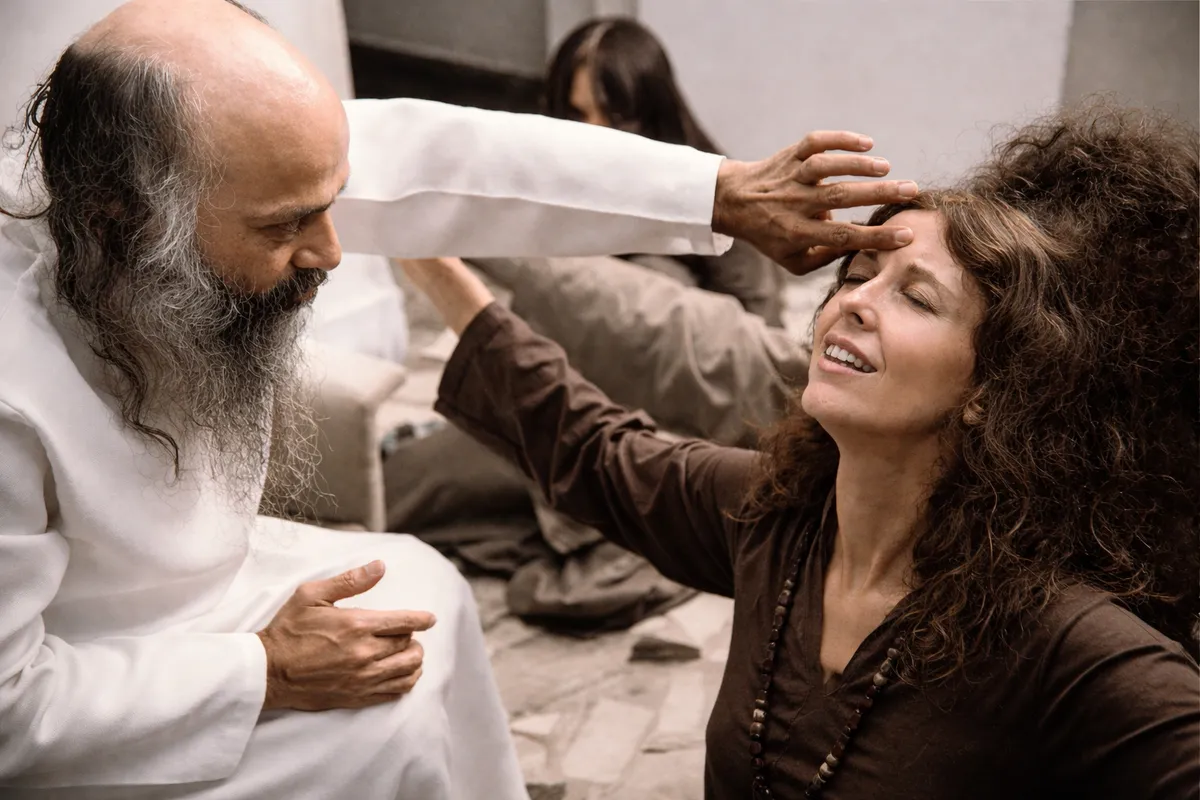
They teach to share love and light right now so ready people can wake up, even if later others turn it into a business.
From the Discourses
Passages where Osho speaks to this question — each links to the complete discourse.
Osho, even after the attainment of the Great Nirvana, in what way do the enlightened and the masters, merged in the Whole, help us? Please make it clearer.
It is not right to say “they help.” Help happens. The doer does not remain. It is not right to say the river quenches your thirst; the river simply flows. If you cup your hands and drink, the thirst is quenched. If the river itself quenched thirst, you would not need to drink; the river would make the effort. But the river moves on, inactive. The river goes on being itself; you can stand on the bank for lifetimes and still remain thirsty. Bend down, fill your cupped hands, drink, and the thirst will be gone. The enlightened do not help you either before merging into the Whole or after merging into the Whole. Because only when the sense of “doership” disappears does knowledge arise. As long as the sense of doership is there, one is not enlightened but ignorant. I am not helping you, nor serving you. I cannot…
Osho, you said that the enlightened ones live wholly in tathata—in suchness. That is, they accept the world exactly as it is; they don’t want it even a hair’s breadth otherwise. If so, why do they preach to us? Why do they keep explaining to us day and night? Why do they want to turn our non-acceptance of tathata into acceptance? And doesn’t this very effort take them into a-tathata?
The question is important, worth understanding. First thing: you have understood that the enlightened give sermons; if you have understood it that way, you have misunderstood. From the enlightened, a sermon happens. If you think they give it, you have thought wrongly—then the mistake has begun. If they were to give it, then they would be outside tathata; a-tathata would begin. To give a sermon would mean they have an insistence that something should be so. To give a sermon would mean that if you did not agree they would be unhappy, and if you did agree they would be happy. No—the teaching happens from them. The enlightened have never given sermons. It has happened. About Mahavira, the Jains have said a very apt thing: words showered from him. That is right. They were not spoken; they showered—like flowers shower from a tree, or fragrance showers from a flower, or…
Osho, Buddha attained enlightenment under a tree. You say that on the day the event of enlightenment happened to Socrates, he was standing leaning against a tree. In Krishnamurti’s life too there is a similar mention, and you yourself, on the day of your enlightenment, left home and climbed a tree. So is there any esoteric relation between trees and enlightenment? And also explain: if enlightenment happens suddenly, how did you have prior intimation of it that day, so that you left home and climbed a tree?
If you go to England or America, you will meditate with the same ease—because what’s the point? That society isn’t yours. Those people are as good as non-existent. Whatever their eyes judge, what harm can it do you? But the eyes that know you, with whom you have dealings, business—those you fear. Your self-interest might suffer by offending them. And the image you have in their eyes—if that changes, you become restless. Because you have no understanding of yourself; what others think you are, that is what you think you are. If others say you are beautiful, you believe you are beautiful. If others say you are good and decent, you believe you are good and decent. And if others begin to think you are mad, it won’t be long before you start doubting yourself—and soon you will accept that you are mad. Psychologists say we stunt the intelligence of…
Osho, whenever someone experiences the Vast, it inevitably expresses itself in some form. Is it not so with the enlightened ones?
The experience is such that, try to hide it and it will not hide; it will manifest. As far as the experiencer is concerned, it will certainly be expressed. But as far as you are concerned, it depends on you: it may be revealed, or it may remain unrevealed. Buddha has said what he came to know—whether you heard it or not… On Buddha’s side, it has been expressed; on your side, it may or may not be revealed. The rain falls: lakes, ponds, pits and hollows fill; the mountains stay empty. If your pitcher is kept upside down, no matter how much the clouds thunder and pour, you will remain empty; for you, the rain will not have happened. Not that there was no rain—there was; only, not for you. And until it is for you, what difference does it make whether it happened or not? Even if the…
Osho, after listening to the discourse on “Nahin Ram Bin Thav,” we were reminded of your proclamation voiced at the Anandshila camp: “I have not come to teach but to awaken. Surrender, and I will transform you—this is my promise.” Please explain this supreme assurance to us in detail. Also tell us: what is the difference between learning and awakening? And what is the relationship between surrender and transformation?
Through the boy, Rasputin had the royal family in his grip. If he left town for a day, they were in trouble. He also declared, “The day I die, within a short time the Tsar’s power will end.” He said it to ensure protection—and the Tsar protected him as best he could. Within a year and a half of Rasputin’s murder, the three‑hundred‑year‑old empire collapsed. In the outer history of the 1917 revolution, Lenin is central; in the inner, psychological history, Rasputin is key. Because of him, a revolution could happen—though such inner causes don’t show on the surface. If you cultivate concentration under a tree, power will arise. All forms of power feed the ego. Therefore concentrated renunciates are almost always very egoistic—their gait, their posture, their speech—all bear the shadow of ego. And for the ego‑filled, what relation can there be with the Divine? Impossible. Meditation is the…