
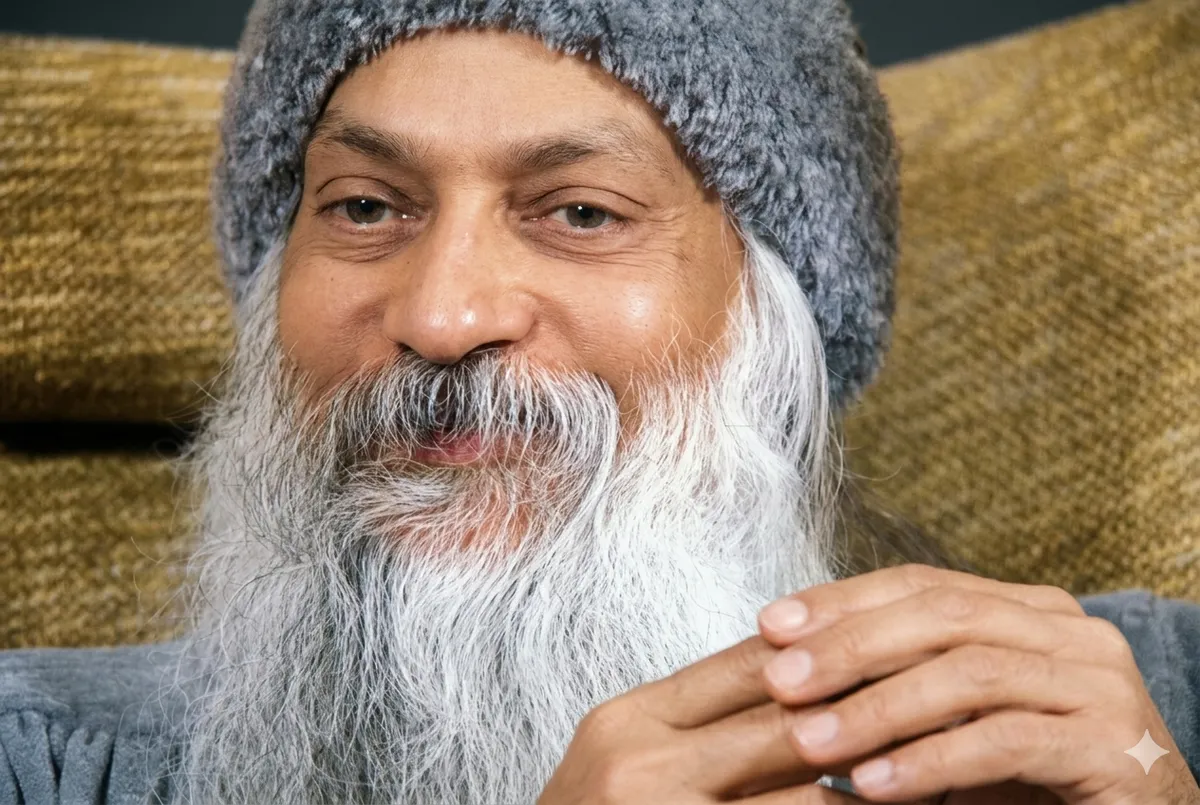
According to Osho, meditation and love are methods; samadhi is the goal. Choose the path aligned with your nature: the mind-centered begin with meditation, reach samadhi, and then love flowers; the heart-centered begin with love/devotion, enter samadhi, and meditation arises by itself. Either route culminates in samadhi and yields the other. The essential task is self-study to take the first step rightly.
Pick the way that suits your heart or mind—love or meditation—because both lead to samadhi, and each eventually gives birth to the other.
From the Discourses
Passages where Osho speaks to this question — each links to the complete discourse.
Osho, please explain the interrelationship of meditation, samadhi, and love. When do the three become one?
I say to you as well: Life is a veena. But you must tune your own veena. Do not imitate others. They must tune theirs. There are many kinds of veenas. Every person has a veena of his own and a hidden music of his own. Svadharme nidhanam shreyah. If you die while playing your own veena, you will attain the great life. If you die carrying others’ veenas—no matter how beautiful a music they produce—you will come empty and go empty. There will be no treasure in your hands. You will have wasted your life. And the greatest danger in this world is that you may fall under someone else’s influence. You are all too ready to be influenced because tuning your own veena is a hard task. Borrowing another’s veena is easy. Seeking for yourself, practicing swadhyaya, is full of risk—mistakes can happen. Borrowing knowledge from another is…
Osho, you have said there are two opposite paths: meditation and love—intelligence or feeling. So tell us, what is the difference between the practice of meditation and the practice of love? Is a meditator not loving before samadhi?
These paths are opposite; where they lead is one. You can arrive from either side. Erase one of the pair, and the other will vanish by itself. Which one you choose to erase depends on your personal inclination. It is the art of erasing one of a pair. The other will vanish because it was the inevitable counterpart. If from existence we remove light itself, darkness will also be gone. It sounds difficult only because in your house, if you blow out a lamp, darkness doesn’t disappear—it increases. But you haven’t removed light from existence. If light were eradicated from existence, darkness would vanish. If darkness were erased, light would vanish. If we remove death from the world, life will disappear that very day. We think the opposite: that death destroys life. You do not know; they are two parts of one thing. Without death there can be no life;…
That's what sannyas is: creating a right space, the right soil for love to grow, for love to expand. As your love becomes bigger, you become bigger. When your love is perfect you are perfect. There is no other way to be perfect. Only the perfection of love can bring perfection to your being. There are two ways to reach God: one is meditation, the other is love. A few people reach through meditation, a few people reach through love. Both are valid ways and both reach the same experience. When the meditator reaches the ultimate peak he suddenly finds love arising in his being, and when the lover reaches the ultimate peak he finds meditation happening of its own accord. On the way they are different, at the peak they become one. The path of meditation is arduous, it demands a little superhuman effort.
Osho, you have titled this series of talks “Sahaj Yoga.” Do “sahaj” and “yoga” not seem mutually opposed?
Anand Maitreya! They don’t just seem opposed, they are opposed. But no ultimate truth of life can manifest without contradiction. Life is made of opposites—darkness and light, day and night, woman and man, negative electricity and positive electricity, birth and death. The very structure of life is woven of opposites. Hence the opposites are not only opposed; they are complementary to each other. If you have labored hard all day, you will be able to sleep deeply. Labor and rest are opposites, yet only the one who has worked can rest deeply—and the one who has not worked cannot. So the opposites are not only opposed, they complete each other. And only the one who has rested deeply at night can rise in the morning and engage in work again. One who has not rested through the night will not be able to work in the morning. Look closely at…
Osho, you always say that love is God. What is the relationship between love and God?
You’ve seen it: sometimes on a lotus leaf two dewdrops roll together and become one, and yet a drop remains a drop. One drop has formed in place of two; nothing vast has occurred. The boundary grows a little. You were a little half-and-half; meeting the beloved you become a little more whole. You were alone; meeting the beloved you are no longer alone. The path of love is the path of prayer. See: among Hindus, the images are made of Sita and Ram together, of Radha and Krishna, of Shiva and Parvati. These images are symbols—symbols that the love which happens between human and human is to be expanded, made so vast that it happens between man and the Infinite. On the path of meditation this is not needed. That is why Mahavira stands alone, that is why the Buddha sits alone. On the path of meditation the other…