
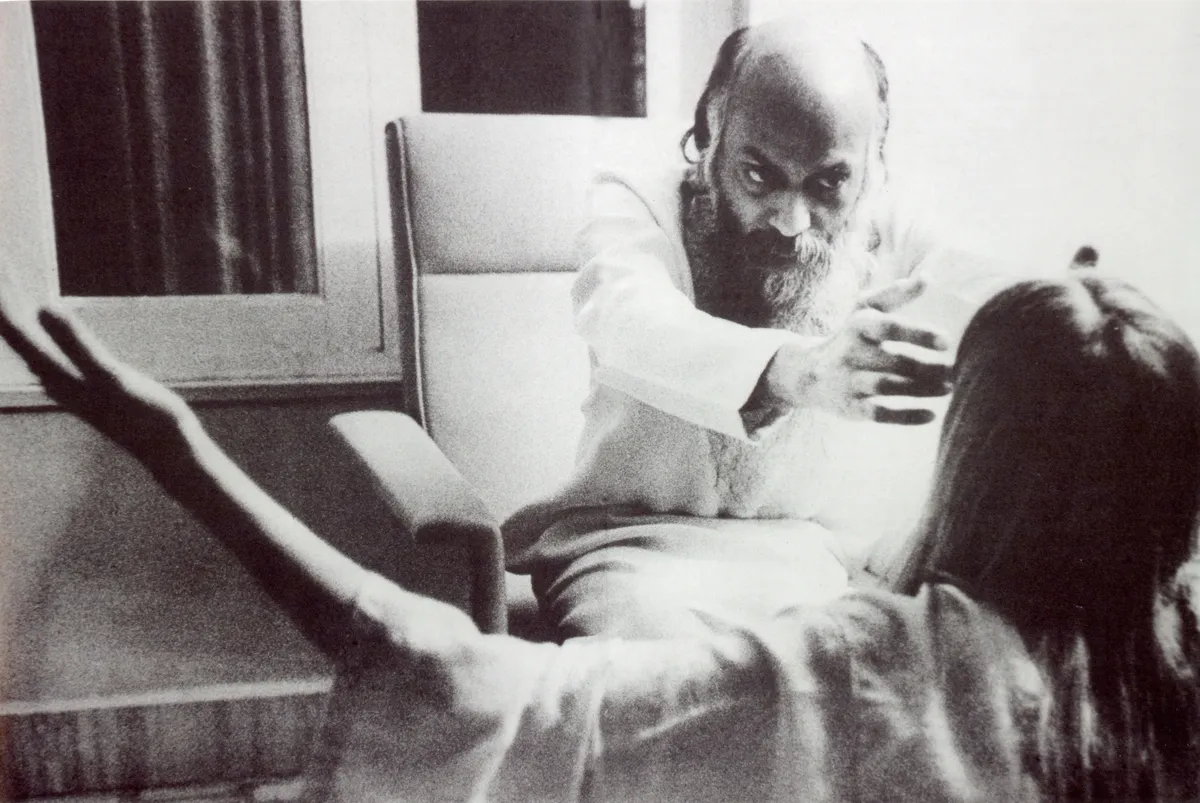
He’s like a mirror that simply reflects, while we keep busy chasing plans without even knowing why.
From the Discourses
Passages where Osho speaks to this question — each links to the complete discourse.
Osho, so far I have listened to many of your discourses and gone through many books, especially those on sadhana—I liked them very much. And in the meditation camp, the directions you gave at the beginning were also to the effect that the mind’s sankalpa–vikalpa should not arise—that there be a resolve in the mind to be the master of inaction, the master of the void, something like that. Now, the practice taught here involves a great deal of action, so it seems to me there may be some contradiction...
It may seem so; there is no contradiction. In fact, we cannot help breaking things into two parts. We look at things by splitting them into two opposing halves. We say: this is darkness, and that is light. But in life, darkness and light are not two things. In life they are the gradations of one and the same thing—degrees of one thing, not two. Yes, degrees of the same thing. What we call light is the dense degree of that very thing; what we call darkness is its rarefied degree. Darkness and light are not two hostile opposites. In the same way, action and nonaction are not enemies. Travel from either side and you arrive at the same place, because deep down the two are one. So when I say nonaction—the path of nonaction—if one can drop all action and become inactive, and drop all thought and become thought-free,…
Osho, a curiosity has arisen. You have said, in the context of apramad (alertness), that a pramadi (negligent) person does nothing; things happen without his will or choice. So please tell us: what is the difference between the “doer” in a sleeping state and the “doer” in an awakened state? Gurdjieff says that an awakened man becomes crystallized—what does that mean? And doesn’t the awakened man’s ego dissolve rather than crystallize?
The sleeping man is not a doer; things happen to him too. But the sleeping man thinks, “I am doing.” The sleeping man is not a doer, yet he believes he is. The awakened man also is not a doer, but he understands that he is not the doer. That is the only difference. The sleeping man thinks, “I am the doer.” He does nothing; it happens. The awakened man also does nothing; everything happens—but the awakened man knows that everything happens, I am not the doer. Between the sleeping and the awakened there is no difference in doing; the difference is in knowing. Their actions do not differ; what differs is the sense of doership. A Buddha walks, and a non-Buddha also walks. A man filled with awareness walks, and a man filled with unawareness also walks. The unawake walks from the center of “I”—“I am.” The awake walks…
Osho, you said... then you will find that the devotee is God. The question arises: if one devotee prefers to be God and another wants to remain only a devotee, then which of the two is superior?
The one who wants to be God will not be able to be. And the one who wants to remain a devotee will become God. The question of superior or inferior does not arise, because only one of the two will happen. The one who does not want to be will be. The one who wants to be will be deprived. That very wanting is of the ego. But the matter is a little delicate. Sometimes humility too belongs to the ego. Beware that your humility may not be of the ego. Perhaps you are saying, “No, I don’t want to be,” because you know that those who refuse are the ones who attain. Then you are clever. Then your humility is adulterous. Your humility is not pure, not sacred, not virginal—it is like a prostitute. The one who wants to be God, whose ego says, “I must become God,”…
Osho, what is the fundamental anguish of human life?
There is only one anguish: that a human being cannot become what he was born to be. There is only one anguish: that the seed remains a seed and does not bloom like a flower; that it cannot scatter its fragrance to the infinite winds; cannot converse with the moon and stars; cannot offer its colors to the sky; cannot be expressed. If the poem within the poet cannot be revealed—anguish. If the painter cannot paint—anguish. If the dancer cannot dance—if chains lie on his feet—anguish. Anguish means only this: that what we are meant to be—our innate nature and destiny—does not come to fruition, and we are forced to be something else. Then anguish is born. Then melancholy gathers over life. And all those countless people you see burdened with sorrow, living in a kind of hell—the reason is only this: each has come carrying the seed of becoming…
Beloved Osho, I am such a doer. How can I become more open and available to you without doing? How to find the balance between doing and non-doing, to reconcile your two statements: "you have to act without will," and, "effort is also needed"?
You will be surprised to know that when I entered the university, I was doing so much exercise -- running, swimming, jogging and other exercises -- that a few other students became interested. They started following me, to go for a run. I had never thought that there was any problem in it, but the man who owned all the restaurants and the mess at the university came to see me and said, "I will give you a totally free pass as far as food is concerned, but please don't help these people to run and jog and swim, because I am going to be bankrupt! "Before you came I had never seen people eating thirty-five chappattis at a time -- and your followers are doing that. At the most four chappattis are enough. But if everybody starts eating thirty-five chappattis at a time, seventy chappattis in a day, then…