
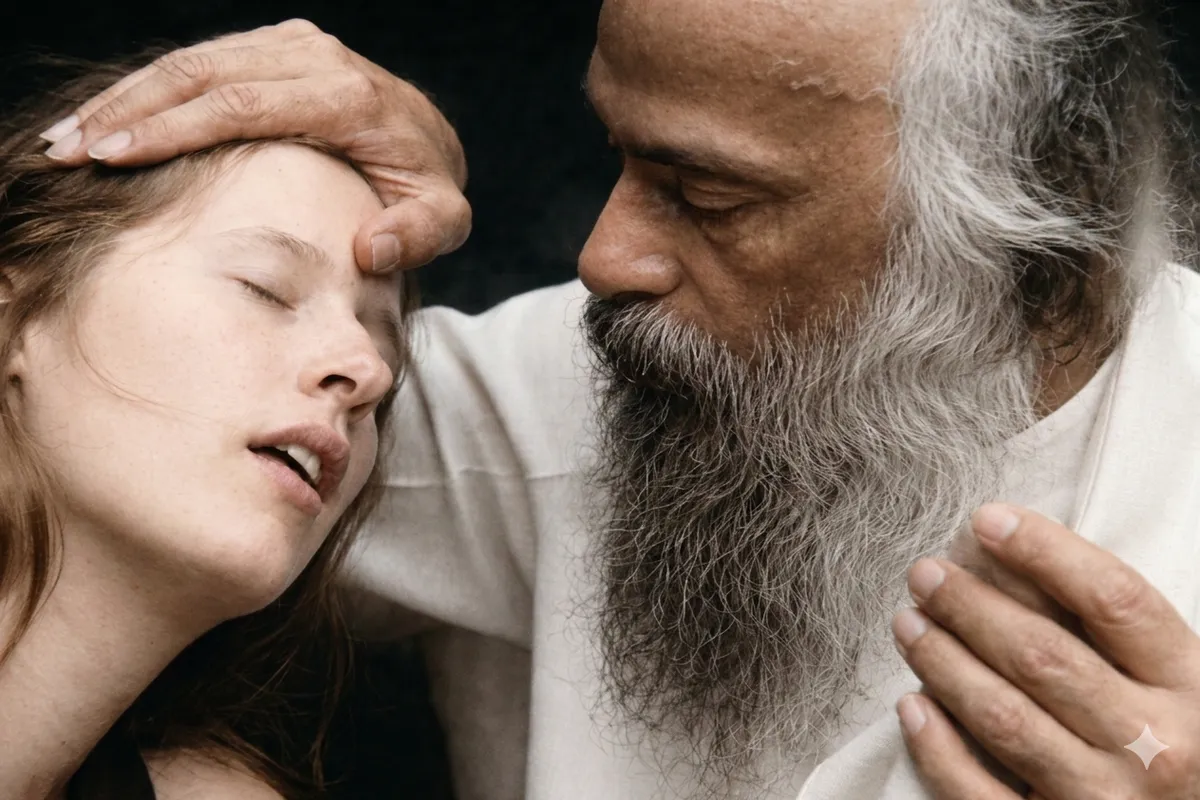
A reaction is your old autopilot pressing buttons; a response is you pausing, seeing what’s really happening now, and then choosing.
From the Discourses
Passages where Osho speaks to this question — each links to the complete discourse.
What is the difference between waiting for godot and waiting for god?
It is as if the sun has risen in the morning and you are sitting in your room with closed doors and windows, in darkness. Open the doors, you become available to the sun. The sun was already available -- just the meeting happens. You cannot wait for God. All waiting is for Godot. Godot means the one who never comes, who CANNOT come, whose arrival is impossible. And the only impossible thing is that which has already happened -- how can it happen again? You are alive, and you are waiting for life, Now, this is ridiculous. The real man of religion does not think in terms of God. He thinks in terms of life or, even better, of living -- because life can again become an abstract idea. Living, moment-to-moment living. In that very living, one knows what God is, because one knows who one is. Your idea…
Osho, you have said that an uncivilized man can change his face with effort, but a civilized, educated man can change faces with ease—meaning this ease of changing faces is a gift of civilization. In this context of shifting faces, I want to ask: what subtle distinction do you make between reactions and response? What are the keys to freedom from reactions and the attainment of responses? Please explain briefly.
A joke circulates about Bertrand Russell. “Joke” is the right word, because who knows whether it really happened. I’ve heard that at the time of his death the words “O God!” came out of his mouth. A priest was standing nearby—very astonished. He had approached full of fear, because Bertrand Russell did not believe in God; how then to ask him for repentance, for a final confession? He stood there, apprehensive. But when, at the last moment, “O God” came from Russell’s mouth, his courage rose. He asked, “Do you believe in God?” Russell opened his eyes and said, “Who are you?” “I’m a priest,” he replied, “standing here fearfully. I had come to have you repent, but I thought you don’t believe. It’s good you do—then make your confession.” Russell said, “It is not proper to send a guest away empty-handed; so I will repent.” And he said, “O…
ओशो, आपने कहा है कि असभ्य आदमी चेहरे प्रयत्नपूर्वक बदल पाता है, लेकिन सभ्य, शिक्षित आदमी सहजता से चेहरे बदल पाता है। अर्थात चेहरे बदलने की सहजता सभ्यता का वरदान है। इस चेहरे की बदलाहट के संदर्भ में मैं पूछना चाहता हूं कि रिएक्शंस और रिस्पांस में आप क्या सूक्ष्म भेद करते हैं? रिएक्शंस से मुक्ति और रिस्पांसेस की उपलब्धि के क्या सूत्र होंगे, इसे संक्षेप में समझाएं।
बर्ट्रेंड रसल के संबंध में एक मजाक चल गया है। मजाक कहना चाहिए, क्योंकि पता नहीं उसने ऐसा किया कि नहीं किया। सुना है मैंने कि मरते वक्त उसके मुंह से निकला, ‘हे परमात्मा!’ पास में एक पादरी खड़ा हुआ था। वह तो बहुत चकित हुआ। वह बड़ा डरता-डरता आया था। डरता-डरता आया था, क्योंकि वह बर्ट्रेंड रसल तो मानता नहीं परमात्मा को, तो उससे रिपेंटेंस के लिए, आखिरी प्रायश्चित के लिए कैसे कहे। वह डरा हुआ खड़ा है। पर जब आखिरी क्षण में रसल के मुंह से निकला, हे परमात्मा, तो उसकी हिम्मत बढ़ी। उसने कहा कि क्या तुम परमात्मा को मानते हो? तो बर्ट्रेंड रसल ने कहा, आंख खोली, कहा: तुम कौन हो? तो कहा कि मैं एक पादरी हूं। डरा हुआ खड़ा हूं। मैं आया था कि प्रायश्चित करवा दूं, लेकिन सोचा कि तुम तो मानते नहीं। अच्छा है तुम मानते हो, तो प्रायश्चित कर लो। तो रसल ने कहा: घर आए मेहमान को वापस लौटाना ठीक नहीं, इसलिए मैं प्रायश्चित करता हूं। …
Generally we react, we retaliate. If someone abuses us, we w ant to abuse him back. We do not want to abuse. Something causes us to abuse and we become slaves of someone. If I was to make you angry only a slight push is required to arouse it. The thing which can be produced in us by others is a sign of slavery. Reaction is slavery. Someone praises us we are greatly pleased. Someone censures us we feel dejected and lost. We by ourselves are nothing at all, we are what the opinion is about us. To know what the people say about us, we preserve the newspaper cuttings with us. It should be considered a matter of great grace, we do not stick them on our clothes. All the time we are simply reacting. We do that, which others cause us to do. We are not individuals.
Question: BELOVED OSHO, WHAT IS MOMENT-TO-MOMENT UNDERSTANDING IN RELATIONSHIP? ... Just when he was leaving he said, "One thing more I would like to say to you. In the other village I left behind, a great crowd just like you had come there and they had brought many sweets just as a present for me, a gift from the village. But I told them that I don't take sweets. They took the sweets back. I ask you, what will they do with those sweets? So somebody from the crowd said, "What will they do? It is easy, there is no need to answer. They will distribute them in the village and they will enjoy. So Buddha said, "Now what will you do? You have brought only insults and I say I don't take them. ... What will you do? ... I feel so sorry for you.
Osho, can you talk about responsibility and what it means for us? I feel its importance more and more, but I am also confused about it. Am I avoiding something?
What I am saying is that if they had experienced it at its peak, its grip over them would have been lost. Then their whole life they would not be looking at PLAYBOY magazines; there would be no need. And they would not be dreaming about sex, having sexual fantasies. They would not be reading third-rate novels and looking at Hollywood movies. All this is possible because they have been denied their birthright. In the aboriginal society they live together in the night. One rule only is told to them: "Don't be with one girl more than three days, because she is not your property, you are not her property. You have to become acquainted with all the girls, and she has to become acquainted with all the boys before you choose your life partner." Now, this seems to be absolutely sane. Before choosing a life partner you should be…