
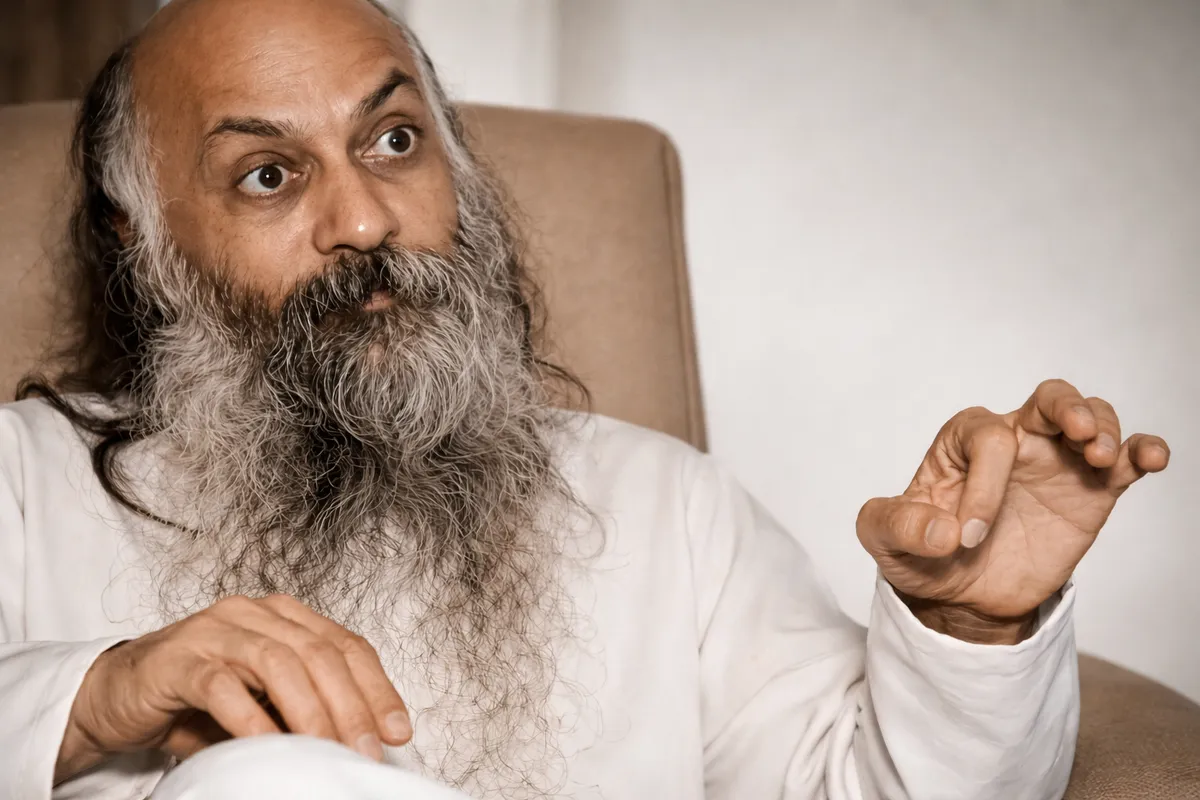
Be super awake and do everything slowly and consciously; then your habits stop bossing you, and your real power shows up by itself.
From the Discourses
Passages where Osho speaks to this question — each links to the complete discourse.
What is the de-activation process of the law of necessity and the activation process of the law of power?
THE LAW OF NECESSITY means you are unconscious, you are functioning like a robot. Only then does the law of necessity apply. So if you want to de-activate the law of necessity, the only way is to become more aware, more alert. De-automatize your activities. Walking, walk with aware ness. Eating, eat with awareness. In the beginning it is very difficult, because you have always lived in unconsciousness. You walk mechanically -- bring awareness to walking. And to bring awareness to walking, a few things will be needed. One: don't walk at the usual pace you walk -- go slower. Go AS slow as you can, because if you go slower than you usually go, your old habit cannot persist. You are bringing something new into it and the body will have to get adjusted. It will take time, and that time can be used to become aware. If you…
What is the law of necessity?
PYTHAGORAS TALKS ABOUT TWO LAWS: the law of necessity and the law of power. The law of necessity means living an accidental life, like a robot, like a machine. The law of necessity means things happen to you; you are not the master, you are not conscious enough to be the master. The law of power means things don't happen to you: you happen to things. You are not just an accident -- you are a power. Consciousness brings power; then life is not just like a driftwood, then life has a direction. Then life has some integrity; then life has a continuum. You have something solid in you, and so powerful it is that you start happening to people. You have a presence. And whatsoever you do, you do it; it is not an unconscious reaction: it is a conscious response. You are not just at the mercy of…
Question: OSHO, WHAT DO YOU HAVE TO SAY ABOUT THE LAW OF KARMA? ... Gurdjieff started wondering how it happened, why it happened, and soon he was able to figure out that it is just a question of your unconscious accepting the idea. Once your unconscious accepts the idea, then your body and your conscious mind have no power to go against it. In his own exercises that he developed later on when he became a Master, Gurdjieff used all these nomad techniques that he had learned from those strange people -- uncivilized, with no language, no written alphabet, but who knew very primitive methods. And he was surprised to see that hypnotism works not only on children but on grown men, because those children become young adults; then too it works. Then they become old, then too it works. It does not change with age.
Osho, does living moment-to-moment begin the awareness of interdependence?
You have heard of Baital Pachisi (the Vetala tales). You would never suppose it could be a teaching for the wise—yet this land has made unique experiments. It has produced books that can be read on many levels, with layer upon layer of meaning—two, three, four, five meanings running parallel like five roads side by side. Thus whoever you are, there is a way. A small child enjoys it; the supreme knower enjoys it. The seeker finds the path; the arrived recognizes the destination. For one who is neither, it is a diversion—that too is something, a little entertainment. The first story goes like this. Emperor Vikramaditya was in court when a fakir arrived. As custom had it, people came in the morning to offer gifts. The fakir offered a wild-looking fruit. The emperor smiled—why come so far to offer a jungle fruit? But a fakir has nothing else, so…
पहला प्रश्न: ओशो, क्या क्षण-क्षण जीने से परस्पर-तंत्रता का बोध शुरू होता है?
तुमने बैताल पचीसी का नाम सुना होगा। तुम कभी सोच भी नहीं सकते कि वह भी कोई ज्ञानियों की बात हो सकती है, बैताल पचीसी। पर इस देश ने बड़े अनूठे प्रयोग किए हैं। इस देश ने ऐसी किताबें लिखी हैं, जिनको बहुत तलों पर पढ़ा जा सकता है, जिनमें पर्त दर पर्त अलग-अलग अर्थ हैं। जिनमें एक साथ दो, तीन, चार और पांच अर्थ दौड़ते रहते हैं। जैसे एक साथ पांच रास्ते चल रहे हों, पैरेलल, समानांतर। तो जिसकी जो सुविधा हो। एक छोटा बच्चा भी बैताल पचीसी पढ़कर प्रसन्न होगा और परम ज्ञानी भी पढ़कर प्रसन्न होगा। खोजी को मार्ग मिल जाएगा, पहुंचे हुए को मंजिल की प्रत्यभिज्ञा होगी। जो नहीं खोजी है, नहीं पहुंचा हुआ है, उसके लिए सिर्फ चित्त का मनोरंजन होगा। वह भी क्या कम है! थोड़ी देर को मन बहलाव हो जाएगा। बैताल पचीसी की पहली कथा है.। पच्चीसों ही कथाएं बड़ी अदभुत हैं, लेकिन पहली तुम से कहता हूं। पहली कथा है कि सम्राट विक्रमादित्य के दरबार में एक फकीर आया। सुबह का वक्त था। रिवाज के अनुसार लोग सम्राट को भेंट चढ़ाने सुबह-सुबह आते थे। …