
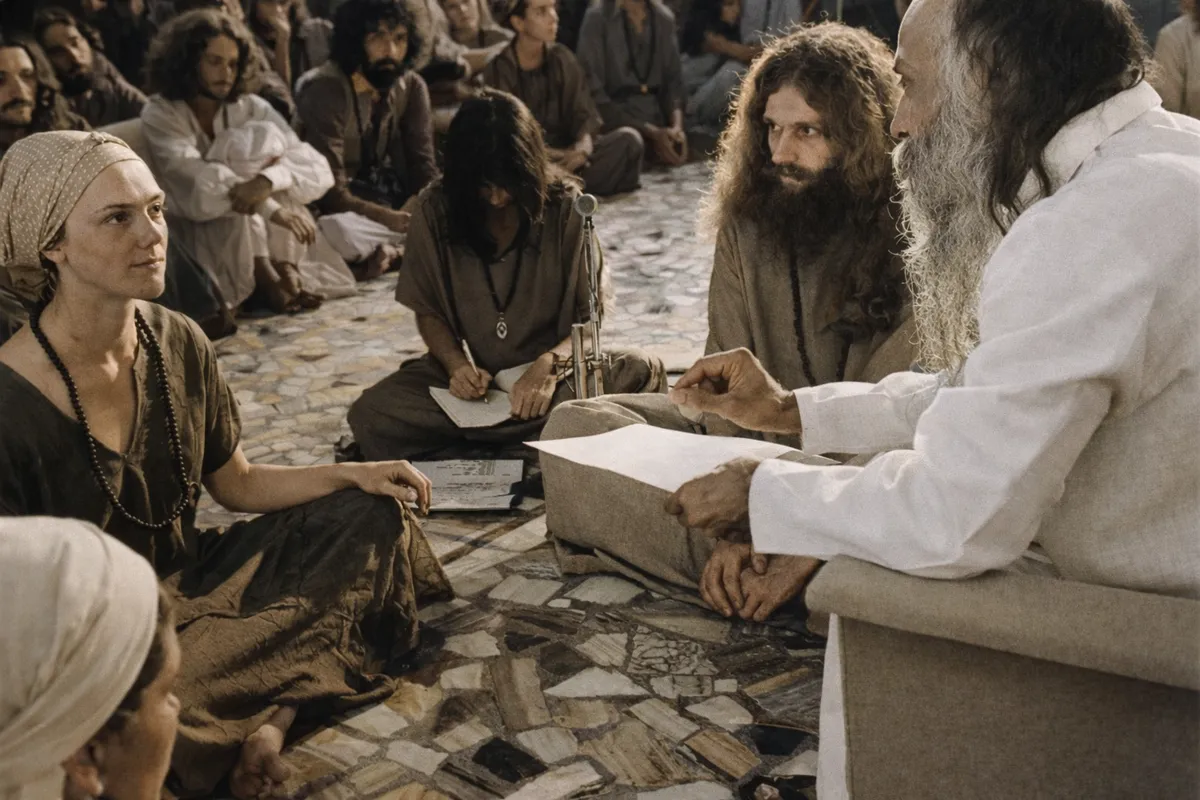
According to Osho, begin with a bath—especially for Westerners—then meditate. The body comes first: outer cleanliness prepares receptivity for meditation, which is the deeper cleansing of your being. If you won’t clean the body, you won’t care to cleanse the soul. Clean the temple first; then you can bathe the inner god in stillness.
Wash your body first, then sit to meditate—cleaning outside helps you feel ready to clean the inside.
From the Discourses
Passages where Osho speaks to this question — each links to the complete discourse.
Can you talk about the brahmin habit of taking several baths every day and changing clothes? Is this recommended for a sannyasin today?
Brahmins have gone neurotic. They suffer from compulsion, obsession, neurosis. To be clean is good, but to clean continuously is mad. And the mind can move to extremes. You can either be dirty, then you don't take a bath.... I used to know an Italian sannyasin. She happened to stay with me in a camp. I was surprised, she never took any bath. Then I inquired and she said, "Once a year," she takes. And she asked, surprised, "Is that not enough? -- once a year?' And then there are brahmins who are not doing anything else -- just taking baths. I know a person, he is a close relative; he has some obsession. He has remained a bachelor all his life -- a very good man in all the ways except one, and that too is innocent, doesn't harm anybody, but has harmed him completely. He is a poor…
Whenever you can find time -- and at least once a day you have to find time.... Any time will do, but it is good to do it when the stomach is empty; the more energy is available when the stomach is empty. Not that one should be hungry -- just that the stomach should not be too full; if you have eaten then after two, three hours. Just a cup of tea is good... a cup of tea is very helpful. Buddhists have used tea for a long time. They have made almost a meditation of drinking tea. And it is helpful: it makes you a little alert, and good! So you can take a cup of tea but not anything else. Whenever you do it, early in the morning or in the night, the stomach should be empty.
Osho, what is the first experience of samadhi like?
You will know only when it happens. It cannot be said; at most a few hints can be given. It is as if, in the dark, a lamp is suddenly lit. Or as if a dying patient, right at the edge of death, suddenly finds a medicine that works; life’s wave, life’s thrill spreads again—so it is. As if a corpse becomes alive—such is the first experience of samadhi. It is the taste of nectar. The experience of the ultimate music. But it will be only when it happens; and only then will you understand. You will not understand by my saying it. It is as with love. How can anyone explain it? To someone who has never loved, never known love, no matter how many explanations you offer—he will hear it all and still ask, “I haven’t understood; please explain a little more.” It is like explaining light to…
Sadaadeeptih apaar amrit vrittih snaanam to be centered constantly in the inner illumination and in the infinite inner nectar is the preparatory bath for the worship.
Whatsoever you have done, whatsoever you have been, whatsoever your past has been. it dings to you -- just like dirt, just like dust, it clings to you. When you enter inner light, it disappears. Why? Because the moment you enter that inner light, everything takes the velocity of light and nothing can remain. The dirt, the dirt of karmas, dissolves -- all that you have done in all your lives. When you enter that realm, everything becomes light, because with light, in that velocity, nothing can remain anything else. So it is not simply a bath. All the karmas, just disappear, they become light, and the consciousness is cleaned. It becomes fresh and young as it should be, as it is meant to be. And when all the karmas disappear -- by "karmas" I mean the material dust that one accumulates through actions and desires and passions -- when…
Osho, in the practice of Vipassana, when does catharsis occur? I practice Vipassana. How can my work in music assist me toward awareness?
Vipassana is an age-old method of meditation. It must have been discovered thousands of years ago; who discovered it, no one knows. It is a wondrous process, the simplest device to get acquainted with oneself. The word Vipassana means: to sit silently and become a witness to yourself. Pashy means: to see. Vipassana means: just sit silently within and watch. This breath came in, this breath went out—watch that too. The heart beat—watch that too. Sit silently inside and watch whatever is happening. And by and by, all the noises disappear and a vast emptiness surrounds you. Buddha spread the process of Vipassana throughout the world. But there is a hitch: two and a half thousand years have passed since Buddha. The method of Vipassana is the same, unchanged. But man’s waywardness is not the same—he has gone further and further into it. Vipassana is simple for an innocent, guileless…