
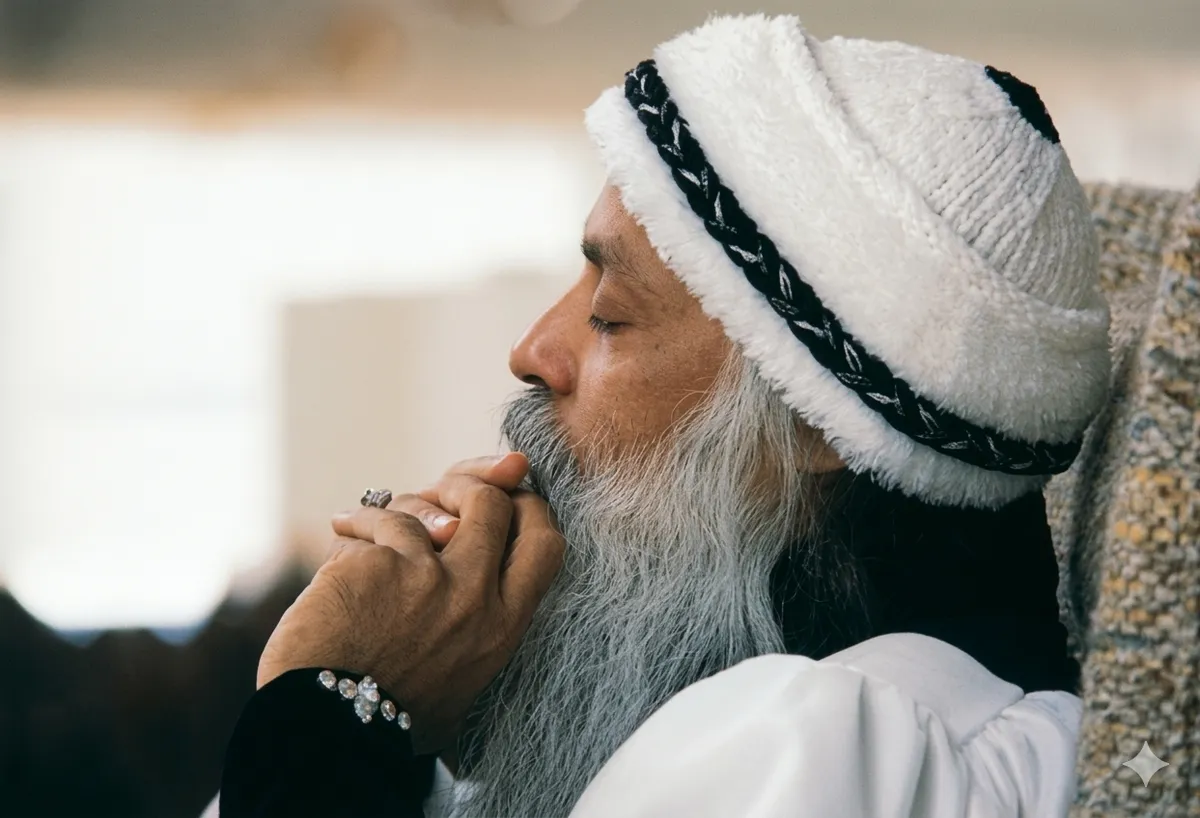
Don't study life to wake up; just live it simply and trust what is happening right now.
From the Discourses
Passages where Osho speaks to this question — each links to the complete discourse.
What is more important, the practise of life or the theory? Is it possible for someone as ignorant as I am, who used to be a really devoted roman catholic, fifty years old, to attain to enlightenment without taking much time to study all which is between heaven and earth?
"Is it possible for someone as ignorant as I am to attain to enlightenment?" It is possible only for those who recognize their ignorance -- because those are the innocent people, who recognize their ignorance. The recognition of ignorance is the very door to enlightenment. If you think you know, then you will be debarred. Pundits have never become enlightened -- they cannot. They have too much knowledge, they are burdened too much with knowledge. They are like donkeys carrying scriptures -- that's what Jalaluddin Rumi has said. And a donkey remains a donkey -- whether he carries a KORAN on his back or not does not matter. You can carry scriptures in your memory, but memory is not knowledge. To memorize a thing is not to know it. To memorize a thing is a way to avoid knowing it. It is very cheap. A computer can do it; there…
All that we do here is to help you to put the mind aside. All the meditations are nothing but devices to put the mind aside. And once you have got even just a glimpse of your inner light, then things become very easy. Then you know that the light is inside. And then to put the mind aside is not difficult because now you know there is no risk -- it is worth putting it aside. Only in the beginning is it difficult because you only know the mind. You have been identified with it, you think you are the mind so to put it aside feels very dangerous. It feels like committing suicide, because it is you! But you are not it. It is just a deep-rooted misconception, a wrong calculation. You are simply making a mathematical mistake. Two plus two are four, and you are putting five.
Osho, even when I understand everything theoretically, why does it not come into practice? Please explain.
Someone told Mulla Nasruddin, “Stop smoking, otherwise you’ll die early. Scientists say it takes a year off your life.” Nasruddin said, “We’ll live sixty-nine instead of seventy—but to live one extra year at the cost of a whole life without the joy of cigarettes, that I don’t understand.” That’s the double-talk. He accepts that scientists are probably right: a year less. A doctor told him—because his illness kept worsening—“Brother, stop drinking, stop smoking; now you’re old—stop running after women, or you’ll die soon.” Nasruddin said, “What you say is fine, doctor. But if I stop all that, what would be the point of staying alive? Tell me that too. Don’t smoke, don’t drink, don’t chase women—then sit like a dummy! What would I live for?” And it isn’t only with men. I read a story: A man died—must have been a Christian. He reached the gates of heaven; Saint Peter…
You said that the real morality is the shadow of enlightenment. But then how is one to live before becoming enlightened?
THE moment you ask 'how' you are asking again for a discipline. The moment you ask 'how' you ask for methods, techniques. Why can't you simply live? Are not animals living? Are not trees living and birds living without asking any 'how'? Why do you carry on continuously about everything with this 'how'? How to love? How to pray? How to be friendly? How to be compassionate? How to be silent? How to live? Drop the 'how' and let life take its own course. It will. It is not waiting for any 'how'. That's what Tao calls spontaneity, TATHATA, suchness. Let life take its own course. Who are you to interfere continuously? Can't you simply eat? Why do you ask how to eat and how to taste? Can't you simply taste? Just eat, chew well, and enjoy. Let life move, don't try to manage it. By trying to manage, you…
Osho, it is difficult to practice what you say. Please tell us, in meditation whom should one remember?
There is a story in the Jain scriptures. A young man returned after listening to Mahavira. He was sitting in his bath pavilion; his wife was rubbing ubtan on him, bathing him—an old story; now no wife bathes her husband. Even if the husband is bathing, she knocks at the door: “Come out—how long will you sit in there? There are other things to do than bathe!” Those were earlier days. She was rubbing ubtan, cleaning his body. They began to talk. The wife said, “You’ve returned from listening to Mahavira; my brother also goes to listen. He’s so impressed that he says, ‘In two or four years I’ll take sannyas.’” Her husband laughed. He said, “Sannyas—‘in two or four years’! There is no certainty of tomorrow, no certainty of the next moment!” The wife said, “I know—he’s practicing at home right now. When his practice is complete, he’ll leave…