
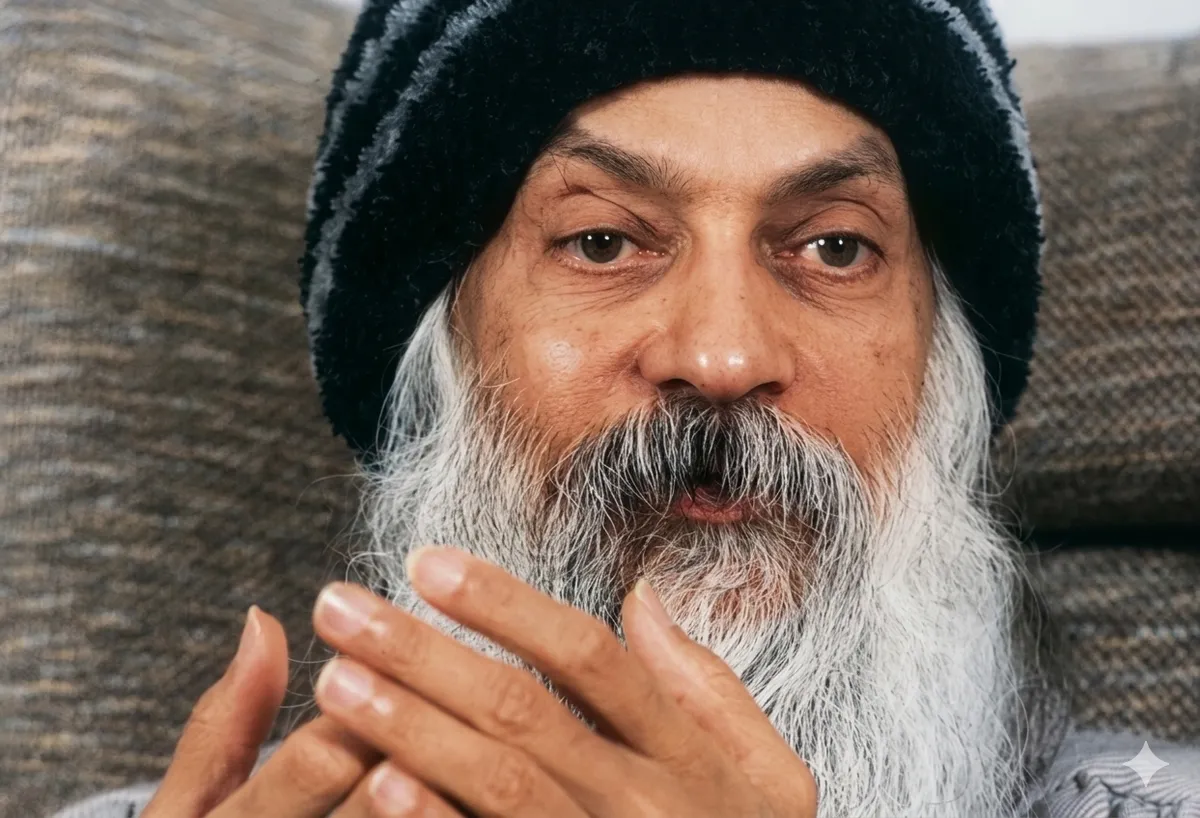
Give yourself so completely to meditation that nothing in you is watching, doubting, or holding back, and fresh energy keeps coming.
From the Discourses
Passages where Osho speaks to this question — each links to the complete discourse.
Something more about the first question: in reference to the efforts regarding meditation, what is meant by the state of total will? What state of meditation will be called the total will stage of the final success?
He was sitting for seven weeks continuously after his Enlightenment. He was just sitting. For his teacher, for the monastery, there were seven weeks. He became Enlightened: there was light all around; he was transformed. Everyone became aware that something had happened. His teacher came and went, came and went every day. He waited for when he would open his eyes and he would talk about it, but he was not opening his eyes. Then ultimately the teacher had to stop him and ask him to come out. Bokuju said, "But how can I come out? It is not ending at all. There is no end to it. And they say, 'You have been sitting here for seven weeks continuously. It is so long!' But I don't remember. I feel as if not a single moment has passed. There has been no time for me." So when the total energy…
You said meditation is 'non-doing'. But to lose oneself in an activity, is it not required to focus, choose, will?
Kavido, if you focus, you will remain. If you choose, the chooser will be there. If you will, the ego cannot disappear. If you really want to get lost in any kind of activity you have to be a non-chooser, you have to drop your will. Your will simply means you don't trust God's will yet. Your will simply means you are still fighting, struggling, with God. Your will simply means you are trying to push the river, you are not ready to go with the river. Your will simply means you are trying to conquer something; you are violent, you are aggressive. To be lost in any activity -- it may be cleaning the floor or dancing or painting or loving; it may be anything -- to be lost in it, you have to drop your will. You have to simply be like a dead leaf in the wind,…
Beloved master, gurdjieff said that in order to attain to real will one would have to surrender one's false will first. Is this also true here?
Peter Markee, it is true everywhere. It is true forever. Truth is universal: time makes no difference, place makes no difference. And this is one of the most fundamental truths of spiritual growth: the false has to be given up because the false is the barrier. You remain deluded by the false; hence the search for the true never starts. You believe the false to be the true. Then why should you endeavor to realize the true? If you think that darkness is light, then where is the necessity to search for light? If you think this life is all, then there is no question of seeking and inquiring about another life. If time is your total reality, then eternity never becomes a quest for you. The false will means the ego; the true will means egolessness. The false will is yours; the true will is God's. The false will…
Once you can remain in your body, but unconnected with it, meditation has happened. This is the first satori. Many hours may pass but you will not feel the passage of time. But this happens only when fear has disappeared and your mind has become acclimatised to the new experience and it is not too terrified by it but becomes curious. Your mind will become so interested that it wants to know more about it and the fear will become transformed into a witnessing of what has happened. Go into it more and more, little by little, and if you start feeling that you will go mad, absorb that madness also by and by. Many people have gone mad. If they are working without a master and not knowing what to do, they land themselves in something which they cannot manage, and they can go mad.
When the deep meaning of things is not understood the mind's essential peace is disturbed to no avail.
THE WAY IS PERFECT LIKE VAST SPACE WHERE NOTHING IS LACKING AND NOTHING IS IN EXCESS. INDEED, IT IS DUE TO OUR CHOOSING TO ACCEPT OR REJECT THAT WE DO NOT SEE THE TRUE NATURE OF THINGS. LIVE NEITHER IN THE ENTANGLEMENTS OF OUTER THINGS, NOR IN INNER FEELINGS OF EMPTINESS. BE SERENE WITHOUT STRIVING ACTIVITY IN THE ONENESS OF THINGS AND SUCH ERRONEOUS VIEWS WILL DISAPPEAR BY THEMSELVES. WHEN YOU TRY TO STOP ACTIVITY TO ACHIEVE PASSIVITY YOUR VERY EFFORT FILLS YOU WITH ACTIVITY. AS LONG AS YOU REMAIN IN ONE EXTREME OR THE OTHER YOU WILL NEVER KNOW ONENESS. THOSE WHO DO NOT LIVE IN THE SINGLE WAY FAIL IN BOTH ACTIVITY AND PASSIVITY, ASSERTION AND DENIAL. Logic will say something absolutely different. Logic will say, "Practice rest the whole day, so in the night you can rest beautifully." Mulla Nasruddin went to his doctor. Coughing, he entered.…