
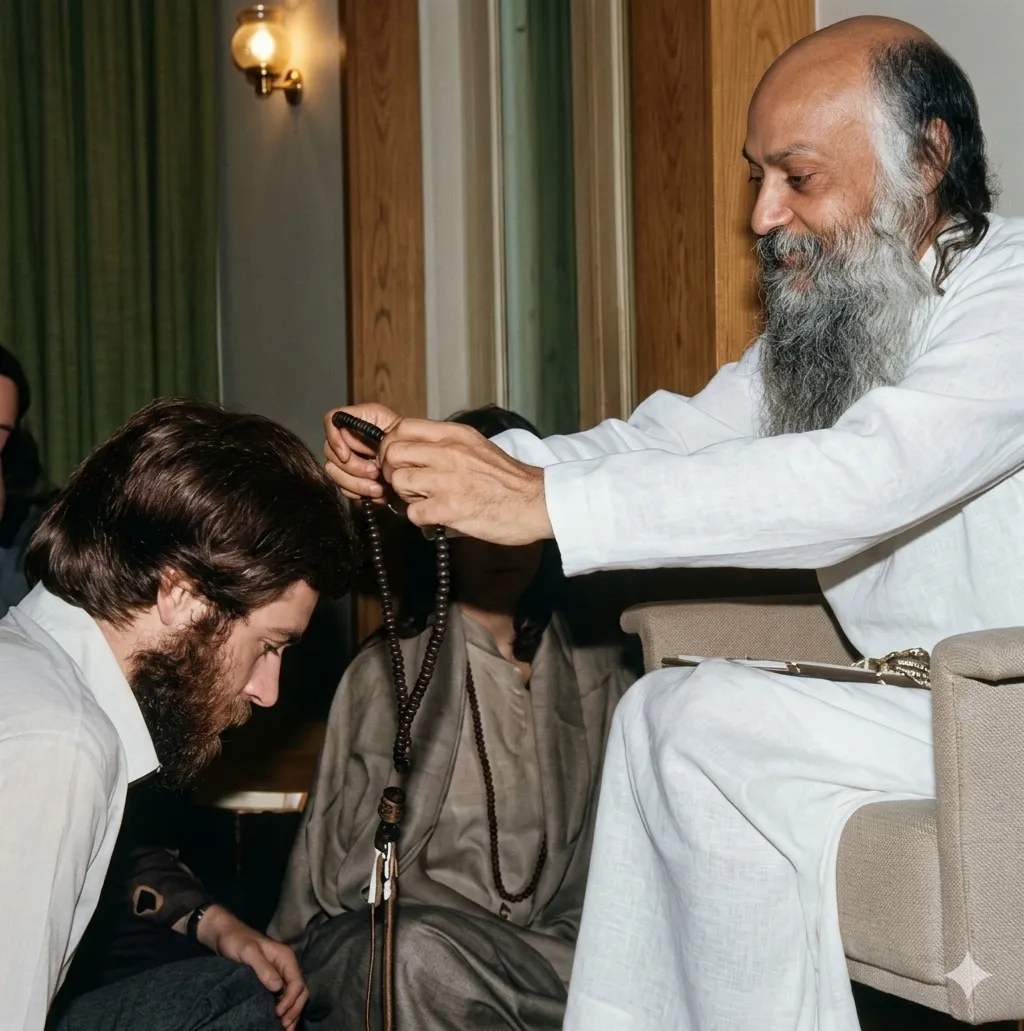
According to Osho, when sannyasins feel deep love and gratitude without wanting to be close, fear and clinging have fallen away. Not-seeking proximity means they gain more through freedom; growth accelerates as individuality is honored. The connection is a friendship of freedom, not bondage or commitment, enabling openness to learn anywhere while maturing into self-respecting, independent awareness.
You’re growing so strong inside that you can love and feel thankful without needing to hold on—like enjoying the sun without trying to grab it.
From the Discourses
Passages where Osho speaks to this question — each links to the complete discourse.
Osho, what is attachment? Why do we become so attached to things, ideas and persons? And is there freedom from attachment?
“So do one thing,” she told the courtesan. “I will pay you whatever you ask. Go to him at midnight. He meditates at midnight—has done so for thirty years. I want to know whether meditation has happened or not before I die. His hut door is only latched; no one ever goes there. Open it and go in. Whatever he says, notice every word and tell me. Go and embrace him—then come back and report. Before I die, I want to be sure that my service was not in vain.” The courtesan went. She opened the door. The monk was startled. He opened his eyes—he had been sitting in meditation—and shouted, “You wicked woman! Why are you here? Get out! What need have you to come at midnight?” But his tongue faltered; his body trembled. The woman had taken her money; she went right in. He cried, “Stay back! Why…
The cloud represents a few things. One: it represents absolute freedom. It is not tethered to anything. It is completely free, it floats in freedom. That's how a sannyasin has to be: Like a cloud, untethered. Secondly, the cloud has no fixed form. It is not static It is constantly moving and changing. Not even for the consecutive seconds is it the same. That represents something very essential: Life is movement; only death is not a movement. Only dead thins don't change Things which are alive are constantly changing. That's how a sannyasin has to be: Always on the move, changing REaching for newer horizons Exploring for newer pastures. A sannyasin is as unpredictable as a cloud; Nobody can say what form It is going to take next moment. And thirdly, the cloud has no ego of its own.
Osho, in a previous talk you said that the effect of shaktipat gradually diminishes, so one needs to reconnect with the medium again and again. Doesn’t that become a dependence on a person in the form of a guru?
But what is in the Gita is known to such a man only as much as the cat knew of books in that library—nothing else. And it could happen that by living in the library long enough the cat might one day come to know what is in a book; but these book‑knowing gurus will never know. Because the more the book is memorized, the less need remains to know; an illusion arises that one has already known. Whenever a person claims, I have known, understand that ignorance has found a voice. The claimant is ignorance. But when someone even hesitates to claim that he knows, understand that some glimpse, some ray has begun to dawn. Yet such a person cannot become a guru. He cannot even conceive of becoming a guru, because with the guru comes authority; with the guru the claim is necessary. Guru means: I know, I…
Bridge or blockade?
Sannyas means surrendering the ego and relaxing, feeling at home with existence, dropping all conflict and struggle, being in a let-go. And then immense bliss follows, infinite benediction showers; flowers and flowers rain, for the simple reason that you have removed the barrier. They were already showering; it is just that your barrier was not allowing you to have a contact, your eyes were closed. The sun rays were knocking on the doors. The moment you drop the ego you open your eyes, you open your doors, and the sun comes rushing in, and the wind and the rain, and the whole existence suddenly starts flowing through you. You become a flute, and god starts singing beautiful songs on you. That's how a sannyasin has to be -- a hollow bamboo flute. That's my symbol for a sannyasin, the hollow bamboo flute. <q>GRATEFUL OR GRUMPY</q> (The first is the attitude…
Gratitude is the essence of prayer
Doubt is a perfectly adequate method for extrovert enquiries, it is the right method. I am not against doubt. It has tremendous importance. The whole edifice of science stands on it: doubt and doubt, unless you stumble upon something that you cannot doubt. But still that is only a hypothesis. That means you are still not going to trust it absolutely. Who knows? -- tomorrow some new facts may turn up, so keep the doors open for doubts. For the time being, use it hypothetically; for the time being this is true, but only for the time being. Science never comes to truth, only to approximations, hypotheses. Religion is a totally different endeavour: it begins in trust. It needs faith, such faith that no doubt ever arises. Not that one has to repress doubt; if you repress it, it will be there. One has to watch, one has not to…