
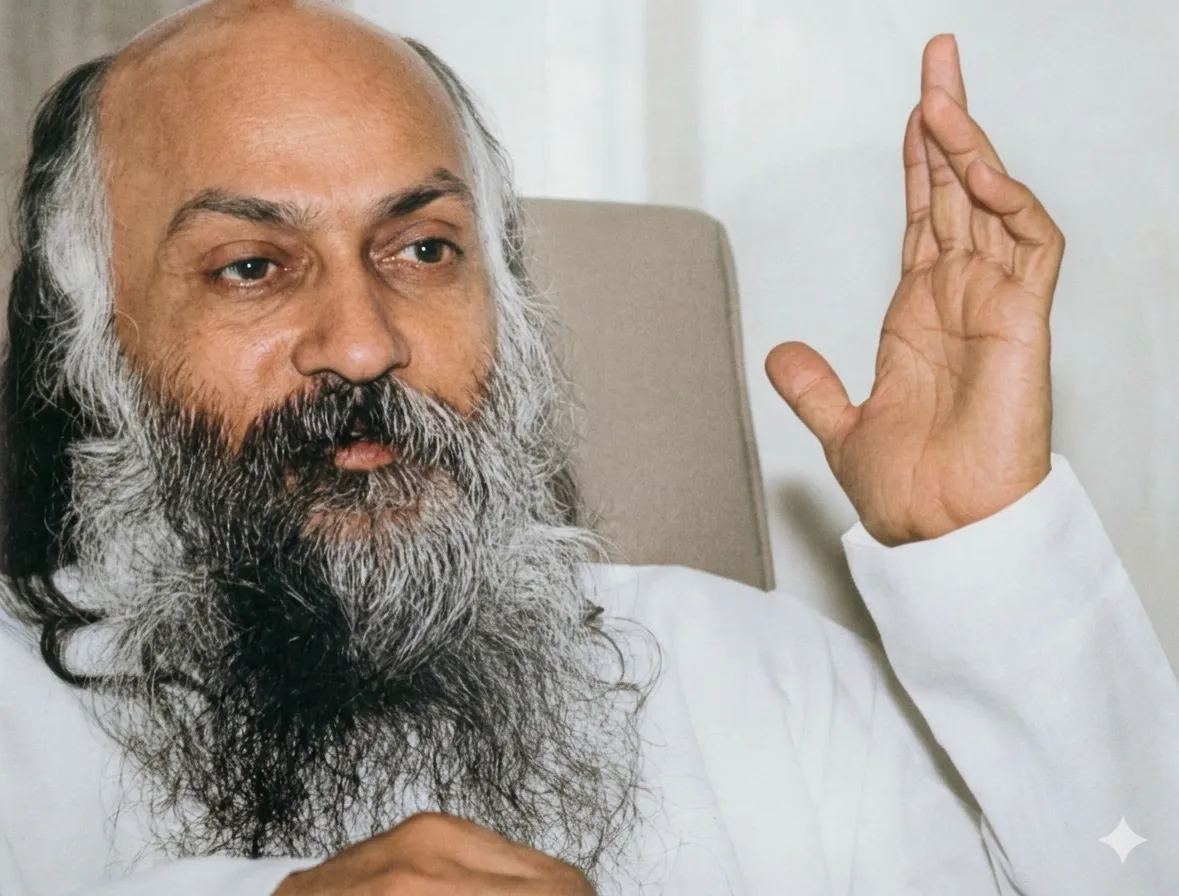
A samyavadi treats everyone as equal and wants good for all, but without getting trapped in any rigid ‘ism.’
From the Discourses
Passages where Osho speaks to this question — each links to the complete discourse.
A friend has asked: Osho, are you a samyavadi—are you a communist?
If I were opposed to the great ones, it would be hard to find anyone who loves the great ones more than I do. I am not even an opponent of Godse—so how could I be an opponent of Gandhi? But when I criticize some great person, I am not opposing the person; I am trying to shake the peg to which you are tied, so that you may be free. You praise the peg so much that your praise becomes the reason for your bondage. Therefore I try to break even your praises. Do not mistakenly think I have any enmity. But our understanding is so small—so very small. And the understanding of the prejudiced is always small. One who has a doctrine has no understanding, because he is already bound and looks at the world only through that fixed lens. Difficulties arise. He cannot grasp what is being…
Another friend has asked; let me take that question as well.
In this country the stark selfishness you see everywhere lies behind the teachings of the so‑called religious. Each person absorbed in his own little worries, with no concern for anyone else. Behind this are not the hands of “bad” people but of the so‑called good, for they teach: each individual should seek his own liberation, cancel his own sins, accumulate his own merits. There is no such thing as society; we are not connected; we are all traveling separately. This notion has turned India’s social life into a madhouse, an ugliness—a very filthy pit—because everyone is busy with his own worry. His own worry. The day Jesus was crucified—perhaps you don’t know—there was a man in the same village with a toothache. Jesus is being crucified—the most loving of men is about to be hung on the cross—and a man has had a toothache since the night before. From morning…
Verse (Sanskrit): सूत्र जहा महातलायस्स सन्निरुद्धे जलागमे। उस्ंिसचणाए तवणाए, कमेण सोसणा भवे।। एवं तु संजयस्सावि पावकम्मनिरासवे। भवकोडीसंचियं कम्मं, तवसा निज्जरिज्जइ।।152।। तवसा चेव ण मोक्खो संवरहीणस्स होई जिणवयणे। ण हु सोत्ते पविसंते, किसिणं परिसुस्सदि तलायं।।153।। ज अन्नाणी कम्मं खवेइ बहुआहिं बासकोडीहिं। तं नाणी तिहिं गुत्तो, खवेइ ऊसासमित्तेणं।। सेणावइम्मि णिहए, जहा सेणा पणस्सई। एवं कम्माणि णस्संति, मोहणिज्जे खयं गए।।154।। सव्वे सरा नियट्टंति, तक्का जत्थ न विज्जइ। मई तत्थ न गाहिया, ओए अप्पइट्ठाणस्स खेयन्ने।।155।। Transliteration: sūtra jahā mahātalāyassa sanniruddhe jalāgame| usṃisacaṇāe tavaṇāe, kameṇa sosaṇā bhave|| evaṃ tu saṃjayassāvi pāvakammanirāsave| bhavakoḍīsaṃciyaṃ kammaṃ, tavasā nijjarijjai||152|| tavasā ceva ṇa mokkho saṃvarahīṇassa hoī jiṇavayaṇe| ṇa hu sotte pavisaṃte, kisiṇaṃ parisussadi talāyaṃ||153|| ja annāṇī kammaṃ khavei bahuāhiṃ bāsakoḍīhiṃ| taṃ nāṇī tihiṃ gutto, khavei ūsāsamitteṇaṃ|| seṇāvaimmi ṇihae, jahā seṇā paṇassaī| evaṃ kammāṇi ṇassaṃti, mohaṇijje khayaṃ gae||154|| savve sarā niyaṭṭaṃti, takkā jattha na vijjai| maī tattha na gāhiyā, oe appaiṭṭhāṇassa kheyanne||155|| Translation: Sutra Just as, when the inflow of water…
Osho, the vernacular newspaper here has been propagating that your discourses, your teaching, aim at spreading communism—and that you are almost on a par with Mao. And today another question has been raised: comparing you with J. Krishnamurti. What are your thoughts on this?
First of all, as I understand it, any intelligent person in the world—from Buddha or Mahavira or Christ up to today—will inevitably, in some sense, be a communist. But the meaning of communism should be made clear. The endeavor of all wise people has always been to bring about a society where each human being attains a state of equality, and where each person has equal opportunity for growth. If communism means the effort toward equal opportunities for growth and the equality of human beings, then I am a communist. And whoever is not a communist in that sense is an enemy of humanity. But if someone thinks that “communists” are the blind devotees of Marx who, by force, crush all democratic sentiments and impose dictatorship; who murder the entire vision of God, truth, love, and soul—if that is what is meant by communism, then no one could be more…
Osho, even while accepting what you indicated—that even from a merely provisional point of view—our approaches to truth tend to bring in a sense of partnership or collectivity. In that context, if we consider some older ideas, then in Jainism, for instance, vada and kevalya came to my mind the moment you were saying that everyone has their own truth, and when a person has completed their total knowing, then it seems that all the paths were different—and that too is fine. And in the same context syadvada also comes in. So these three...
So when Christ is born there is no acceptance of Christ. His society hangs him on a cross. Today, two thousand years later, thousands accept him. But if Christ were to return now, he would be rejected at once. Because the dead structures we have built—of doctrines—within them it is very hard to find a hold. Life cannot be caught in frameworks; truth cannot be caught in frameworks either. Only in experience—and experience is not a framework. Therefore, neither vada, nor Jain, nor Hindu, nor Muslim. You and life—that much is enough. I and life. And in the relationship between me and life there can be two relationships: either my relationship with life is of ignorance; or my relationship with life is of knowing. Either I not only live life, I also know it and have entered into it; or I stand outside life and do not know. Between life…