
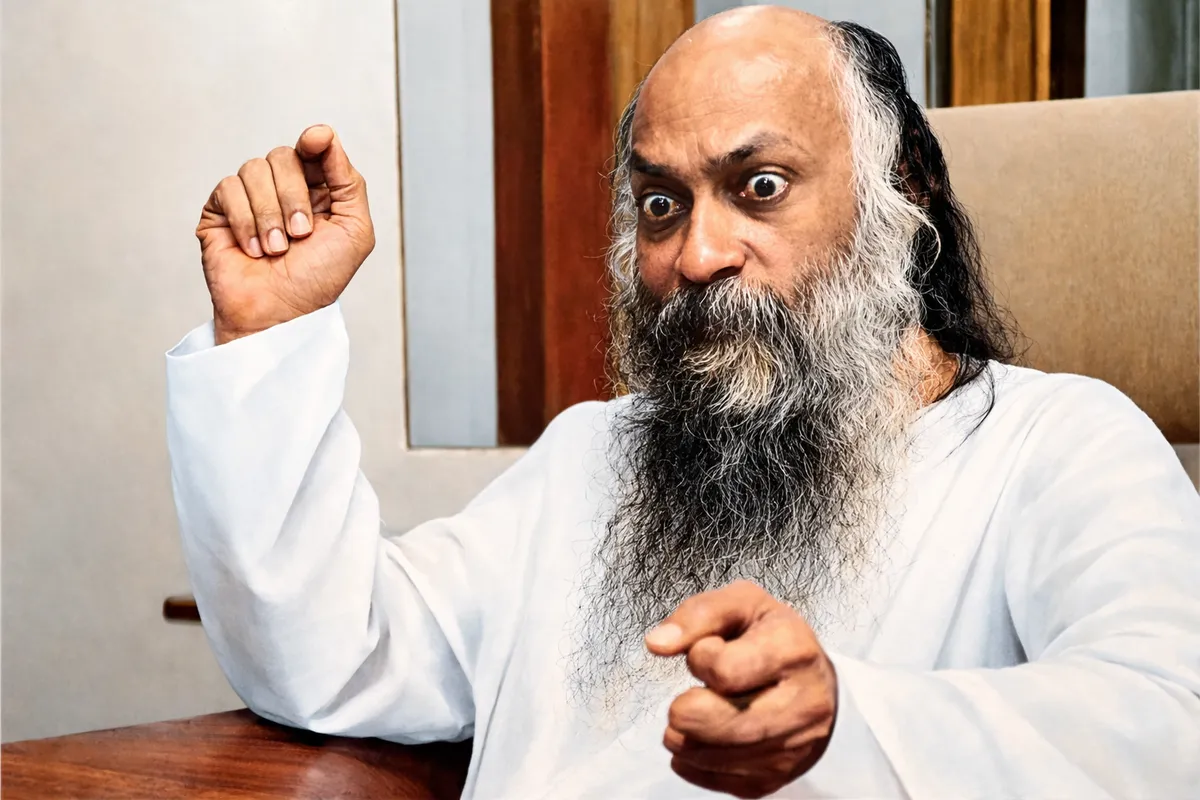
Osho spoke about death freely, cheerfully, almost tenderly. In his commune, death was met with singing. His teaching runs directly against the instinct to look away — only a life that has made peace with death, he insisted, can be fully lived, and the fear of death is really the unlived life knocking.
The passages below are drawn from across his English and Hindi discourses; every one links to the complete chapter.
Death in Osho's words
The threads that run through his talks on death. The short notes are Osho Live's; the quoted passages are his own words, checked against the talk.
Why Osho's People Talk About Death Happily
Asked why his religion discusses death freely and happily where others whisper about it in grave tones, Osho explained what changes when death stops being a punishment.
It is certainly one of the most significant things. It determines whether a religion is authentic or pseudo. The pseudo-religion knows nothing about death. In fact it knows nothing about life either, hence the fear, fear of both. It is not possible to be afraid only of death, because death is not separate from life, death is part of life.
Death across the years
When Osho spoke about death: talks where it comes up at least 5 times, counted from 6,627 dated talks on Osho Live.
Where he speaks of it most: Es Dhammo Sanantano · Tao Upanishad · Maha Geeta
| Year | Talks about it | Dated talks that year |
|---|---|---|
| 1964 | 7 | 13 |
| 1965 | 12 | 19 |
| 1966 | 3 | 7 |
| 1967 | 23 | 33 |
| 1968 | 22 | 30 |
| 1969 | 75 | 110 |
| 1970 | 85 | 131 |
| 1971 | 81 | 111 |
| 1972 | 144 | 223 |
| 1973 | 135 | 205 |
| 1974 | 216 | 271 |
| 1975 | 233 | 303 |
| 1976 | 362 | 700 |
| 1977 | 314 | 679 |
| 1978 | 384 | 702 |
| 1979 | 392 | 683 |
| 1980 | 369 | 674 |
| 1981 | 64 | 122 |
| 1984 | 46 | 63 |
| 1985 | 237 | 356 |
| 1986 | 215 | 369 |
| 1987 | 285 | 486 |
| 1988 | 116 | 276 |
| 1989 | 48 | 61 |
More in his words
Nothing Is As Sure As Death
Osho's most compact statement of the teaching: certainty about death is not morbidity — it is the beginning of seriousness about life.
There is nothing as sure as death. Where there is life, there is bound to be death. He who bears not this fact in mind, wastes life, whereas he who knows this truth, obtains that which is immortal. I do not feel depressed at anybody's death... it is a matter of sorrow, no doubt, if I see a life wasted.
"I Am Very Afraid of Death. What Should I Do?"
The most human question in the corpus, asked in a Hindi discourse — and answered without false comfort.
You say, "I am afraid of death." This bitter wine too must be drunk one day. Bitter, granted, is the wine of death, but one day it must be drunk.
The Desire to Escape Is the Fear
Commenting on the Ashtavakra Gita, Osho locates the fear of death precisely: not in death, which is natural, but in the mind's project of somehow being exempted from it.
Death is natural. Trees, animals, birds, humans — all will die. Only man is afraid, because man keeps thinking, "Somehow there must be a way to escape." As long as you want to escape, you will be afraid. The very desire to be spared creates fear. Accept it! Death is, and will be.
From the discourses
Passages where Osho speaks on death, each linked to the exact place in the talk.
Question: OSHO, CAN MAN LAUGH EVEN IN THE FACE OF DEATH? Narendra, IT DEPENDS. There are people who cannot laugh even when life is showering all its joy on them; they remain serious, dull, dead. Flowers go on showering on them; they don't look at those flowers, they don't feel grateful. They have completely forgotten the language of gratitude. They have forgotten to laugh. But a man who is alert and aware, a man who is a man in the real sense -- integrated, centered, grounded -- will laugh in the face of death. Mansoor laughed when he was being killed. He laughed so loudly that the people who were killing him could not contain their curiosity. They asked, "Mansoor, what is the matter? Are you mad or something? Why are you laughing?" He said "I am laughing because you are killing somebody else.
Osho, is a person’s death fixed in advance, or is it accidental—like through an accident?
Both are true. In one sense death is fixed—fixed the way a watch you buy in the market comes with a guarantee: it will run ten years. But if you use the watch properly and maintain it well, it can run twenty years. Throw it around, break it, and it may not last even five days. Man’s body is a mechanism. The soul does not die; only the body dies, and the body is purely mechanical. When a child is born, the body made from the germ cells received from the parents has a certain inner capacity—how long it can run. It can last that long. But with great care and right regimen it can go to a hundred and twenty-five years; with poor care it may be finished even by seventy-five. So age belongs to the body; the soul has no age. Therefore the question of age is not…
प्रश्न: ओशो, मौत जो है वह आदमी की निश्चित होती है पहले से या अकस्मात यानी एक्सीडेंट से?
दोनों ही बातें हैं। एक अर्थ में तो निश्चित होती है मौत। इस अर्थ में निश्चित होती है जिस अर्थ में बाजार से घड़ी खरीदें तो गारंटी होती है, दस साल चलेगी। लेकिन घड़ी को चलाएं, कम चलाएं, व्यवस्था से चलाएं तो बीस साल भी चल सकती है। पटक दें, तोड़ डालें तो पांच दिन भी न चले। तो आदमी का शरीर तो एक यंत्र है। आत्मा की तो कोई मौत होती नहीं। और शरीर बिलकुल यंत्र है। शरीर की ही मौत होती है। जब एक बच्चा पैदा होता है तो मां-बाप से जो भी वीर्यकण उसे मिले हैं, उन वीर्यकणों से बना हुआ शरीर कितना चलेगा, उसकी इनर कैपेसिटी होती है। उतना चल सकता है। …
Osho, in the Dwarka camp you said that meditation and samadhi are a voluntary, conscious entry into the state of death, through which the illusion of death dissolves. Then the question arises: to whom does the illusion of death occur? Does it occur to the body or to consciousness? Since the body is only an instrument, it cannot have delusive awareness; and there is no reason for consciousness to be deluded. Then what is the cause and basis of this event of delusion?
They sent word. She came very annoyed. “It’s his same old habit,” she said. “He’s grown old but hasn’t dropped it. Even at death he will create mischief.” She came with a stick, banged it on the ground and said, “Stop this devilry! If you must die, die properly!” The man laughed, came down, and said, “I was only playing a little—wanted to see what they would do. Now I will die properly, conventionally.” Then he lay down and died. His sister left, saying, “Fine, now finish the rites. There is a right way for everything; do things properly.” Our illusion about death is a social delusion. It can be broken. There are methods and arrangements to break it. And even if no one else breaks it for you, anyone who has done a little meditation will break it himself at the time of death. No outside help is needed.…
ओशो, द्वारका शिविर में आपने कहा है कि ध्यान व समाधि स्वेच्छा से सचेतन मृत्यु की स्थिति में प्रवेश है, जिससे मृत्यु का भ्रम विसर्जित हो जाता है। तो प्रश्न उठता है कि मृत्यु का भ्रम किसको होता है? शरीर को होता है या चेतना को होता है? शरीर चूंकि उपकरण-मात्र है, इसलिए शरीर को भ्रमरूपी बोध नहीं हो सकता है; और चेतना के भ्रमित होने का कोई कारण नहीं है। फिर भ्रम की घटना का कारण, आधार क्या है?
… तो वह लेटकर मर गया। और उसकी बहन चली गई कि अब ठीक है, उसको निपटा दो। फिर उसने लौटकर नहीं देखा पीछे। उसने कहा, ठीक है, अब निपटा दो। हर चीज का एक ढंग होता है, उसकी बहन ने कहा, ढंग से काम करो। जो भी काम करना है, व्यवस्था से करो। हमारी मृत्यु का भ्रम हमारी सामाजिक भ्रांति है। इसे तोड़ा जा सकता है। इसे तोड़ने की विधि और व्यवस्था है। और अगर कोई भी न तोड़ रहा हो तो मरते वक्त प्रत्येक व्यक्ति, जिसने थोड़ा-बहुत भी ध्यान साधा है, वह खुद ही तोड़ लेता है। कोई जरूरत नहीं रहती है। …
Osho, to remain awake to life, is the fear of death necessary?
I did not speak of fearing death, because what does fear of death even mean? It is essential to know that death is. The one who does not know this is the one who is afraid. To be afraid means we carry the notion that someday we will die—that what we presently take to be life will be snatched away. So the fear is that death might take away our life. That is what the fear is. But if you come to know that you are already dead, what is there to fear? If you come to see that every day you are dying, that much of you has already died, what is there to fear? As long as what you take to be life appears to you as life, the fear of death appears. And if this very thing begins to be seen as death, what fear of death…
पूछा है इस संबंध कि ओशो, जीवन की जागृति रखने के लिए क्या मृत्यु का डर जरूरी है?
मैंने डर नहीं कहा मृत्यु का, क्योंकि मृत्यु से डर का मतलब ही क्या है? मृत्यु है, यह जानना जरूरी है। जो इसे नहीं जानता वही डरता है। डरने का अर्थ यह होता है कि हमेें यह खयाल है कि हम किसी दिन मर जाएंगे। अभी जिसे हम जीवन समझ रहे हैं, वह छीन लिया जाएगा। तो डर इस बात का होता है कि जो हमारा जीवन है वह कहीं मृत्यु छीन न ले। डर इस बात का होता है। लेकिन अगर आपको पता चल जाए कि आप मरे ही हुए हैं, तो डर किस बात का होगा? अगर आपको पता चल जाए कि आप मर ही रहे हैं रोज, मर ही चुके हैं काफी, तो डर किस बात का होगा? …
Osho, to remain awake even in death—or to successfully orchestrate a conscious death in meditation—what preparations should a seeker make concerning the body-system, the breath-system, the state of the breath, the state of prana, celibacy, willpower, etc.? Kindly shed detailed light on this.
But even in a cinema hall, where it is easier because it is all shadows, we do not remain witnesses. If we inspected the handkerchiefs of those exiting, we would know how many cried. We all know nothing is on the screen—only light and shadow. Yet everything “happens” there, and we become participants. Do not be mistaken that while watching a film you are merely a viewer—you become a participant. Someone pleases you, someone repels you; you identify. If we cannot be witnesses even to a film, how will we be witnesses in life? Life, too, is not much more than a film. At depth, like the play of rays on the screen, life is the play of electrical particles. If you reduce the body or a wall to its ultimate component, you find only electric particles. The difference between the screen and this is not great—two-dimensional there, three-dimensional here.…
Osho, Why does everyone praise a person after he dies—even those who spent his whole life condemning him? What’s the secret?
You ask, “Why do people praise a person after he dies?” They have to. That’s why at weddings people offer blessings and congratulations. The elders send blessings, contemporaries send best wishes—because the poor fellow is as good as dead! Finished! The end has come. They say when an ant is about to die it grows wings—well, the wedding wings have sprouted; the ant is near its end! Henceforth no future. Only darkness ahead. So give all the congratulations and blessings now. Bid a final farewell: “Brother, from here on, it’s between you and God!” That’s why you honor mahatmas and saints so much—the poor fellows are dead! Already dead! Walking corpses! If you don’t respect them, what else can you do? There’s nothing else left to do with them. If they were alive, there would be other ways to relate. Now all you can do is show as much reverence…
दूसरा प्रश्न: ओशो, व्यक्ति के मर जाने पर क्यों सभी लोग उसकी प्रशंसा करते हैं? वे भी जो कि जीवन में जीवन भर उसकी निंदा करते रहे! इसका राज क्या है?
तुम पूछ रहे हो कि ‘व्यक्ति के मर जाने पर क्यों सभी लोग उसकी प्रशंसा करते हैं?’ करनी पड़ती है। इसीलिए तो विवाह के अवसर पर लोग शुभकामना करते हैं, आशीर्वाद देते हैं बड़े-बूढ़े हूए तो, समसामायिक हुए तो बधाइयां देते हैं, क्योंकि यह आदमी मर रहा है बेचारा! खतम! इति आ गई इनकी। जैसे कहते हैं न, जब चींटी मरने को होती है तो उसको पंख ऊग आते हैं--इनका विवाह होने लगा, अब चींटी मरने के करीब आई! अब आगे से इनका कोई भविष्य नहीं है। अब सब अंधकारपूर्ण है। अब कर लो जितनी भी बधाइयां वगैरह करनी हैं और जितनी भी शुभकामनाएं करनी हैं। अब इनको आखिरी विदाई दे दो कि भैया, आगे तुम जानो और भगवान जाने! इसीलिए तो तुम महात्माओं की, संतों की इतनी आवभगत करते हो--मर गए बेचारे! मरे-मराए लोग! चलती-फिरती लाशें! अब इनका सम्मान न करो तो क्या करो और! अब और करने योग्य कुछ बचा भी नहीं। …
Is death also like that—does it happen in unconsciousness?
Absolutely. That is precisely why one never really experiences death. We have died many times, yet we did not experience it—because long before the actual moment of dying we had already fainted. Hence we never came to know the event of death. We have died many times, but almost as if under chloroform. And nature has made full arrangements. Nature has arranged it so that any situation beyond your capacity to endure immediately makes the body release such elements that you become unconscious. For example, if an overwhelming sorrow descends, one faints. The sorrow was so intense that, had one not fainted, one would have died. To save you from death there is a substitute: the body renders you unconscious. Then you are no longer aware of the pain. By the time you regain consciousness, time will already have healed much of the wound. And if the practice of meditation…
प्रश्न: मौत भी ऐसे होती है, मूर्च्छा में?
बिलकुल ही। तो वह तो इसीलिए वह मौत का अनुभव उन्हें नहीं हो पाता। हम बहुत बार मरे हैं, हमें अनुभव नहीं हुआ उसका। क्योंकि मरने के बहुत पहले ही हम मूर्च्छित हो गए हैं। मरने की घटना इसलिए कभी हम जान नहीं पाए। मरे बहुत बार। लेकिन करीब-करीब क्लोरोफॉर्म की हालत में मरे। और प्रकृति ने पूरा इंतजाम किया हुआ है। प्रकृति ने पूरा इंतजाम किया हुआ है कि कोई भी ऐसी स्थिति जो आपके सहने के बाहर हो, तत्काल आपके शरीर में वह इस तरह के तत्व फेंक देती है कि आप मूर्च्छित हो जाएं। जैसे कोई भी बहुत दुख आ जाए और वह मूर्च्छित हो गया। वह दुख इतना था कि अगर मूर्च्छित न होता, तो मर जाता। …
Beloved Osho, it is stated that man becomes unconscious at the time of death. Why is this so? Is it due to the terror of death or the process of death?
Ananda said, "But you are a little late. We have given our permission that the master can disappear into the whole, and he has already entered the first stage. So please forgive us, it is not our fault. Forty-two years you have postponed; now wait a few thousand years more. When another Buddha appears, another enlightened man, then don't be so foolish." But Buddha opened his eyes. He said, "Ananda, this will be a condemnation for me -- that a man had come thirsty, and I was still alive and I could not quench his thirst. I can delay death a little bit, but his question has to be answered; otherwise the poor fellow will feel guilty his whole life." A conscious man dies in a totally conscious way, step by step. And if he wants to return before he has taken the fourth step, he can come back. His…
How can one come to know that neither he nor anybody else dies?
There is no other way except to die. One Zen Master was asked -- a great emperor came to enquire; he was afraid of death, as everybody is, and of course an emperor has more to lose than a beggar so an emperor is bound to be more afraid of death than a beggar; death will take more from an emperor than from a beggar and so of course obviously he is more afraid. He became old and he came to the Zen Master and he asked: Tell me something about death, Master. The Master said, How am I to know about it? The emperor said, But you are an enlightened Master. He said: Yes, but -- an alive one, not dead, how am I to know about it? This moment life is there -- live it. That is the training for death. Otherwise when you are dead you will…
Beloved Osho, thoughts of death have been a frequent visitor during my disciplehood. How can a disciple die in a master's presence, especially when the master is physically distant? Osho, is mahakashyap the only answer?
They opened the door to see whether Ananda was still sitting outside -- because they had told him, "You sit outside. If we need some confirmation from you, we will ask you, but you cannot enter the conference." They saw a transformed being. The old Ananda, the old egoist was gone. An innocent being with tears of joy... and they all could see the light surrounding him. They invited him -- "You come in. Now there is no need for us to be worried. But it is strange... you could not become enlightened for forty-two years, and just after twenty-four hours you have attained that state" -- and this was continuously emphasized by Gautam Buddha. Ananda said, "It was my fault. His death became the death of my ego too." All the scriptures that are in existence are related by Ananda. There were other enlightened disciples who did not die…
Osho, you said the truth of life is death. Then what is the truth of death?
Buddha called this the state of suchness—accepting what is, as it is. No yes-and-no. No imposing your desire that it be like this or like that. As it is, let it be as it is. Kabir said: Just as it is—accept it as such. Because as long as you reject, you are fighting life—you are contending with God. You are trying to impose your will. You are not a seeker of truth; your ego is still thick. In accepting what is, as it is, the ego dissolves; there remains no place for it. The struggle is gone, the ego is gone. Ramana lay down. He consented: If death comes, it comes. What is in my hands? “Jih vidhi rākhe Rām, tih vidhi rahiye”—In whatever way Ram keeps you, remain that way. If death has come, it has come. This is how Ram wishes to take me—so be it. He was…
पहला प्रश्न: ओशो, आपने कहा कि जीवन का सत्य मृत्यु है। फिर मृत्यु का सत्य क्या है?
इसको बुद्ध ने तथाताभाव कहा है। जो हो, उसे वैसा ही स्वीकार कर लेना। उसमें ना-नुच न करना। ऐसा हो, वैसा हो, ऐसी अपनी आकांक्षा न डालना। जैसा हो, वैसा का वैसा। कबीर ने कहा है--जस का तस, जैसा का तैसा, वैसा ही स्वीकार कर लेना। क्योंकि जब तक तुम अस्वीकार करते हो, तब तक तुम जीवन से लड़ रहे हो, तब तक तुम परमात्मा से संघर्ष कर रहे हो। तब तक किसी न किसी भांति तुम अपनी आकांक्षा आरोपित करना चाहते हो। तब तक तुम सत्य के खोजी नहीं हो। तब तक तुम्हारा अहंकार प्रगाढ़ है। जो है, जैसा है, उसे वैसा ही स्वीकार कर लेने में अहंकार समाप्त हो जाता है। अहंकार के खड़े होने की जगह नहीं रह जाती। संघर्ष गया, अहंकार गया। रमण लेट गए। राजी हो गए, मौत आती है तो मौत आती है! अपने बस क्या है! जिहि विधि राखे राम तिहि विधि रहिए। …
Beloved Osho, a friend wrote to me that two days after her father died, sitting by the corpse she felt an incredible rise of energy in her. What is happening around a dead person, and how should we look after the body of a person who has died?
The moment a person dies he releases all his energy. If you are receptive, you will feel it. If you are available, open, you will feel your energy level rising up. It depends on many things -- what kind of man has died, what kind of energy he used to have. If he was a man of anger, violence, then it is better not to be close to him because all his repressed anger, all his repressed violence will be released and you can unnecessarily suffer from all that energy entering you. And it is very natural because when somebody is dying or dead, you automatically become silent by their side -- nobody makes any noise, nobody talks. Death is such a mysterious phenomenon that everybody is in shock. So the first thing to be aware of is, what kind of person is dying. If the person has been a…
Questions put to Osho about death
Each opens the talk at the moment the question was asked.
- Osho, is a person’s death fixed in advance, or is it accidental—like through an accident? Prem Nadi Ke Teera · Discourse 1 · 1965-10-09
- Osho, in the Dwarka camp you said that meditation and samadhi are a voluntary, conscious entry into the state of death, through which the illusion of death dissolves. Then the question... Main Mrityu Sikhata Hun · Discourse 10 · 1970-08-01
- Osho, to remain awake to life, is the fear of death necessary? Jeevan Ki Khoj · Discourse 3 · 1965-12-30
- Osho, to remain awake even in death—or to successfully orchestrate a conscious death in meditation—what preparations should a seeker make concerning the body-system, the breath-system,... Main Mrityu Sikhata Hun · Discourse 12 · 1970-08-03
- Osho, Why does everyone praise a person after he dies—even those who spent his whole life condemning him? What’s the secret? Udio Pankh Pasar · Discourse 6
- Is death also like that—does it happen in unconsciousness? Prem Nadi Ke Teera · Discourse 15
- Beloved Osho, it is stated that man becomes unconscious at the time of death. Why is this so? Is it due to the terror of death or the process of death? From Death To Deathlessness · Discourse 23 · 1985-08-28
- How can one come to know that neither he nor anybody else dies? Tao The Three Treasures Vol 3 · Discourse 2 · 1975-08-12
- Beloved Osho, thoughts of death have been a frequent visitor during my disciplehood. How can a disciple die in a master's presence, especially when the master is physically distant?... Beyond Enlightenment · Discourse 7 · 1986-10-09
- Osho, you said the truth of life is death. Then what is the truth of death? Es Dhammo Sanantano · Discourse 97 · 1977-06-06
- Beloved Osho, a friend wrote to me that two days after her father died, sitting by the corpse she felt an incredible rise of energy in her. What is happening around a dead person, and... The Transmission Of The Lamp · Discourse 11 · 1986-05-31
Frequently asked
Short answers by Osho Live, based on the passages above.
What did Osho say happens after death?
Osho taught that consciousness is not extinguished at death: for the unconscious person death is a blackout followed by rebirth driven by desire, while for the meditator it can be a fully lucid passage — which is why he called conscious dying the ultimate test of a life of awareness.
How did Osho say we should deal with the fear of death?
Not by consolation or belief, but by acquaintance: meditate to the point where you find, inside yourself, something the death of the body cannot touch. Secondarily, live totally — Osho held that only unlived life is afraid of ending.
Why were funerals celebrated in Osho's commune?
Because in his vision a death is a completion, and completions deserve gratitude. Celebrating a funeral was a deliberate practice: it trains the community — and the dying — out of the fear-and-mourning reflex that makes death terrifying in the first place.