
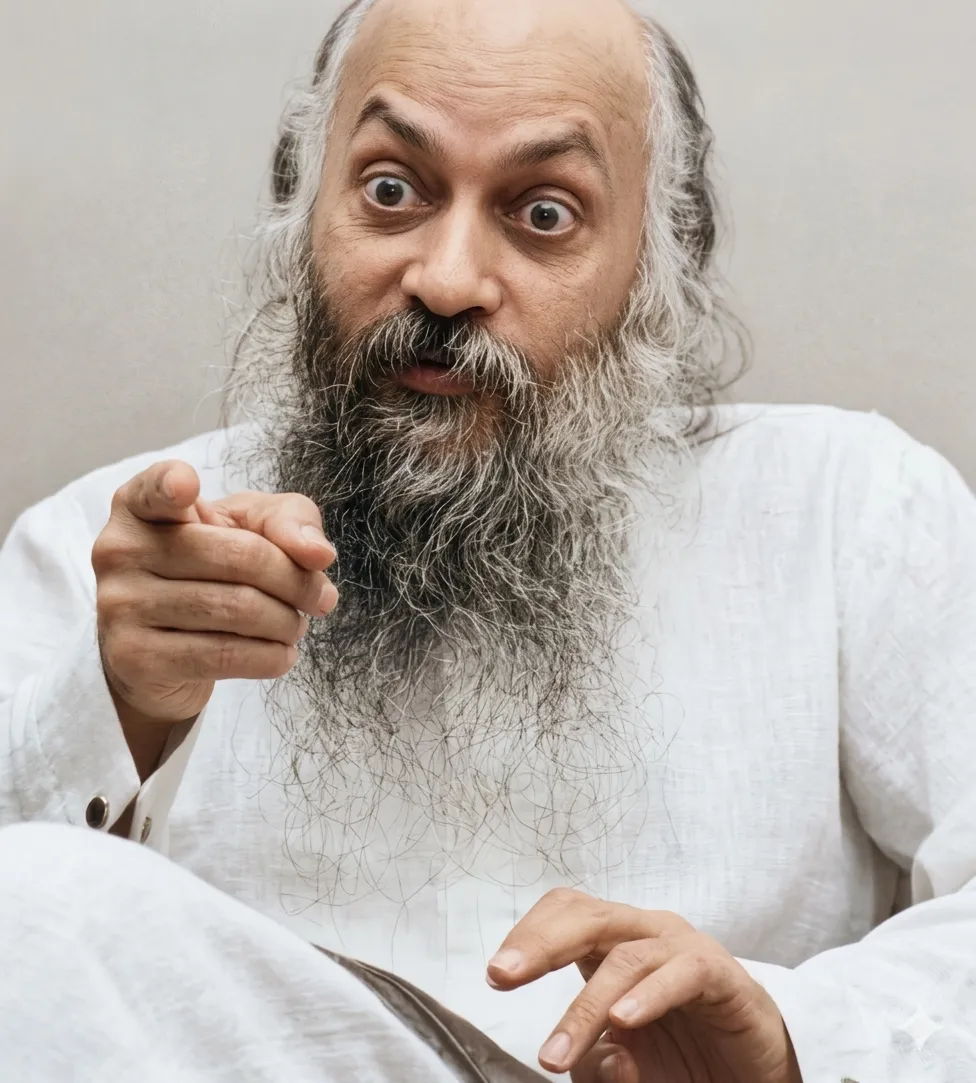
If you chase earning more to donate more, you’re still stuck wanting more; true giving starts when you stop the “more” game and share without expecting anything.
From the Discourses
Passages where Osho speaks to this question — each links to the complete discourse.
A friend has asked: earn more money in order to give more?
Greed is not related to money. Nor is it related to charity. It is related to the obsession with “more—more.” One who is busy earning more is stuck in “more.” Tomorrow he may give more too, and he will still be stuck in “more.” Charity is good, but only as penitence. It has no creative, positive value. Just as asking forgiveness is good, but it does not mean you should first do something that makes you ask for forgiveness—first abuse someone, then apologize—because apologizing is so good. Apologizing is good as atonement; it is no virtue in itself. Charity is not a virtue; it is only atonement for the hoarded wealth. There is nothing creative in charity; it carries no positivity. So when people say, “Give generously,” if what they mean is “first pile up wealth, then donate it,” that is just a clever arithmetic: first commit plenty of sin,…
Question: BELOVED OSHO, THEN SAID A RICH MAN, SPEAK TO US OF GIVING. AND HE ANSWERED: YOU GIVE BUT LITTLE WHEN YOU GIVE OF YOUR POSSESSIONS. IT IS WHEN YOU GIVE OF YOURSELF THAT YOU TRULY GIVE. FOR WHAT ARE YOUR POSSESSIONS BUT THINGS YOU KEEP AND GUARD FOR FEAR YOU MAY NEED THEM TOMORROW? AND, TOMORROW, WHAT SHALL TOMORROW BRING TO THE OVER-PRUDENT DOG BURYING BONES IN THE TRACKLESS SAND AS HE FOLLOWS THE PILGRIMS TO THE HOLY CITY? AND WHAT IS FEAR OF NEED BUT NEED ITSELF? IS NOT DREAD OF THIRST WHEN YOUR WELL IS FULL, THE THIRST THAT IS UNQUENCHABLE? THERE ARE THOSE WHO GIVE LITTLE OF THE MUCH WHICH THEY HAVE -- AND THEY GIVE IT FOR RECOGNITION AND THEIR HIDDEN DESIRE MAKES THEIR GIFTS UNWHOLESOME. AND THERE ARE THOSE WHO HAVE LITTLE AND GIVE IT ALL.
And this is true of all kinds of wealth: only that is yours which you give away. This will seem a paradox. That which you never gave was never yours—for how could it be? A thing becomes manifest only when you give it. In exchange wealth appears. Closed in your fist, it dies. What difference does it make whether there was a hundred thousand in your safe or not? The safe remained closed; you lived outside, died outside. Whether the hundred thousand lay locked or not—what difference does it make? None at all—unless you shared it. The greedy does not share. When he does not share even outer wealth, how will he share inner? If he cannot share petty rupees, how will he lavish the glory of life? If he cannot give away shards, how will he pour out his heart?
The fakir wanted to purchase something. The Jewish shopkeeper said, “Since you are one of us: the price is a hundred, but from you I will not take a hundred, only ninety; and then, you are a fakir—I won’t even take ninety, only eighty.” The fakir said, “Had you not been a Jew, I would have given fifty for this. Since you are a Jew, I will not give fifty, only forty. And you are being so affectionate toward me—so even forty I will not give; I will give thirty. I do not bargain.” This is our common language. Knowingly or unknowingly we keep trying to take, to snatch, from one another. And we call that one clever who snatches more, who grabs more; and we call that one foolish who loses in the bargain. This whole world is a scramble to snatch.
Osho! Revered Daddaji has, since my childhood, treated me as his own, showering unreserved affection and inspiration. Amid a heap of memories, his sense of kinship with all, childlike love, readiness to give everything away, and a presence that filled the whole atmosphere with joy kept filling me within, and filling me. Every day, on one pretext or another, he would say to me: “Apna hai kya—lutaao! What is there that is ours—give it away!” Please kindly tell us the purport of this dear saying.
Narendra! That is precisely the fundamental meaning of sannyas: “What is there that is ours?—Give it away!” Whoever takes anything to be “mine” has built the world. And whoever builds the world for himself forges his own prison, casts his own chains. Our chains are cast from mine-and-thine—this is mine, that is yours; here is the boundary of mine, there the boundary of yours. All our boundaries become prisons—chains on our hands and feet. And the more we become entangled in “mine,” the more miserly we become, the more stingy. And the Divine can never be available to a miser. Why not? Because to attain the Divine there is one condition a miser cannot fulfill—and that condition is love. A miser simply cannot love; for the miser, love is impossible. He fears that if he loves someone, he will have to drop the feeling of mine-and-thine. What else is love?…