
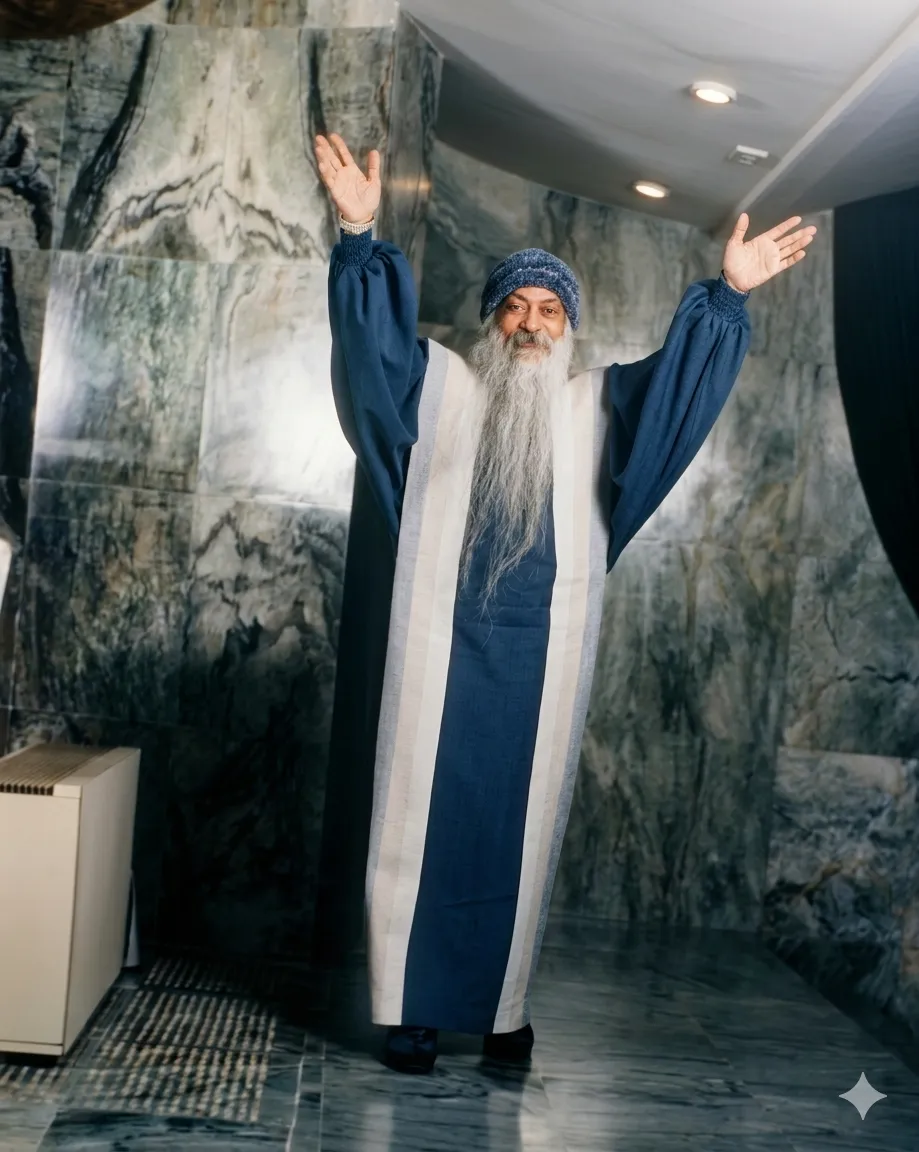
According to Osho, your confusion between meditation and love is a postponement strategy. The issue isn’t the path but your unwillingness to surrender. Any authentic path works if you follow it totally. Stop comparing masters and methods, choose one, put your mind aside, and commit. Totality, not variety, brings transformation.
Pick one path and give yourself completely to it instead of delaying by comparing.
From the Discourses
Passages where Osho speaks to this question — each links to the complete discourse.
Beloved Osho, it has been my understanding that the meditator and the lover have different paths. The other day we heard your beautiful explanation of the path of meditation. Is this path different from that of the lover? If so, how to tell which path to choose?
Somebody attracts you; there can be any reason for that attraction. Mostly -- perhaps one hundred percent, not mostly -- the woman you are attracted to has something in her eyes, in the color of her hair, in her way of talking, in her voice, in her gestures, the way she walks... something in her resembles your mother. You are always in love with your mother, and your whole life you are seeking another mother. Of course, you are going to be frustrated. All lovers are frustrated, except those who never manage to get married. For example, Laila and Majnu -- the society did not allow them. Shiri and Fariad -- their families came in. They were never frustrated, they remained lovers their whole life. They lived loving the other person, they died loving the other person. But if you come together.... They were prevented from coming together. If you…
Question: Osho, you have spoken of two paths to reach the Divine—love and meditation. My situation is that a feeling of love does not well up in my heart. It isn’t that I don’t want to love anyone; it just isn’t my temperament. I like to be quiet and sit in silence. So I chose the path of meditation and began the practice of witnessing. Now the difficulty is this: the moment I become aware that I am watching my thoughts, the thoughts stop and there is a momentary experience of bliss; then a stream of thoughts starts again. And then again I watch them—and again and again the same thing. In my situation I don’t see any progress. Am I making some mistake somewhere? Or is my choice of the path of meditation wrong?
Osho, you always say that love is God. What is the relationship between love and God?
You’ve seen it: sometimes on a lotus leaf two dewdrops roll together and become one, and yet a drop remains a drop. One drop has formed in place of two; nothing vast has occurred. The boundary grows a little. You were a little half-and-half; meeting the beloved you become a little more whole. You were alone; meeting the beloved you are no longer alone. The path of love is the path of prayer. See: among Hindus, the images are made of Sita and Ram together, of Radha and Krishna, of Shiva and Parvati. These images are symbols—symbols that the love which happens between human and human is to be expanded, made so vast that it happens between man and the Infinite. On the path of meditation this is not needed. That is why Mahavira stands alone, that is why the Buddha sits alone. On the path of meditation the other…
Love is a path unto itself, and so is meditation. One can follow either love or meditation; both lead to the same goal. But there are a few people who can follow both, and of course their journey is far richer. And that is going to be the work for you: love as deeply as possible and meditate as deeply as possible and go on moving between the two. Remain fluid, flexible. The lover finds it difficult to meditate because he needs the other and meditation means to be alone. The meditator finds it difficult to love because he becomes accustomed to being alone and the freedom of being alone. The very presence of the other seems to be a transgression, an interference, a disturbance. So ordinarily it is simple to follow one, but if you can manage both then your life will have more richness.
Osho, you have said there are two opposite paths: meditation and love—intelligence or feeling. So tell us, what is the difference between the practice of meditation and the practice of love? Is a meditator not loving before samadhi?
These paths are opposite; where they lead is one. You can arrive from either side. Erase one of the pair, and the other will vanish by itself. Which one you choose to erase depends on your personal inclination. It is the art of erasing one of a pair. The other will vanish because it was the inevitable counterpart. If from existence we remove light itself, darkness will also be gone. It sounds difficult only because in your house, if you blow out a lamp, darkness doesn’t disappear—it increases. But you haven’t removed light from existence. If light were eradicated from existence, darkness would vanish. If darkness were erased, light would vanish. If we remove death from the world, life will disappear that very day. We think the opposite: that death destroys life. You do not know; they are two parts of one thing. Without death there can be no life;…