
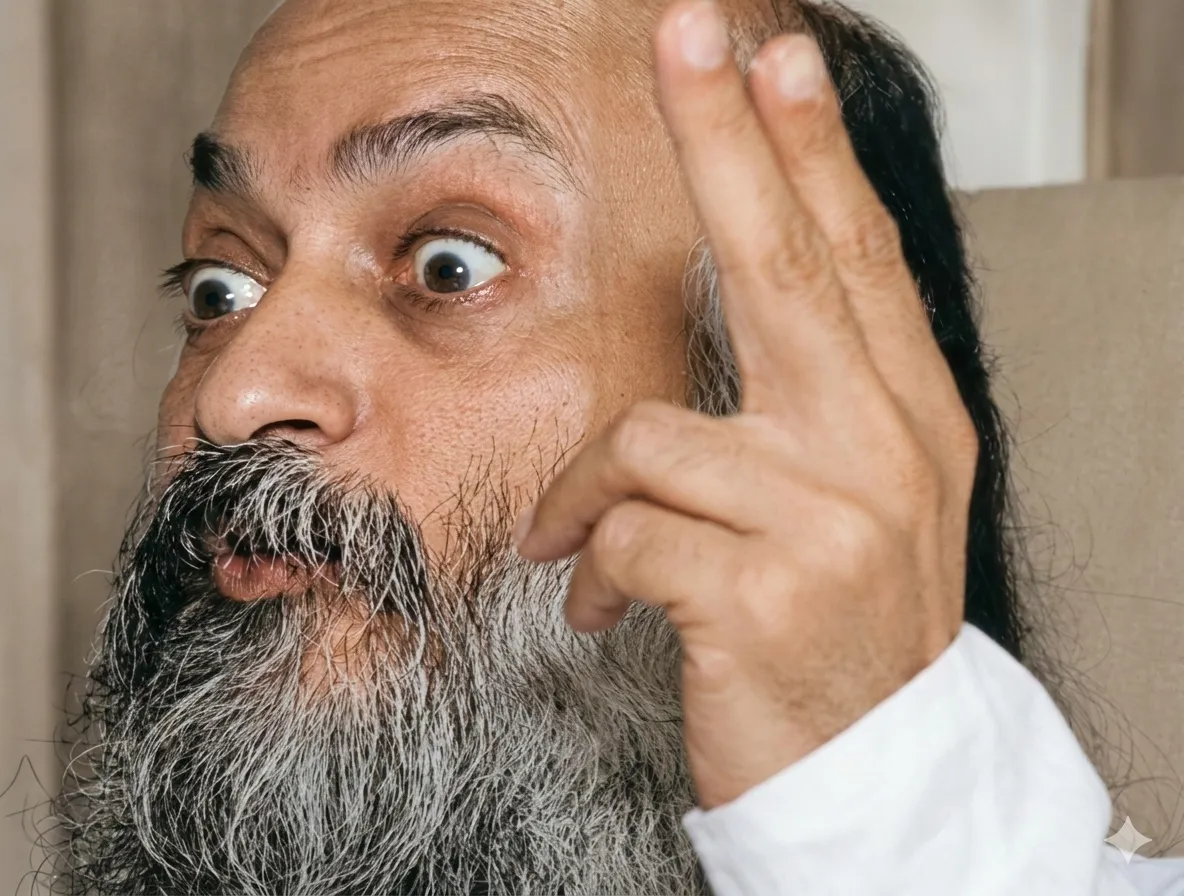
If you hide the hard or messy parts of life from kids, they won’t grow strong or wise; let them meet everything so they become whole.
From the Discourses
Passages where Osho speaks to this question — each links to the complete discourse.
Osho, is it not possible to raise children in such a way that they never become interested in the dirty things of life?
Some days later the king called his son. "Well, my son, you are almost fifteen. What would you like as a birthday gift?" "Ah, father, please may I have a swan?" the boy replied. It is impossible to keep somebody unaware of life's complexities Many times the experiment has been done and each time it has been a failure. When Buddha was born all the great astrologers of the country gathered, of course. In his late old age the king had given birth to a child. No one had ever heard of a child so beautiful, and a child with such grace that he did not seem to be part of this world, as if a god v. as born. So all the astrologers gathered to predict about him. They calculated, they looked into their scriptures, and they were at a loss as to what to say. All the astrologers…
Beloved Osho, you said every child is born a god, yet my two children were very different right from birth. One is very serene and god-like, but the other seemed disturbed before she was influenced by any conditioning. How should we deal with the difficult one?
Give the child a wholeness. Make him infectious to your awareness. Love him, tell him what your experience is, but don't try to make him follow your experience. Don't force. If he follows of his own accord, it is good; if he doesn't follow, wait -- there is no hurry. It is difficult to be a father or to be a mother, the MOST difficult thing in the world. And people think it is the easiest. I have heard: One woman was coming in a taxi to her home from the market, and the taxi-driver was just crazy. He was going zigzag; any moment there would be an accident. And he was going so fast...the woman was very, very nervous, sitting on the edge of the seat, and many times she said: Don't go so fast, I'm scared. But he wouldn't listen. Then she said: Listen! Twelve children are waiting…
Beloved Osho, what is the right way to help a child grow without interfering in his natural potentiality?
The right way is not to help the child at all. If you have real courage then please don't help the child. Love him, nourish him. Let him do what he wants to do. Let him go where he wants to go. Your mind will be tempted again and again to interfere, and with good excuses. The mind is very clever in rationalizing: "If you don't interfere there may be danger; the child may fall into the well if you don't stop him." But I say to you, it is better to let him fall into the well than to help him and destroy him. It is a very rare possibility that the child falls into the well -- and then too, it does not mean death; he can be taken out of the well. And if you are really so concerned, the well can be covered; but don't help…
Osho, does a child not have as much right to privacy and freedom from parental conditioning as the parents themselves expect?
Jimmy: 'Yes, Mum, there wasn't time to take them off.' The first-grade teacher was talking to her class about nature and she called it 'The World Around You'. She asked little Helen in the first row, 'Now, Helen, tell everyone in the class. Are you vegetable, animal or mineral?' 'I'm not any of those,' she replied promptly. 'I'm a real live girl!' A little fellow who was fishing off the end of a pier lost his balance while trying to land a fish and fell in the lake. Several men who also were fishing nearby rushed to his aid and pulled him out. 'How did you come to fall in?' one of the men asked him. 'I didn't come to fall in,' the kid said. 'I came to fish!' A large family was finally able to move into a more spacious home. Some time later an uncle asked his nephew,…
Osho, you have called training a child’s intellect essential. But should training in meditation also be given simultaneously? Many sannyasins have families. What outlook should they have toward their children? Where should the emphasis be? Please shed light on this.
Jesus tells a very sweet parable—understand it. Jesus used to say, and because his whole emphasis was on love, the story is indicative. He said: A father had two sons. The father was very rich. One son was obedient; the other was rebellious. One increased the wealth; the other broke and wasted it. At last there was no way but to separate them. The father divided the wealth in halves. The elder stayed with the father, invested, bought fields, made orchards. The younger disappeared from the village as soon as he got his share. Soon news began to come that he had squandered everything in gambling, drank it away, lost it in the dances and songs of prostitutes—everything turned to dust. The father sent word: come back home. The younger, who had left, a gambler and drunkard, could not believe that after wasting everything his father could still call him…