
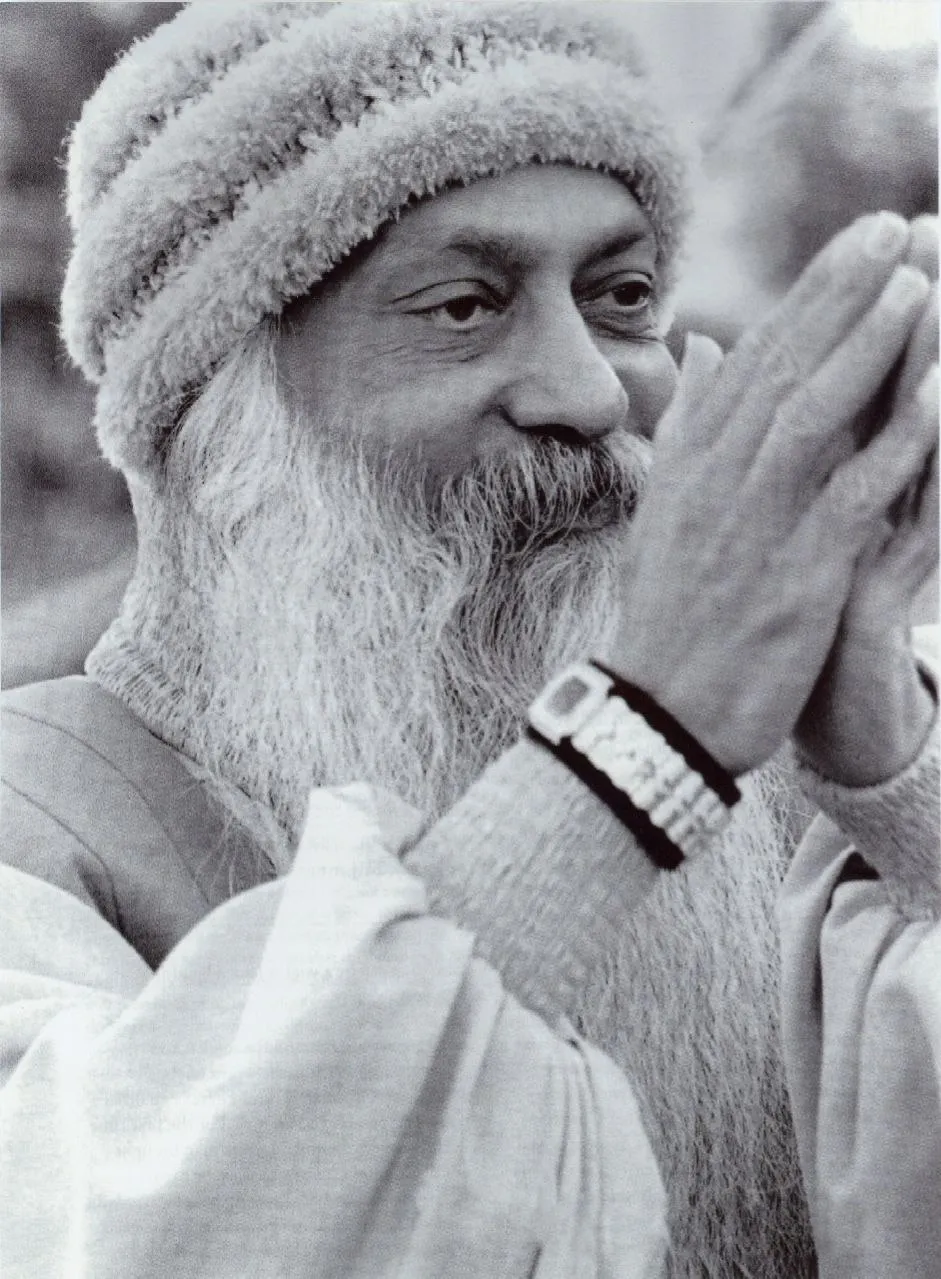
Too much thinking, tech, and wealth makes kids bored, so they look for the opposite—silence, feeling, and meaning—in Eastern meditation and wisdom.
From the Discourses
Passages where Osho speaks to this question — each links to the complete discourse.
What factors do you attribute the western youth revolt to, and why are so many young people from the west now becoming interested in eastern religion and philosophy?
The whole attitude of modern youth is one of boredom with an empty affluence. The youth are leaving the society, and they will go on leaving it unless the whole society becomes poor. Then they will not be able to leave. This leaving, this renunciation, can exist only in an affluent society. If it is taken to an extreme, the society will decline. Then technology will not progress, and if this continues the West will become like the East is today. In the East they are turning to the other extreme. They will create a society just like that of the West. The East is turning to the West and the West is turning to the East, but the disease remains the same. As I see it, the disease is the imbalance, the acceptance of one thing and the denial of the other. We have never allowed the human mind…
Osho, if we proceed on the basis of your own argument, then today in America, after sociological analysis, they have concluded that despite so much affluence, among twenty-one- and twenty-two-year-old youth a restlessness, derangement, and despair toward society has arisen—what...
I understand; let me tell you. The restlessness in the hearts of American youth is the beginning of a religious era. Such a thing has never happened in the world before. Such restlessness did occur, but only in a few households. People like Buddha or Mahavira felt this kind of restlessness. They had everything. The most beautiful women were gathered around them. As many beautiful women as could be found in Bihar were confined within a single household. All the beautiful girls were there, all the wealth, all the splendor. When all this is attained, a restlessness arises—Now what? A difficulty arises—Now what shall we do? This used to happen now and then to a few great families. America has reached the point where millions of families are in the condition once experienced by the families of Buddha and Mahavira. For the first time an entire society has become affluent.…
Why are young people so rebellious nowadays?
There are many factors. One is universal education: for the first time the youth of the world are well-educated. And to the educated mind the old establishment looks absurd and out of date -- rooted in the past, of course, but with no future. Secondly, the scientific progress of the world and the scientific training of the young basically presupposes a training in doubt. Since all the old cultures and civilizations are based on faith, there is a gap. The young are trained for doubt and all religions and cultures require faith, so it becomes impossible. The young are now really in search of a faith which can be scientific, a faith which is so alive that it can allow doubt, a faith that is unafraid of doubt. Life is complex, and everything exists with its polar opposite. A scientist begins with doubt and ends in faith while a religious…
Osho, you said there are three successive steps of evolution—body, mind, and soul. Western civilization has evolved a great deal on the planes of body and mind, yet the outcome has been melancholy, meaninglessness, and despair. Please explain why, as a natural sequence, the Western intellect has not evolved toward the third stage?
Have you ever thought what you would ask if God appeared to you? Think honestly: if tomorrow morning God stood before you, what would you ask? On a piece of paper, write three things. You will be shocked at your own desires—“a beautiful wife, a film actress; a big house; a big car; victory in my lawsuit.” Whatever you ask will reveal where you are. Your asking will expose you. Will you start begging when you see God—or will the seeing itself so fulfill you that you say, “Nothing to ask”? In the very impulse to ask is hidden the fact that you did not seek God—you sought something else and were going to use God to get it. God was not the goal; what you want to ask for is the goal. If God appears and you ask for an Impala car, then the car was the real deity;…
A friend has asked: Osho, you said about a wayward son that one should let him pass through his experiences, and he will learn on his own. But even after experiencing, he still prefers the same thing—someone is asking about his wayward son—no matter how much suffering he has to endure, even if death itself should come, still he does the same. After stumbling again and again, he repeats it. What can be done? How to reform him?
You will not be able to reform him. If life cannot reform him, if even death cannot reform him, what will you be able to do? If what you say is true—that again and again, even after suffering, he does the same thing; even if death comes, he will still do the same thing, and he does not change—then take your hands off. You will not be able to reform him. You cannot be stronger than death. And one who does not learn from suffering—what will he learn from you? Do not call him a wayward son. You have found yourself a Jadabharata. Because those whom suffering does not reform, whom even death does not reform—these are great, arrived masters; they are in the ultimate state. Do not even try to reform such a one. And why are you so eager to reform another? It is enough to reform yourself.…