
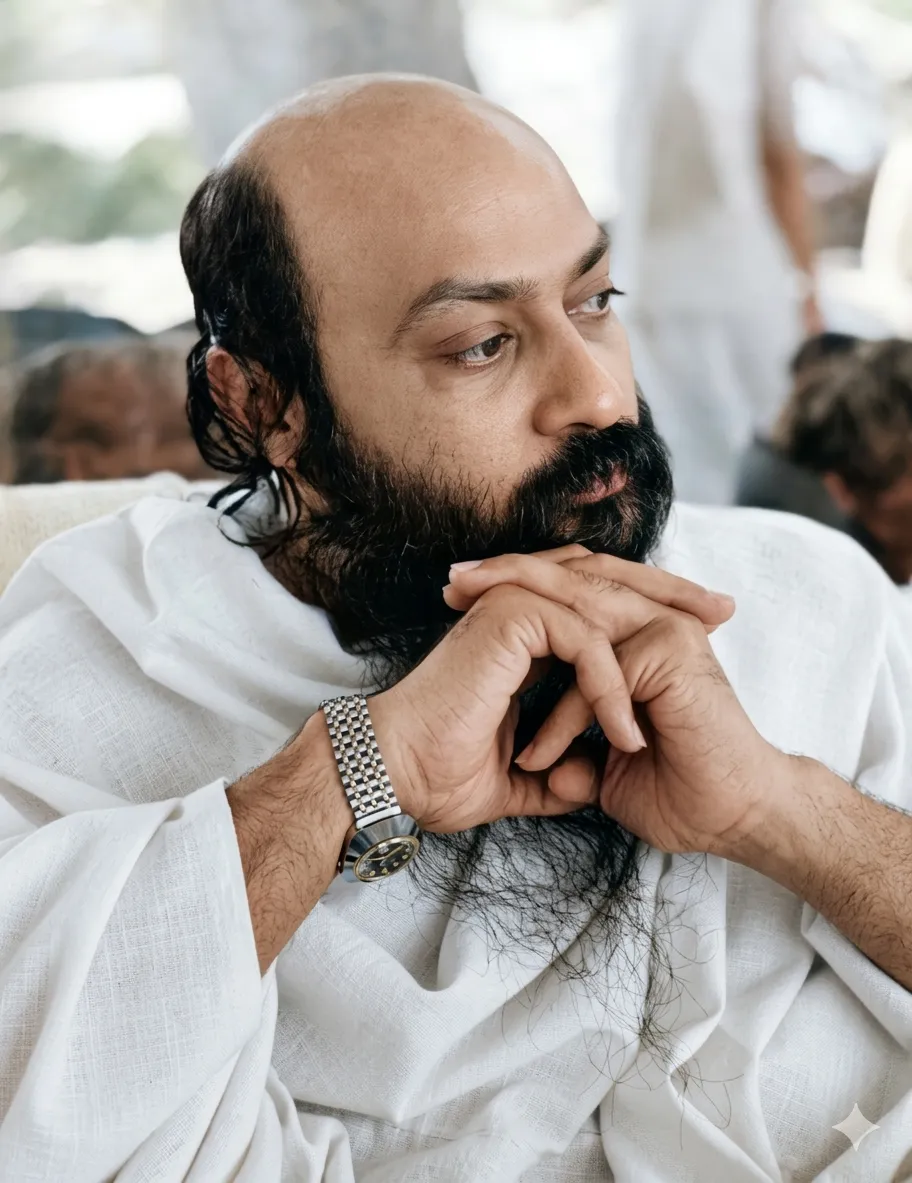
According to Osho, to become conscious is to bring inner light—through meditation—so awareness expands from ordinary mind into superconsciousness, collective superconsciousness, and cosmic consciousness. This upward movement instantly burns the unconscious ‘rubbish’; you don’t dig into darkness, you illuminate it. Consciousness is presence, clarity, and silence that dispels burden and tension, like lighting a candle rather than wrestling with the night.
Becoming conscious means stop fighting the mess in your head and simply switch on an inner light (meditation) so the mess melts away.
From the Discourses
Passages where Osho speaks to this question — each links to the complete discourse.
Beloved Osho, does "to become conscious" mean that something that was unconscious is raised to the level of the mind, and only when it has passed through the state of the mind can it rise to the level of superconsciousness? Does everything need to pass through the mind, or is it possible to become conscious from another place, and jump the mind stage?
Those who believe only in the mind -- for example, psychoanalysts, who are replacing the priests in the West and who are creating a substitute religion as bogus as the one they are replacing -- for them, there is nothing higher than mind. There are steps lower than mind; hence everything has to pass through your conscious mind to be released, so your unconscious becomes unburdened. But it is a very long process, because your unconscious carries the whole rubbish of this life, which is immense. Every second of your life, awake or asleep, you are collecting rubbish. The amount is so much that your remaining life will not be able to free you from it. Moreover, while you are freeing yourself from the old rubbish, every day you are collecting new rubbish. And this is not all. Deeper than this is your collective unconscious which has not even been…
Beloved Osho, when I was a student at a japanese buddhist university I heard the word consciousness. Beloved Osho, what does it mean?
Kranti Satbodha, consciousness you already have, but only in a very small proportion. It is just like an iceberg -- one tenth is above water and the rest is under water. Just a little bit is conscious in you. I am saying something and you are listening to it; without consciousness it is not possible. These pillars of Chuang Tzu Auditorium are not listening -- they don't have consciousness. But we are aware only of a very small piece of consciousness. Meditation is the whole science of bringing more and more consciousness out of darkness. The only way is to be as conscious as possible twenty-four hours a day. Sitting, sit consciously, not like a mechanical robot; walking, walk consciously, alert to each movement; listening, listen more and more consciously, so that each word comes to you in its crystal clear purity, its definitiveness. While listening, be silent, so that…
Misery is rooted in our robot-like behavior; it arises out of our unconsciousness. You become angry because you are unconscious; if you are conscious, to be angry is so stupid -- it is impossible to get into it. One can get into it only unconsciously; hence even unconscious people later on repent. When they start getting a little bit alert to what they have done, how they have behaved, how ugly it was, then they start saying "I am sorry -- I did it in spite of myself!" But how can you do it in spite of yourself? Then who does it? But there is a certain significance in that expression; it shows that when you are unconscious you are not yourself. Then you are at the mercy of anything that is happening outside -- it can drive you into any direction. You become driftwood.
We have two words which are very different but which appear very similar. One is self-consciouses, the other is self-awareness. The meaning is exactly the same as far as language is concerned, but existentially there is a great difference. Self-consciousness is a disease. The emphasis is on the self. You become self-conscious only when you are nervous, afraid. If you suddenly have to go for an interview you become self-conscious, or if you are suddenly asked to deliver a lecture standing on a podium you become self-conscious. Facing so many people who are all focussing on you creates great trembling inside. It is said that the mind starts functioning the moment the child is born till one day you stand on a podium to speak, then it stops. Then suddenly you don't know what is what. Suddenly all thoughts disappear. Those are the only moments you know of no-thought.
Question: OSHO, HOW DOES ONE EXPLORE THE HIGHER STATES OF CONSCIOUSNESS? ... He throws a rock into the well and runs away. Certainly, the rock falling in the well makes a big noise, and all the people who are following him stop near the well -- they think that the man has jumped into the well. So now some arrangement has to be made: more light has to be brought, somebody has to go down and find out who this man is, whether he is alive or dead. Now their whole mind is diverted. He reaches his home, really angry, almost ready to kill the father. And the father is sound asleep, covered with his blanket... it was a cold night. He pulls off his blanket, and he says, "Is this the way to teach your own son? He said, "Are you back? That's enough; you have learned the art.