
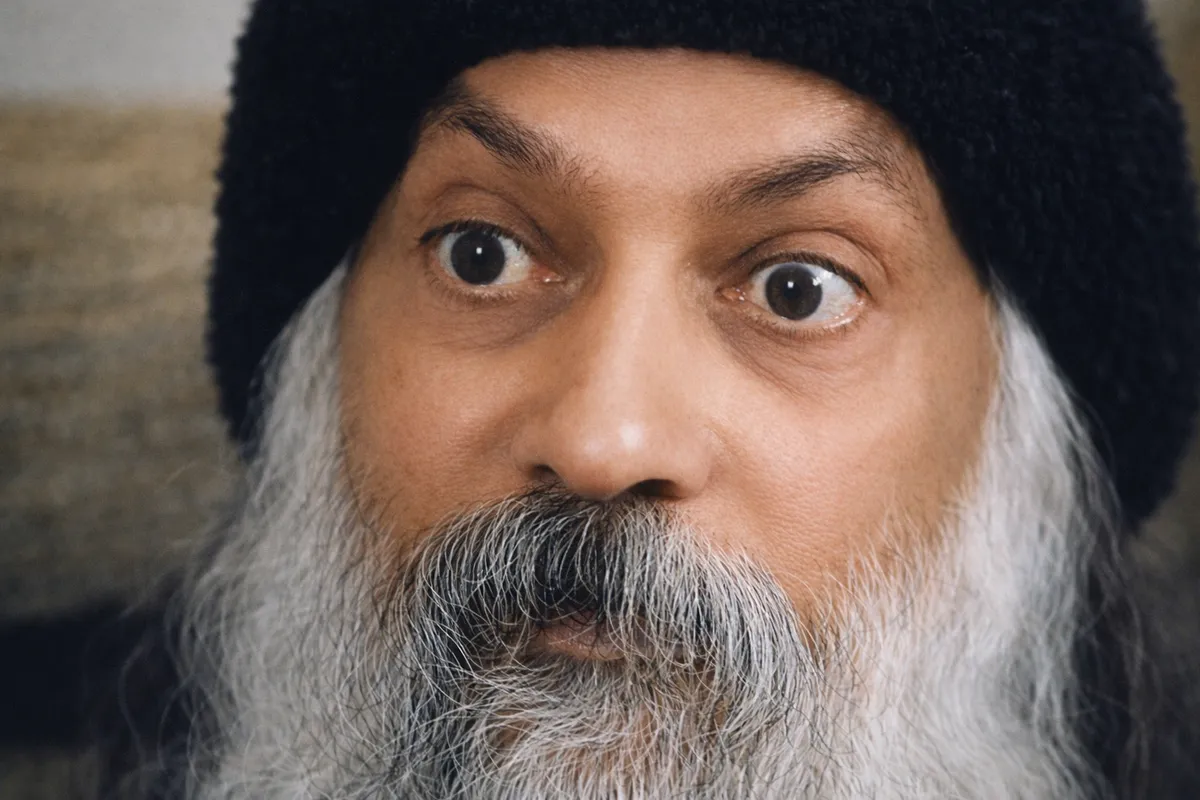
Like tasting honey, truth must be experienced directly—no amount of talking can replace the taste.
From the Discourses
Passages where Osho speaks to this question — each links to the complete discourse.
Beloved master, when you say that truth can only be realized and can't be described, what do you actually mean?
If you experience only things which can be explained, described, defined, then your world is very small and your mind is very childish. You go beyond mind only when you start experiencing things which mind finds itself incapable of bringing to language. To transcend language is one of the most significant things for anyone who is intelligent enough; otherwise, as far as idiots are concerned, they can express everything. They have never experienced anything which goes beyond mind. The truth is beyond mind; the truth is beyond language. That's why, Rahul, it can be experienced, but it cannot be described. One of the most absurd and most loving mystics of China was Chuang Tzu. If Rahul had gone to Chuang Tzu... He used to push sweets into people's mouths, forcibly. And you were asking, "Why can truth not be described?" and after you had swallowed the delicious sweet he would…
Beloved Osho, for the past seven years I have heard you speaking about truth. But this is still an empty word for me. Often you say that one knows truth when one is silent inside. I know this delicious feeling that takes me over when I close my eyes and become quiet inside, but what is truth to do with that?
That is the truth. Truth is not an object that you will find somewhere when you are silent. Truth is your subjectivity. Just try to understand. You are there, and the whole world is there. Whatever you see is an object, but who is seeing it is the subject. In silence all objects disappear -- and the word `object, has to be remembered; it is the same word as `objection.' `Object' means that which prevents you. So all preventions, all objects, all objections, disappear; you have the whole infinity, and just silence. It is full of consciousness, it is full of presence, of your being. But you will not find anything as the truth -- that will become an object. And truth is never an object. Truth is subjectivity. To discover your subjectivity -- unhindered, unobjected to by anything, in its total infinity and eternalness -- is the truth. "The…
Osho, what is the definition of God?
Words are very small. If you say God is light, then what of darkness? The scriptures have said that God is light. Suppose we accept this as a definition—then what about darkness? Where will darkness go? Darkness is too; in fact it is far more than light. Light sometimes is and sometimes is not; darkness is always, eternal. Where will you place darkness? If you say God is light, darkness is left out. If you say God is darkness, then light is left out. If you say God is both darkness and light, a contradiction arises: they cannot be together. Try to have both darkness and light in the same room. If you bring in light, darkness disappears; if you preserve darkness, you cannot have light. Then how can both be together? That becomes an impossibility. So you cannot say “both” either. Then the fourth device is to say: it…
Why is truth inexpressible? Why can't it be told?
All words are small. All human efforts are limited. And then, it cannot be told straight. It can be communicated straight, but it cannot be told straight -- and that is the difference between a thinker and a meditator. The thinker goes roundabout because he has to go through thought. He searches for the sky through the clouds and gets lost in the clouds, may never reach the sky. The thinker gets lost in thoughts. The meditator starts by dropping thoughts. He starts by dropping thinking itself, and a moment comes when there is no thought: then there is immediacy. Then there is nothing between you and that which is. Then there is nothing at all -- you are bridged with reality. But that is an experience. Whenever you would like to tell that experience to somebody else you will have to use words, out of necessity, and words cannot…
Butei, the emperor of ryo, sent for fu-daishi to explain the diamond sutra. On the appointed day fu-daishi came to the palace, mounted the platform, rapped on the table before him, then descended and, still not speaking, left. Butei sat motionless for some minutes, whereupon shiko, who had seen all that had happened, went up to him and said, "may I be so bold, sir, as to ask whether you understood?" the emperor shook his head sadly. "what a pity," said shiko. "fu-daishi has never been more eloquent."
I have heard that Wittgenstein, a great Western philosopher, who comes nearest to the Zen attitude, used to say that he did not solve philosophical problems -- he dissolved them. And he used to say: "We leave things as they are but perhaps for the first time we come to see them as they are." Nothing can be done about things as they are. All that can be done is to help you to see them as they are. "We leave things as they are but perhaps for the first time we come to see them as they are." And again: "Philosophy simply puts everything before us, and neither explains nor deduces anything -- since everything lies open to view, there is nothing to explain." Yes, life is a mystery, and there is nothing to explain -- because everything is just open, it is just in front of you. Encounter…