
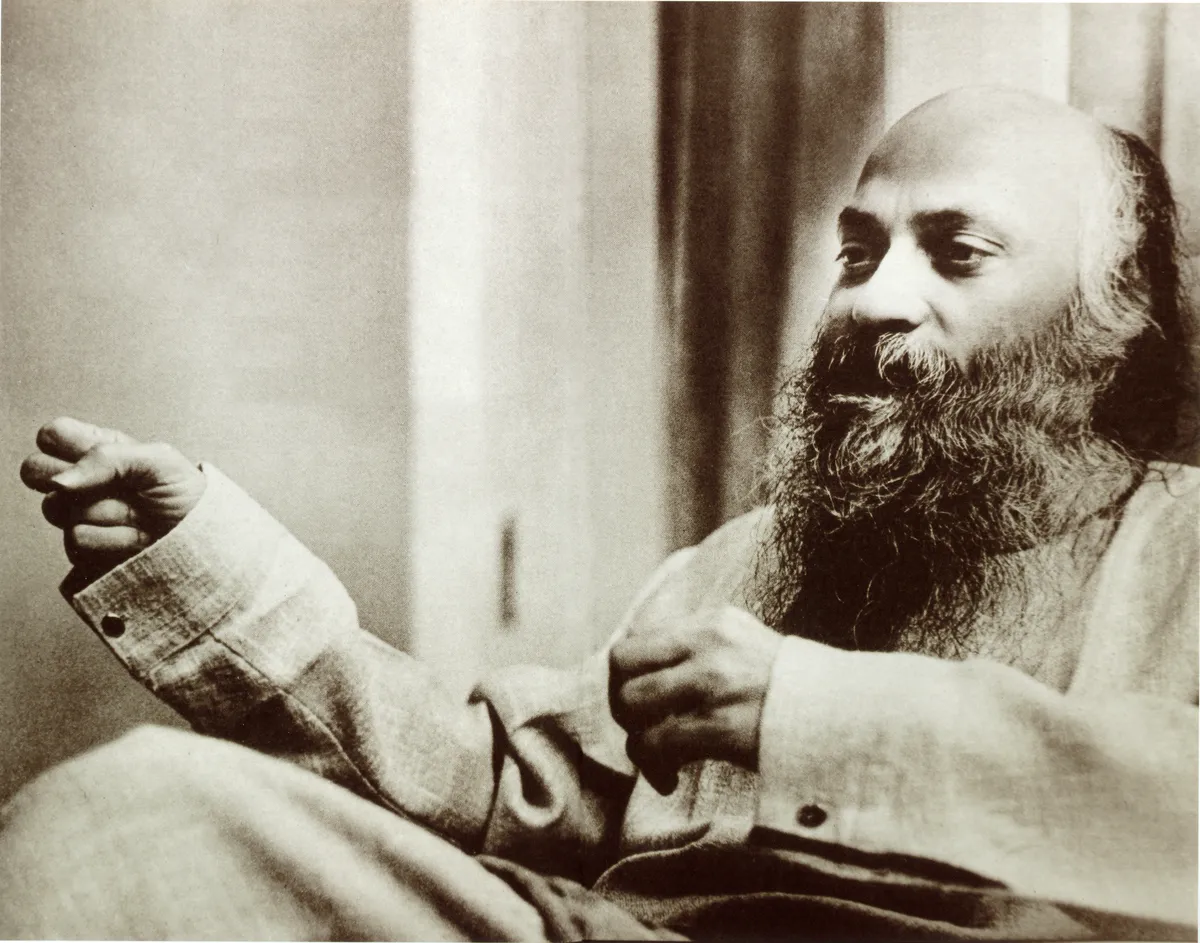
According to Osho, posture and mind run parallel: standing meditation fosters alertness and witnessing, and lowers the hypnosis-like drift into sleep; it also frees the body for spontaneous movements and catharsis. Sitting (cross‑legged asanas) stabilizes, locks limbs, minimizes movement, and was designed to suppress such expressions. Use standing for initial awareness and release; sitting for settled, later-stage stillness.
Standing helps you stay awake and let energy move; sitting keeps you steady and quiet once that energy has settled.
From the Discourses
Passages where Osho speaks to this question — each links to the complete discourse.
Osho, in the experiment you are speaking about these days, what physical and psychic difference is there between doing it sitting and doing it standing?
When you are in anger, in a sense you are in a momentary madness. At that time you do things you would never do in awareness. You abuse, you throw stones, you can break things, jump off a roof—anything. If a madman did it, we would understand; but when an ordinary person does it in anger, we say, “He was angry.” But it was the same person. If these things were not inside him, they could not come out; they are within. We are just holding them down. My understanding is that, before meditation, all this must be released. The more it is released, the lighter your consciousness will become. Therefore, what took years in the old methods where you sat in siddhasana can be completed in months by this process; what took lifetimes can happen in days. Because even in that approach, expulsion had to happen—only, the movements had…
In the meditation experiments you are presently conducting, what are the physical and psychic differences brought about by sitting or standing for the experiment?
It makes a great difference. As I told you before, deep within every condition of the body is connected with a particular state of mind that corresponds with it. If we tell a man to remain awake when he is lying down it will be difficult for him to do so; if we tell him to be alert when he is standing this will be easy. If we tell him to sleep when he is standing it will be difficult; if we tell him to sleep when he is lying down it will be easy. So there is a double process in which there is the fear that the meditator may fall asleep or become drowsy. If he stands this will help to dispel this fear. If he stands the possibility of drowsiness is less. The second part of the experiment is the witnessing attitude -- awareness. Initially it is…
Question: BELOVED OSHO, CAN YOU PLEASE SPEAK ON DISCIPLINE AND MEDITATION? The lotus posture was chosen for many reasons. If one can manage it without torturing himself, then it is the best, but it is not a necessity. It is certainly the best situation in which you can enter into watchfulness. The legs are crossed, the hands are crossed, the spine is straight; it gives many significant supports to being watchful. First, in this position, gravitation has the least effect on the body because your spine is straight. So the gravitation can effect a very small portion. When you are lying down, gravitation effects your whole body. That's why for sleeping, lying down is the best posture. Gravitation pulls the whole body, and because of its pull, the body loses all tensions.
In walking you get tired because you are going against gravitation, you are fighting; when you are walking you are fighting against gravitation. It is a fight. The earth is pulling you downwards and you are raising your legs up -- that means you are fighting. In running you get even more tired and more quickly for the simple reason that running is a greater fight. Sitting became the posture Or meditators, particularly the lotus posture when the spine is absolutely erect and. the legs are crossed. For Westerners it is a little difficult because for centuries they have never used the lotus posture; they have completely forgotten it. In the East it is a very common phenomenon: people sit on the earth without knowing they are sitting in a lotus posture -- or something very close to it.
Is the practicing of traditional asanas helpful for meditation?
Why was Mahavira sitting in that position? Buddha's posture is all right, but Mahavira's posture is very absurd. He was not practicing it; it came. Something happened within him and his body took on a certain posture -- although a very absurd posture. If he had been practicing asanas he would have been sitting just like Buddha, because that was the traditional meditation posture. But he was in an attitude of letgo, and samadhi came and created a posture that was particularly required for his body and his individuality. Everyone will need to express himself individually. No person is like any other and no one can be. An individual is unique so that everything that flowers in him will flower in an individual and unique way. If you impose something from without, then it will be a generalized conception; it can never be fitting and harmonious to your situation. So…