
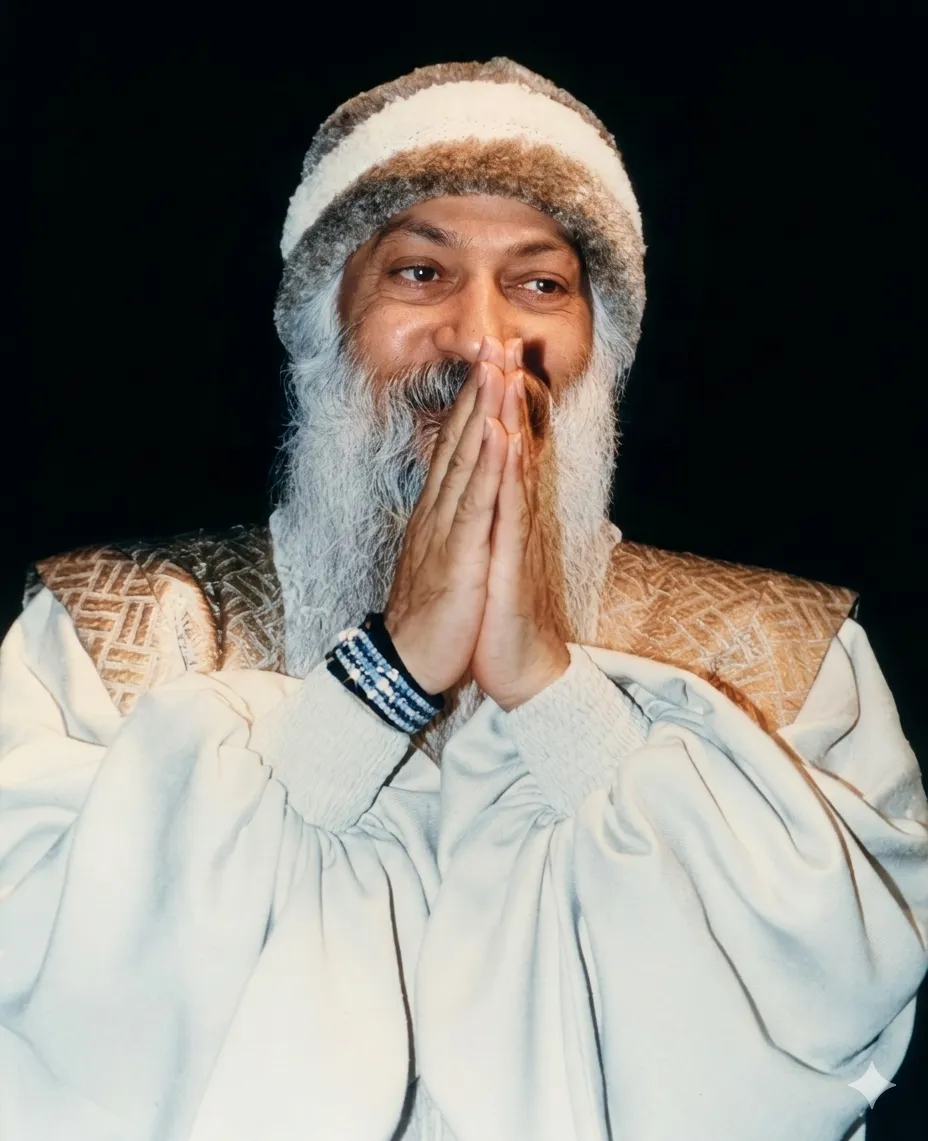
Wanting is knowing a specific thing you want, desire is a fuzzy push to be important, and longing is your heart’s gentle ache for love or God.
From the Discourses
Passages where Osho speaks to this question — each links to the complete discourse.
Beloved Osho, would you please tell us more about what the sufis call "adab"? Is it a "tariqa"... A method that extends beyond the physical presence of the master, becoming part of the innermost being of the disciple and reflecting, in every action of his daily?
Radha Mohammed, yes, adab is a tariqa, a method. It is the beginning of something very immense, of something utterly incomprehensible to the intellect. It is the first step of a great eternal pilgrimage. To be with the Master is simply a lesson in how to be with God. That's why down the ages the Master has been called "God". It is very symbolic, it is a metaphor. The word "metaphor" is beautiful. Meta means beyond, phor means going: that which takes you beyond. The Master is a metaphor -- he takes you beyond himself. He is just a beginning, a jumping-board. To be with the Master is nothing but a discipline in how to be with God. God is not visible, the Master is visible; it is easier to learn from the visible and then move to the invisible. Have you looked into children's books? We have to make…
What is the difference between waiting for godot and waiting for god?
It is as if the sun has risen in the morning and you are sitting in your room with closed doors and windows, in darkness. Open the doors, you become available to the sun. The sun was already available -- just the meeting happens. You cannot wait for God. All waiting is for Godot. Godot means the one who never comes, who CANNOT come, whose arrival is impossible. And the only impossible thing is that which has already happened -- how can it happen again? You are alive, and you are waiting for life, Now, this is ridiculous. The real man of religion does not think in terms of God. He thinks in terms of life or, even better, of living -- because life can again become an abstract idea. Living, moment-to-moment living. In that very living, one knows what God is, because one knows who one is. Your idea…
Osho, you say the same thing in countless ways. But when I listen to you, it feels as if I am hearing it for the first time. And I feel so much joy that I don’t feel like going back home. What should I do—what can I do—so that I can just keep listening to you!
You will feel as if you have been made to rise out of season, before time—as if you were not yet to go and yet had to go. And if you go in that way, your home will become even more desolate than before. I do not want to make your home desolate; I want to make your home a temple. I want that when you go home, your home’s new form is revealed. I do not want to tear you away from home, from the world, from family life. That is the newness of my sannyas: I do not want to sever you from the world; I want to join you to the world in such a way that your connection with the world becomes a connection with the Divine. Let the world no longer be a barrier between you and the Divine; let it become a means. If…
पहला प्रश्न: ओशो, आप एक ही बात कहते हैं अनेक-अनेक ढंगों से। पर जब आपको सुनता हूं तो उस समय यही लगता है कि पहली बार सुन रहा हूं। और इतना आनंद मिलता है कि वापस घर लौटकर जाने का जी नहीं करता। क्या करूं, मैं क्या करूं कि आपको सुनता ही रहूं!
… ऐसा लगेगा जैसे अभी जाना न था और जाना पड़ा। और अगर ऐसे तुम गये, तो घर और भी उदास हो जाएगा। जितना पहले था, उससे भी ज्यादा। मैं तुम्हारे घर को उदास नहीं करना चाहता। मैं तुम्हारे घर को मंदिर बनाना चाहता हूं। मैं चाहता हूं कि तुम जब घर जाओ, तो तुम्हारे घर का अभिनवरूप प्रकट हो। मैं तुम्हें घर से, संसार से, गृहस्थी से तोड़ नहीं लेना चाहता। वही मेरे संन्यास का अभिनवपन है कि मैं तुम्हें संसार सेे तोड़ नहीं लेना चाहता। …
Osho, what is the difference between surrender and blind imitation?
So be careful: the freedom you allow yourself, allow the other too. You have no right to judge another as blindly credulous or as a surrendered being. Drop that concern. You cannot judge anyway—how will you enter another’s heart? How will you know? Think only about yourself. See within whether, up to now, you have lived by blind belief or by surrender. Decide only there; leave worrying about others. Otherwise, all your judgments will be wrong. Jesus said: Judge not; do not set yourself up as a judge in relation to another. To the friend who has asked: if you are asking for yourself, good. Drop worrying about others. Look within and see: whatever I have been clinging to till now—have I ever staked my life to hold it? Have I meditated for it? Have I loved for it? Or am I just clutching what culture, society, civilization handed me?…
चौथा प्रश्न: ओशो, समर्पण और अंधानुकरण में क्या अंतर है?
इसलिए खयाल रखना, जो तुम अपने लिए मौका देते हो, वह दूसरे को भी देना। तुम्हें कोई हक नहीं है किसी दूसरे के बाबत निर्णय करने का कि वह अंधविश्वासी है, या समर्पित हुआ व्यक्तित्व है। तुम इसकी चिंता छोड़ो। तुम कर भी नहीं सकते निर्णय। तुम दूसरे के हृदय में उतरोगे कैसे? जानोगे कैसे? तुम तो अपनी ही सोच लो। इतना ही देखो अपने भीतर कि अब तक तुम अंधविश्वास से जी रहे हो, या समर्पण से जी रहे हो। बस, वहीं निर्णय कर लो, दूसरों की फिकिर छोड़ दो। अन्यथा तुम्हारे सभी निर्णय गलत होंगे। जीसस ने कहा है, निर्णय करो ही मत; दूसरे के संबंध में न्यायाधीश बनो ही मत। तो जिन मित्र ने पूछा है, अगर अपने लिए पूछते हों, तो ठीक। दूसरों की चिंता छोड़ दें। अपने भीतर ही देख लेना है कि अब तक जो मैं पकड़े हुए हूं, उसको पकड़ने के लिए मैंने कोई जीवन दांव पर लगाया है? कोई ध्यान किया है? कोई प्रेम किया है? या सिर्फ संस्कृति ने, समाज ने, सभ्यता ने जो दिया है, उसे पकड़े हुए हूं! दूसरों ने दिया है। …
I don't understand. You said that longing is in and of itself divine. Yet you have often said that all desiring, even for god, is mundane and not spiritual.
Deva Ashoka, longing in its purity is divine, longing when it longs for nothing is divine. The moment an object of the longing arises, it becomes mundane. Longing is a pure fire that purifies, longing is a smokeless fire, a smokeless flame. But the moment it becomes attached to any object whatsoever -- worldly, otherworldly; money, meditation, God, nirvana, it doesn't matter -- any object, and the longing is no more pure, it is contaminated by the object. Then the object becomes more important than the longing itself. Then the longing is only a means, it is no more the end in itself. And the whole effort of sannyas is to help you drop all objects of longing. Longing will not disappear -- in fact, the more objects are dropped, the more intense, the more total the longing will become, because the energy involved in the objects will be released.…