
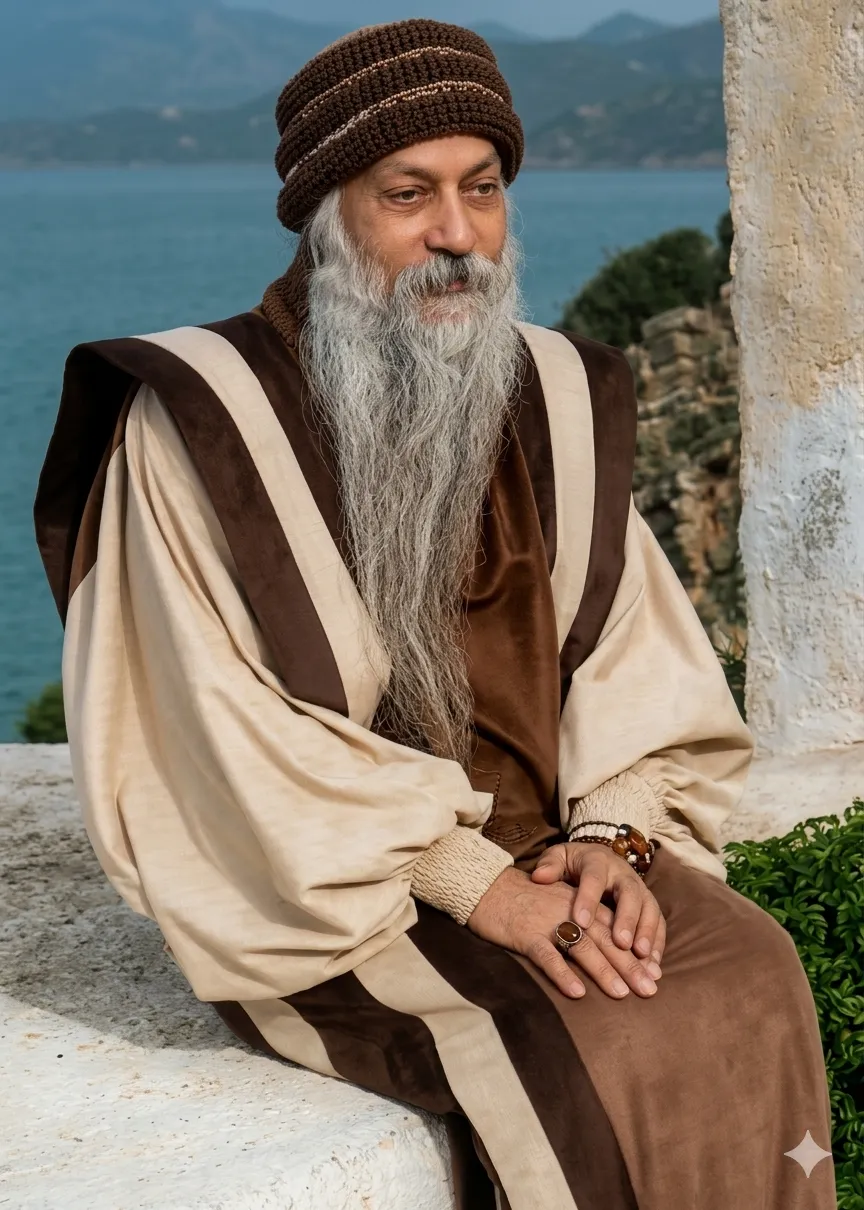
According to Osho, begin where you actually are: for now, only the body is present, so let the body dance. Dancing is a doorway to discovering the 'within.' Once inner awareness blossoms, action becomes spontaneous—sometimes dance, sometimes stillness. Don’t make a theoretical split between ‘you’ and the body; use embodied movement as the first step, and clarity will come.
Start by letting your body move; later, when you really feel your inside self, you’ll know naturally whether to dance or be still.
From the Discourses
Passages where Osho speaks to this question — each links to the complete discourse.
Osho, in meditation, should I dance, or should my body dance?
As yet, you are not there; for now only the body can dance. When you too arrive, then you can dance as well. Right now you are not; right now there is only the body. Why are you raising matters from a place where you are not? You have heard about the soul, but have you known it? You have read about the soul—have you experienced it? For now you are the body. For now the soul is only a dream. Can you make a dream dance? How will you make that which is not yet, dance? For now, let the body dance. Dance with what you have. Begin with the body. People come to me and say, “We want to take sannyas; but give us the inner—what is the use of the outer sannyas?” I tell them, where is your “inner” yet? I am ready to give you the…
My understanding is that dance, in the beginning, was born out of meditation. And I think all that is significant in life has had its origin in meditation. Meera did not have to go anywhere to learn dancing. People are mistaken if they think that Meera found God through dancing. Meera burst into dancing when she found God. The fact is otherwise: no one finds God through dancing, but one can dance if he finds God. What can a drop do but dance when a whole ocean enters into it? What can a beggar do but dance when he suddenly comes upon a treasure of infinite wealth? But man has been so much crushed and crippled by civilization that he cannot dance.
Osho, when does dance happen? You are always speaking of dance—what dance? And when does this dance happen?
Certainly I speak of dance, because for me dance itself is worship. Dance itself is meditation. There is no method more effortless than dance, no samadhi so natural. Dance is the most effortless, the simplest. For nowhere else can you melt your ego as easily as you can in dancing. If you can dance with a full heart, you will vanish. You will be effaced in the dance. Dance is a wondrous path of self-forgetfulness, a miraculous alchemy. And dance has another beauty: as you dance, your life-energy begins to flow. You have become inert. You were born to be a river; you have become a stagnant pond. You were born to flow; you have become blocked. Your life-energy must flow again, must gush forth again. Let the waves rise again. For a river one day reaches the ocean; a pond never does. A pond remains closed within itself. That…
Osho, I am dancing here. I, who never danced. Far from dancing—I had never even thought I would dance. I am astonished at myself. I ask: what has happened to me?
Love has happened to you; religion has happened to you. You have begun to come toward your home. You have turned back. You have set out toward your source. The Ganges has started flowing back toward Gangotri. The current has reversed. Your first steps have begun to fall in the direction from which you came. And when the first steps fall that way, dance is born. The farther you go from the divine, the more dance is lost; gloom, frustration, melancholy spread through life. When you are very miserable, understand that you are very far from the divine. The rishis have described the divine as sat-chit-ananda—being, consciousness, bliss. Saraha says, Tilopa says: it is mahāsukha, the great bliss. That means the more you are in sorrow, the farther you are from it. The proportion of your sorrow is the proportion of your distance. The measure of your sorrow is the…
[An indian visitor, who is a professional dancer, asked what meditation technique would be right for her, and then went on to ask about love and relationships.] There is no need to find any other meditation. Dance itself becomes a meditation if the dancer is lost. The whole point is how to lose oneself. How you do that, or where, is irrelevant. Just lose yourself. A point comes where you are not, and still things go on... as if you are possessed. Dance is one of the most beautiful things that can happen to a man. So don't think about meditation separately. Meditation is needed as something separate for people who don't have any very deep creative energy; no direction for their energy to get so deeply involved that they can be lost But a dancer, a painter, a sculptor, need not have any other meditation.