
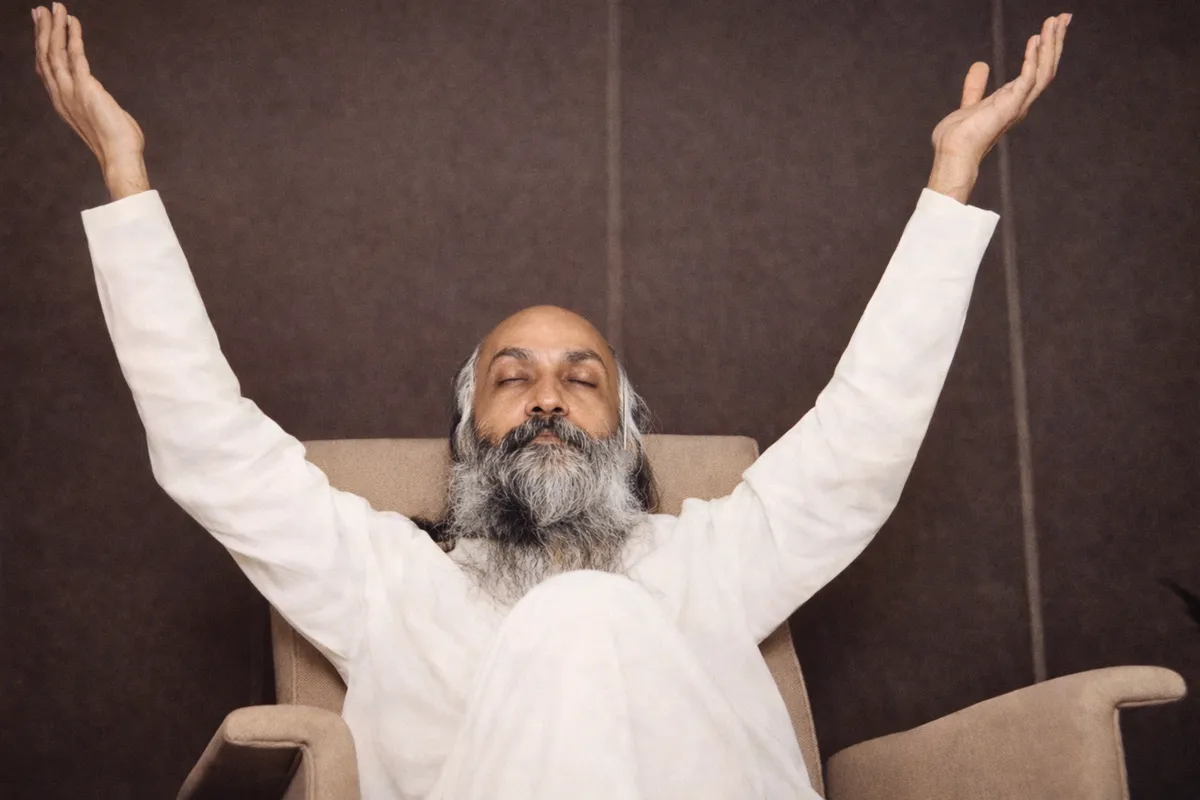
No—if a master doesn’t push beliefs and helps people drop labels, he can guide endless people.
From the Discourses
Passages where Osho speaks to this question — each links to the complete discourse.
Beloved Osho, gurdjieff said that a master has three kinds of disciples: those who are helpful to themselves, those who are helpful to him as the master, and those who are helpful to the group. Ideally, the disciple would flower in all three directions. Osho, what kind of disciples do you have?
Gurdjieff was not a philosopher, he was not a rationalist, not a logician. That's why P.D. Ouspensky -- who was a mathematician, a philosopher, a logician -- became his best spokesman. Even though he went against Gurdjieff, his books are the best introduction to Gurdjieff because he is articulate. Ouspensky did not know what Gurdjieff was saying, but once Gurdjieff gave him an indication of what had to be said, then Ouspensky could figure out the best way to say it. As far as I know, in this century Ouspensky was the most articulate man. His every sentence is so pregnant, so full of meaning and so clear; being a mathematician he could not be unclear. He does not write in paragraphs, he simply writes in single lines, because each line has such an independence and is so complete in itself that it does not need to be explained in…
Beloved Osho, in many traditions the total transmission was passed from a master to only one disciple, such as from buddha to mahakashyapa, from bodhidharma to hui-ke, down to hui neng, whom you mentioned this morning. Do you have such a one right disciple to whom you plan to transfer total knowledge among your disciples? Is there a possibility that you will do this with a number of persons rather than only one? Why is it that the ultimate secret is usually transmitted to only one in many traditions?
Now, because this will be the last meeting, I would like to say something to you before you leave the campus. Firstly, this has been my observation -- that ninety percent of you, and this is a very great number, have been doing meditation very intensely. This is very hopeful but the intensity was more or less dependent on the group. It may be difficult for you to be so intense back at home. So do one thing: when you do the meditation at home, close your eyes first, feel me present just before you as I am here. Visualize me, visualize the group around you and then start meditation as you have been doing with the group. That will be very helpful. If you have a tape-recording, then put it on so that the whole atmosphere is created and you are not alone. It is very difficult to do…
Beloved Osho, your relationship with your disciples seems to be unique among the religions. Would you say something about this?
The person who made it possible for you to have those few moments, the woman, the man -- be grateful, immensely grateful to the person. Yes, those moments are no more there. Nothing can be done about it. They cannot be pulled back, and even if there was some way to pull them back, they would not be the same. It would be a repetition. It wouldn't bring you the same joy, the same ecstasy. It is good that they cannot be pulled back, otherwise even the memory of those cherished moments would be spoiled. Respect the person, be grateful to the person that, for no reason at all -- she is a stranger, you are a stranger -- for no reason at all, for no bargain, there was no business... mysteriously the universe managed; something transpired between you. And it was nourishing to both of you. It has made…
You said that you don't "work" on people, so what is the meaning of having disciples?
A Master is just a presence, an encompassing present... Like a cloud he surrounds you. If you allow him, he enters to the deepest core of your being. Not that he enters! You simply allow... it happens. And in that moment when the disciple is allowing and the Master is present: a chemical change, better to call it alchemical, mutation -- the disciple also disappears, the same way as the Master has disappeared. The ego is no longer there. The disciple has also become a nondoer. Now he can function as a presence to others. He can be a Master. Sariputta, one of Buddha's disciples, one day entered into Buddha and allowed Buddha to enter in him. He became enlightened. Immediately, Buddha said, "Now, Sariputta, no need to hang around me. Now go. Go to the farthest corners of the country. Many people are thirsty. Now you have the water…
A friend has asked: Osho, none among Buddha’s disciples rose to his stature. Among Christ’s disciples no second Christ was born. Mahavira’s disciples are just the opposite of him. In Krishna’s disciples too there is no Krishna. Do you still believe in the master–disciple tradition?
Yet Jesus was crucified—and that, paradoxically, became an advantage. Because of the crucifixion you remember him. Christianity was not born because of Jesus, but because of the cross. Had there been no crucifixion, Jesus would have been forgotten long ago. The cross became a mnemonic; his hanging on the cross became an event that overshadowed history. History has its own ways. But don’t imagine that among the disciples of Mahavira, Krishna, Christ, or Buddha none attained. Many did—each in his way. They reached exactly where the masters reached—but by their own routes. One reached dancing; another in silence; another by speaking. The ways differed. But whosoever can surrender near a buddha-like presence will certainly arrive. Surrender is the art of learning. Before a buddha-like presence you need the capacity to bow down completely. We have forgotten the art of bowing—that is why religion is fading from the world. A friend…
एक मित्र ने पूछा है कि ओशो, बुद्ध के शिष्यों में कोई भी उनकी श्रेणी का नहीं हुआ। क्राइस्ट के शिष्यों में भी कोई दूसरा क्राइस्ट नहीं बन सका। महावीर के शिष्य ठीक उनके विपरीत हैं। कृष्ण के शिष्यों में भी कोई कृष्ण नहीं है। क्या फिर भी आप गुरु-शिष्य प्रणाली पर विश्वास करते हैं?
लेकिन जीसस को सूली लग गई, यही एक फायदा रहा। सूली लगने की वजह से आपको याद रहे। जीसस की वजह से क्रिश्चियनिटी पैदा नहीं हुई, क्रास की वजह से पैदा हुई। अगर सूली न लगती, तो जीसस कभी के भूल गए होते। वह सूली याददाश्त बन गई। जीसस का सूली पर लटकना एक घटना हो गई; वह घटना इतिहास पर छा गई। इतिहास के अपने ढंग हैं। लेकिन इस खयाल में मत रहें कि महावीर, कृष्ण, क्राइस्ट, या बुद्ध के शिष्यों में कोई उनको उपलब्ध नहीं हुआ। हुआ; अपने ढंग से हुआ। ठीक उसी जगह पहुंच गया, जहां वे पहुंचे थे। लेकिन अपने ही ढंग से पहुंचा। कोई नाचता हुआ पहुंचा; कोई चुप होकर पहुंचा; कोई बोलकर पहुंचा। अपने-अपने ढंग थे। उन ढंगों में फर्क हैं। लेकिन बुद्ध जैसे व्यक्तित्व के पास जो भी समर्पित होने की सामर्थ्य रखता है, वह जरूर पहुंच जाएगा। समर्पण कला है, सीखने की। …