
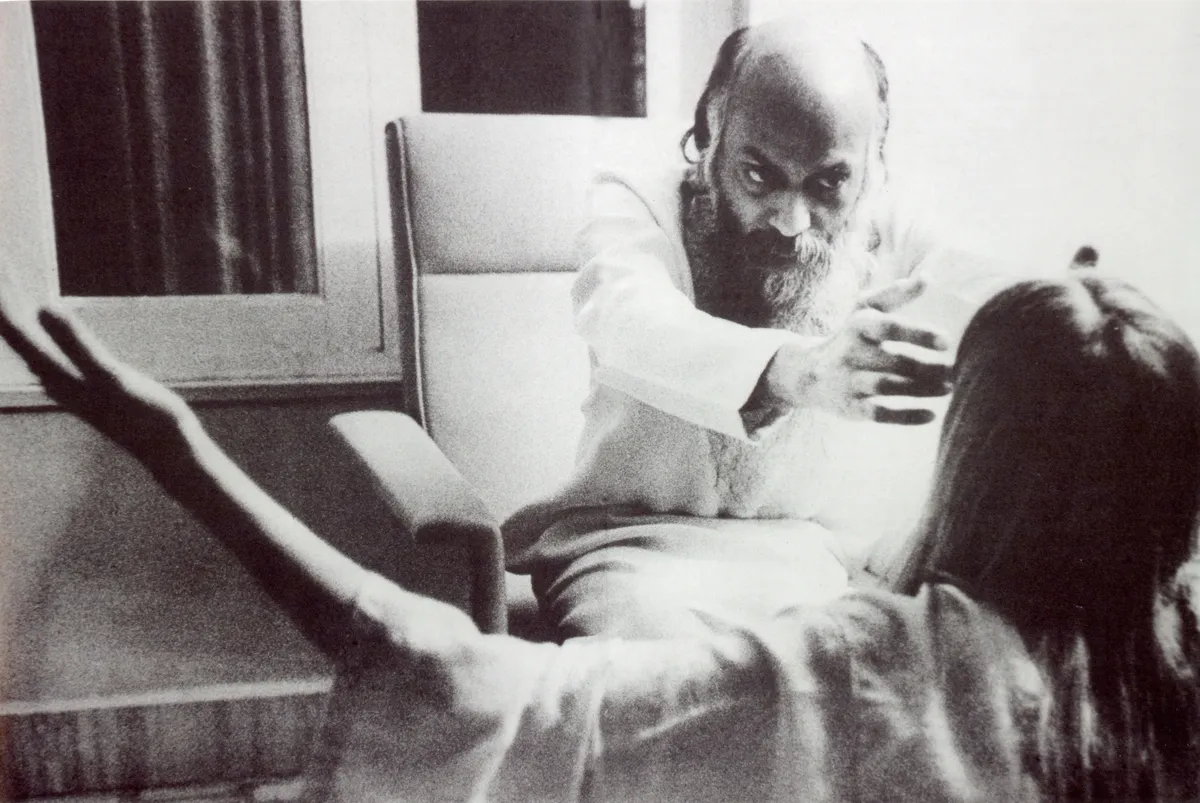
A living Master can wake you up; nature is lovely but asleep and can’t wake you—once awake, you’ll see the divine in nature too.
From the Discourses
Passages where Osho speaks to this question — each links to the complete discourse.
Osho, you sing the glory of the Master’s satsang every single day, but you speak of communion with nature only once in a while. Is the Master an even more sensitive doorway than nature? Please explain.
I have heard: A man died; he reached the gates of heaven. The gatekeeper asked, “Sir, have you done some virtue that you have come straight to heaven?” He said, “Yes, I have. I once gave an old woman three paise.” Seeing such a miser, such a niggard, they could not believe it. There had been reports from earth that he was a great miser. That he had given three paise—hard to believe. But they checked the accounts book. He had indeed given three paise. It was recorded. So the gatekeeper asked his colleague, “Now what should we do?” The colleague said, “Give him not three but four paise back—interest included—and send him to hell. What else can we do!” What you have done in the name of religion is just like those three paise. And remember: the fourth paise will be returned to you—and then the journey to hell!…
Osho, the true master Tosotsu devised three barriers and would have the monks pass through them. First barrier: the study of Zen. The purpose of studying Zen is to behold your own true nature. Now, what is your true nature?
Second: when someone realizes their true nature, they will be free from birth and death. Now, when you hide the light in your own eyes and live like a corpse, how can you liberate yourself? Third: if you free yourself from birth and death, then you should know—where are you? Now your body separates into the four elements. Where are you? Osho, please be compassionate and clarify these Zen barriers for us. But he had a prepared answer—why bother thinking? Never memorize answers. No other thing safeguards ignorance more than answers. Only madmen memorize scriptures. If you have memorized the Gita, forget it. If the Quran is by heart, let it go. Avoid scriptures. Fixed answers will not let you enter the Divine’s gate. You will be thrown back into the world. Your own answer must come—from your very life—authentic, resonant with your whole being, tasting of you. Which means…
We, in our unawareness and egoistic state, are not always in touch with the master. But is the master always in touch with us?
The third door remains open. You may be against me rationally. It doesn't matter: I am in touch. You may hate me. It doesn't matter: I am in touch -- because the third door always remains open. You have surrendered. And it is very difficult to close the third door -- very, very difficult It is difficult to open, it is difficult to close. It is difficult to open, but not as difficult as to close it. But that too can be closed because you have opened it. That too can be closed You can decide some day to take your surrender back. Or, you can go and surrender yourself to somebody else. But that never -- almost never -- happens, because with these three doors the Master is working to open the fourth door. So there is very... almost impossible possibility that you will take your surrender back. Before…
Osho, you call sannyas, meditation, and love a leap. What do you mean by a leap?
Narendra! Whatever is essential in life—be it meditation, love, or sannyas—does not come the way mathematics does. It has no method, no staircase. There is no sequential movement in it. It is an explosion. Everything happens in a single instant. It is not a conclusion of thought; it is a condition of the heart, a state of feeling. Suddenly! When you light a lamp, darkness doesn’t go away gradually—first a little, then a little more. Here the lamp is lit, and there the darkness is gone—in one moment, at once. I call the lighting of the lamp and the vanishing of the darkness a leap. If it left little by little, in sequence, in measurable increments, then it would be a process. So too with sannyas: it is not a process. In a moment of awakening, the futility of life is seen. It is seen with such intensity that nothing…
Osho, you spoke of two kinds of sleep. One is the ordinary sleep from which we wake in the morning when it is complete. The other is what we call spiritual sleep, in which we are all asleep—even during the day. To wake from that sleep too, is it necessary that it also be allowed to complete itself?
When Buddha was born, astrologers said that when he grew up he would either become a renunciate or a great emperor. His father grew very anxious. To become a great emperor—this a father can desire—but if he becomes a renunciate, that would be a painful event. It is easy to touch the feet of a renunciate, but if your own son wants to renounce, it hurts deeply. If someone else’s son renounces, you even go and touch his feet. The father was troubled. He asked the astrologers, “Then what can be done so that he does not become a renunciate?” They said, “Only one thing: see that his sleep is never disturbed at all. Because sometimes, through a disturbance, a man wakes.” It is not necessary that only an alarm awakens you—the alarm is merely a disturbance. Clouds may thunder in the sky and your sleep may break. Some circumstance…