
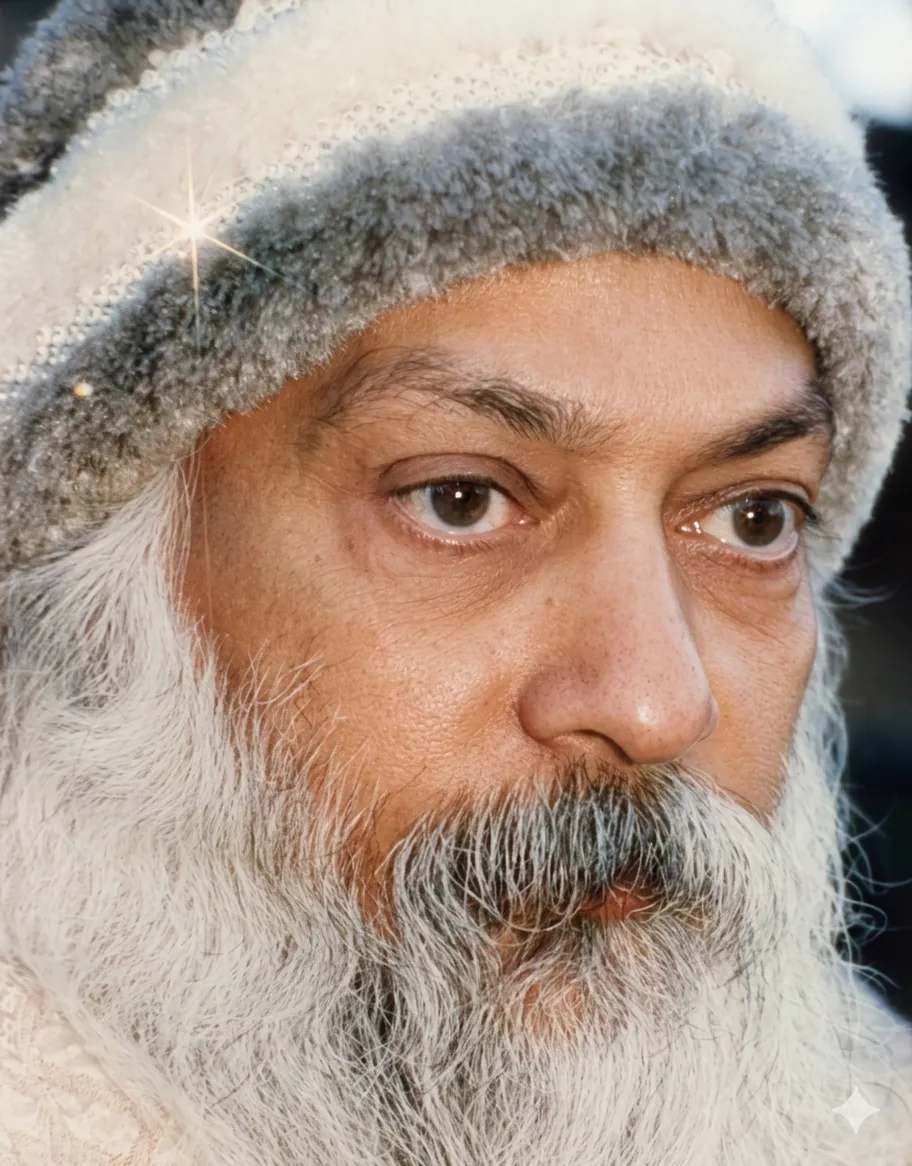
He says ‘he’ to show the master is just a job he watches, not who he really is.
From the Discourses
Passages where Osho speaks to this question — each links to the complete discourse.
Question: BELOVED OSHO, WHY DO YOU ALWAYS SPEAK OF THE MASTER IN THE THIRD PERSON? Because I am only a witness. My function as a master is not my identity. It is just like somebody is a plumber and somebody is a surgeon; I am a master -- but it is functional, it is not my reality. That's why I speak in the third person. So I go on talking about the master as `he' -- I don't use `I' -- just to make you aware that I am more than the master, that I am watching the master. Just as you are watching him, I am watching him too. You are watching from one side, I am watching from another side. But I am as different from it as you are different from it.
Beloved Osho, you said that when the master is in an absentlike presence and the disciple is also absentlike, then the divine work begins. If both are to be absentlike, then please explain the role of the master in the spiritual endeavor.
Basically, it is always the master to whom YOU come. Whether the master goes to the palace or the emperor comes to the master's hut, it makes no difference. It is always the emperor who is coming to the master because he is to be changed. HE will be changed. Bayazid says that it is the nature of the master to change others; it is not an effort. Nothing is being done by the master, simply his presence.... And if he appears to do something, that appearance is just a trick because you cannot understand the language of nondoing. You can only understand the language of effort. So he creates a language for you. Even if you cannot understand his language, he can understand your language very well. Even if you cannot understand him, he can understand you very well. So he gives whatsoever you can understand and by and…
Beloved Osho, the other morning I heard you saying that the so-called self is just an idea of the mind, because it seems hard for the mind to accept that our being is just pure nothingness, surprisingly containing the whole. Then who and what is the witness you talk about so much? Is it a masterly device which has to be dropped at some point?
Just a few days afterwards there was a master passing by who heard about Ramakrishna, that he had a six-hour samadhi. The master came. Ramakrishna was a very humble man; he touched the feet of the master and said, "Help me, because I attained that experience but it was only for six hours -- then I was back to my old stage." The master said, "You don't understand, it was not a real experience. You forced that experience upon yourself by your stubborness because you were going to kill yourself. After dancing the whole day and singing, your mind simply stopped, seeing the situation -- `The man is going to kill himself!' It had nothing to do with Kali or anybody; it was simply the stopping of the mind. And that experience was only an experience of when mind is not chattering, and you feel immense silence and beauty and…
Beloved Osho, if someone were to ask me, "who is the master of this house?" I would reply, "my master, of course. He lives upstairs." but somehow I feel that if you were asked the same question, you would reply, "I am but a guest here. The master is not to be found." is this not true?
It is true. I can be your master only if I am not. If I am, then I cannot be a real master; then I can only be an egoist exploiting people. I am only a guest. That means you cannot take me for granted. Today I am here, tomorrow I may not be here. Today I am available, tomorrow I may not be available. Today I am speaking, tomorrow I may stop speaking. I am not predictable. In that sense I am only a guest. The Indian word for "guest" is very beautiful; the Indian word is atithi. Tithi means "date" and atithi means one who comes without giving a date, and who leaves without giving a date. He comes suddenly and he leaves suddenly. His coming and going is not controllable. His coming and going is just like a breeze: it comes, and you feel the coolness of…
Osho, who are you?
And there will be ten percent of cases when you will feel ecstatic. Then don't think that I am giving this ecstasy to you -- nobody can give truth to you. I can inspire you, I can challenge you. I can invite you, I can seduce you into the journey, but I cannot give the truth to you. You have to find it yourself; I can only show your face. I am simply a mirror, Deben. Fanfani is on an official visit to France and he is taken to the Louvre. The museum director shows him around and they stop in front of a painting. "Cezanne?" Fanfani asks. "No," replies the director, "Renoir." They come to another painting and again Fanfani asks "Pizarro?" "No, Your Excellence, Degas." After walking around a little more he stops in front of another one and asks, "Is this a self-portrait of Toulouse-Lautrec?" No, Your…