
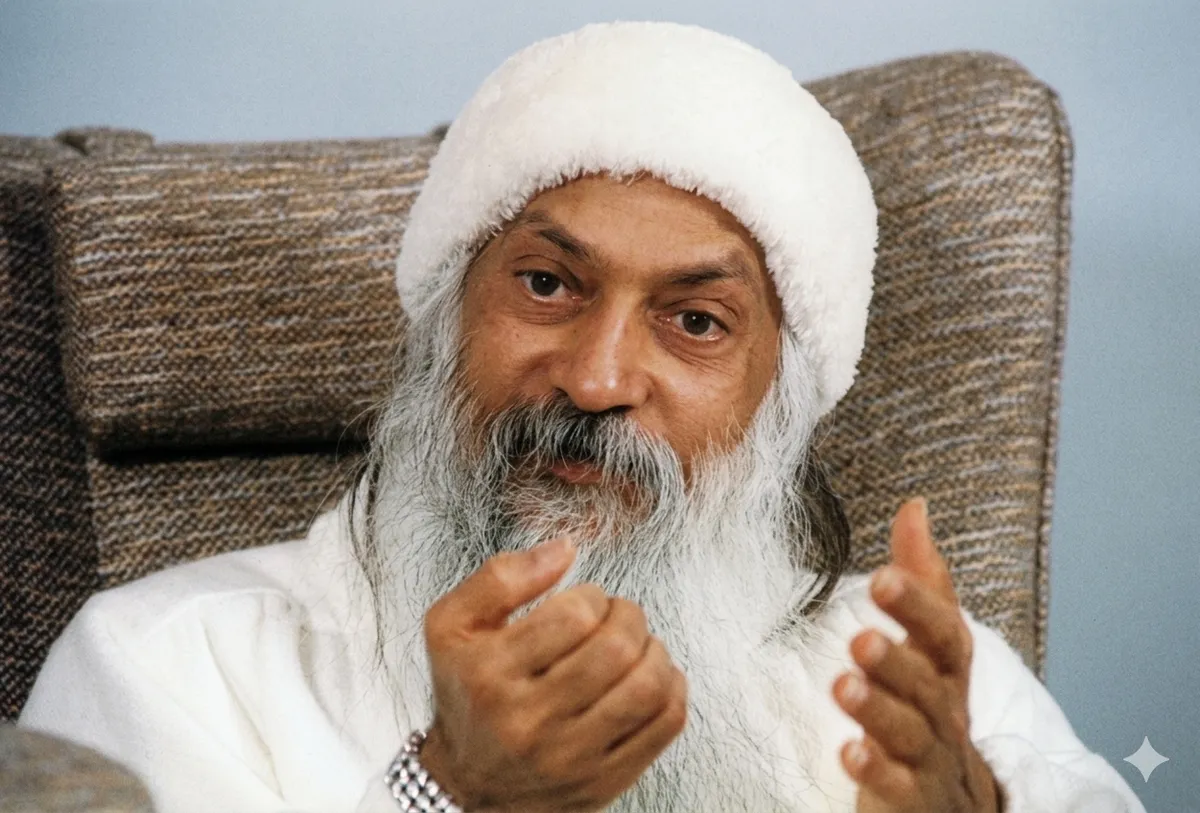
Different questions are like puzzle pieces; when put together, they reveal one picture.
From the Discourses
Passages where Osho speaks to this question — each links to the complete discourse.
Beloved Osho, you seem to mixing together all of our questions. It's like puzzle pieces, where all the pieces fit together perfectly in the end. Is this one example of the oneness of all?
The truth is, with numbers, at the most I can remember up to three. After that, I don't know what number comes. Secondly, all the questions that I choose have a certain coherence, a certain inner unity. It may not be apparent to you. When I speak, if I go into one question in absolute detail, then I cannot deal with another question on that day. One question will be enough for two and a half hours. So I have my way; I introduce the first question, answer its essential points; then I take the second question, answer its essential points, and if there is any point there that can emphasize something in the first question, I bring in the first question again. And it is not done in any systematic way because I have not prepared it. It is just my sensitivity and my spontaneity. I simply go with…
Osho, the witness, the seer, consciousness is always separate—virginal and unbound. And the whole play of life is nothing but the movement of the gunas within themselves. In such a situation, if a person’s qualities of sattva, rajas, and tamas are calmed in a scientific or chemical way, or if a person is made sattvic, will he then attain that ever-free witness? If the witness is forever free and present, then by chemically altering the three gunas will it not be revealed? Would the person not then become religious? What is the fundamental difference between solving the problem arising from the
Sadhana means we are dissolving the current itself, not breaking the bulb. There is no point in breaking the bulb. In fact, the bulb is useful; it tells you whether the current is flowing or not, whether there is current or not. Your anger within tells you you are still sunk in ignorance. Lust tells you your life energies have not yet become aware. If we remove these elements, anger will stop manifesting and you will also stop knowing that you are in deep ignorance. It is as if a man is sick and we snatch away the symptoms of his disease so that he doesn’t even come to know he is ill. And keep in mind, anger is an opportunity. Only the unwise say anger is simply bad; I do not say so. Anger is an opportunity; you can use it badly or well. Anger is a chance. In…
पहला प्रश्न: ओशो, साक्षी, द्रष्टा, चैतन्य सदा ही अलग कुंवारा और अनबंधा है। और सारी जीवन-लीला गुणों का ही स्वयं में वर्तन है। ऐसी स्थिति में व्यक्ति से सत्व, रज, तम के गुणों को वैज्ञानिक या रासायनिक ढंग से शांत कर दिया जाए या व्यक्ति को सात्विक बना दिया जाए, तो क्या वह उस हमेशा से मुक्त साक्षी को उपलब्ध हो जाएगा? यदि साक्षी सदा ही मुक्त एवं उपस्थित है, तो त्रिगुणों को रासायनिक ढंग से बदल देने पर वह क्या प्रकट न हो जाएगा? क्या व्यक्ति तब धार्मिक नहीं हो जाएगा? त्रिगुणों से उत्पन्न समस्या को रासायनिक ढंग से हल करने में या साधना के माध्यम से हल करने में क्या मौलिक भिन्नता है?
साधना का अर्थ है कि हम बिजली की धारा को ही विलीन कर रहे हैं, बल्ब को नहीं तोड़ रहे हैं। बल्ब को तोड़ने का कोई अर्थ ही नहीं है। बल्कि बल्ब तो उपयोगी है। क्योंकि वह बताता है, धारा बह रही है या नहीं; धारा है या नहीं। आपके भीतर क्रोध यह बताता है कि अभी आप अज्ञान में डूबे हैं। वासना बताती है कि अभी आपके प्राण जागरूक नहीं हुए हैं। अगर ये तत्व हमने अलग कर लिए, तो क्रोध प्रकट होना बंद हो जाएगा और आपको यह पता चलना भी बंद हो जाएगा कि आप गहन अज्ञान में पड़े हैं। यह तो ऐसा हुआ, जैसे कोई आदमी बीमार हो और हम उसके बीमारी के लक्षण छीन लें, तो उसे यह भी पता न चले कि वह बीमार है। और यह भी खयाल में रहे कि क्रोध एक अवसर है। क्रोध सिर्फ बुरा है, ऐसा नासमझ कहते हैं; मैं नहीं कहता। …
But Osho, I have learned that there are four types of movement: physical movement, intellectual movement, emotional movement, and the fourth is wisdom. Perhaps, in the ultimate state of leisure, what is meaningful is that a person’s intellectual or emotional capacities be stimulated, so that he can shift from one plane and move to another?
This is exactly what I am saying: for human energies to move into higher dimensions, it is essential that one be freed from the lower. So I do not say that the old man’s answer to Confucius was right. I do not agree with the old man—though I have heard that Confucius agreed with him. Gandhi would have agreed with him; I would not. In my view, perhaps the old man saved his son from laziness, but then what? The boy would still die harnessed to the plough like an ox. And if the old man thinks that if the boy uses a tool he will become a machine, has he noticed that by yoking him like a bull he is turning him into a bull? That does not occur to him. Besides, using a machine is not possible for an animal; it is possible only for man. So rather…
Osho, it seems that the expansion of consciousness or awareness is the root of all spiritual practice. Then, through the many paths—jnana and bhakti, yoga and tantra, action and nonaction, and so on—is it this same basic element that is being sought? And if this is the very needle we have to find, why is such a dense jungle of doctrines erected around it?
Truth is very little, extremely small. It can fit into a single moment, even into a single word. But in that form you will not understand it. You cannot see that atom. It is so subtle that you will miss it. To show you that tiny truth, your intellect makes many demands. The nets of doctrine are not erected to point to truth; they are erected to satisfy your intellect. And without that satisfaction, you cannot enter into the search. All your questions are futile. What Arjuna asks of Krishna is futile. What Ananda asks of Buddha is futile. But he asks; and until answers are given, his journey will not begin. Even if you are asking in vain, the true master still has to answer. Merely telling you that it is futile will not satisfy you. Merely saying it is irrelevant, that there is no point in asking, will…
पहला प्रश्न: ओशो, ऐसा लगता है कि चेतना या बोध का विस्तार समस्त धर्म-साधना का मूल है, तब क्या ज्ञान व भक्ति, योग व तंत्र, कर्म व अकर्म आदि अनेकानेक मार्गों से इसी बुनियादी तत्व की खोज की जाती है? और यदि इसी सुई को खोजना है, तो उसके इर्द-गिर्द सिद्धांतों का इतना भारी जंगल क्यों खड़ा किया जाता है?
सत्य तो अत्यल्प है, अति छोटा है। एक क्षण में भी समा जाए, एक शब्द में भी। पर वैसे सत्य को आप समझ न पाएंगे। उस अणु को आप देख न पाएंगे। वह सूक्ष्म है, इसी कारण आप उससे चूक जाएंगे। उस छोटे-से सत्य को दिखाने के लिए आपकी बुद्धि बहुत-सी मांग करती है। सिद्धांतों के जाल सत्य को इंगित करने के लिए नहीं खड़े किए जाते, आपकी बुद्धि की तृप्ति के लिए खड़े किए जाते हैं। और बिना तृप्त हुए आप खोज में संलग्न नहीं हो सकते। आपके सभी प्रश्न व्यर्थ हैं। अर्जुन जो कृष्ण से पूछ रहा है, सभी व्यर्थ है। आनंद जो बुद्ध से पूछ रहा है, सभी व्यर्थ है। लेकिन वह पूछ रहा है; और जब तक उसे उत्तर न मिल जाएं, तब तक उसकी यात्रा प्रारंभ न होगी। आप व्यर्थ ही पूछ रहे हों, तो भी सदगुरु को इसके उत्तर देने पड़ेंगे। इतना भर कह देने से कि वह व्यर्थ है, आपकी कोई तृप्ति नहीं होगी। इतना भर कह देने से कि असंगत है, पूछने में कोई सार नहीं है, आपकी तृप्ति नहीं होगी।
Beloved Osho, putting together all your statements about one subject or question, there are not just contradictions, but such a richness of different viewpoints and angles from which you look at the question... So many colors. When you talk about a certain subject, something in me starts dancing, remembering some of the answers you have given before. What's happening?
Every time one realizes something of the truth, there is a dance in the heart. The heart is the only testimony for the truth. And it cannot testify through words. It can testify in its own way: trough love, through dance, through playing music: nonverbal -- it speaks, but it does not speak in language and logic. And this is a realization of a certain truth which many people go on missing. They think what I am saying is contradictory, because they are thinking -- and thinking is a logical process. And logic can never see beyond contradictions; it has no way to bridge contradictions. Logic is a divider, not a joiner. The whole of humanity is divided by the mind: the Christian from the Hindu, the Mohammedan from the Jew, the Indian from the American, the German from the Italian. Mind goes on dividing -- divisions within divisions within…