
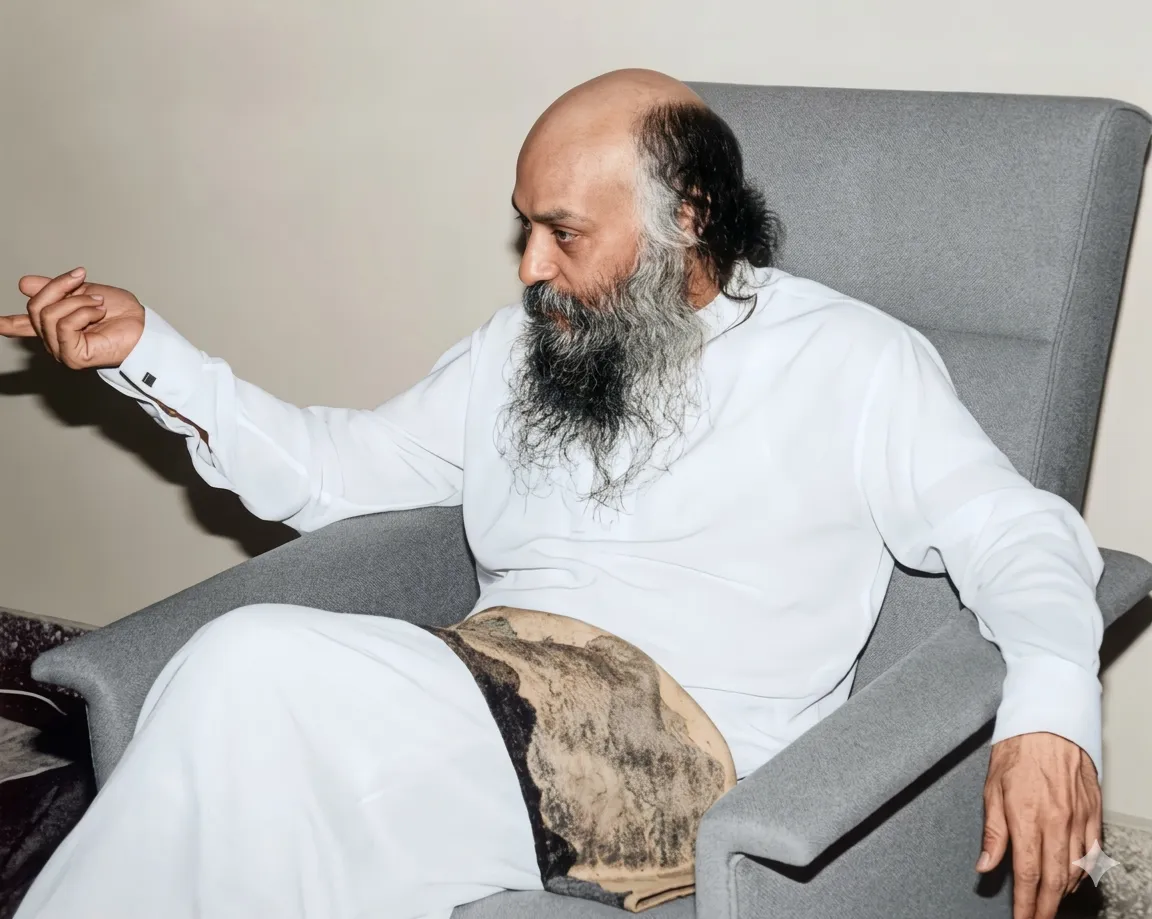
That strong pull you feel now is your true inner voice—don’t let your thinking mind or a different setting talk you out of it.
From the Discourses
Passages where Osho speaks to this question — each links to the complete discourse.
Yesterday someone asked a question. I did not answer it then; I had kept it for today. The question is: Who is a siddha?
Drowsy, listless, the days slipped by; nights won vows of wakefulness. Why does arrival turn to departure? Why does destruction become creation? Is death birth, or birth death? Nowhere a resolution appears. Pride in knowledge is all that remains, sewing together the start and end. In a moment, sunlight turned to shadow— Maya’s forms, and forms enamored of Maya. Water in the stone, stone in the water; in each soul the world is nestled. In the river—wave; in the wave—current; in each current, all of life. O you who fill drop by drop— why do brimming oceans run empty? “All’s well”—that’s what we heard; why did all depart, head in hands? If Brahman is truth and the world a lie, why do sunbeams weave dream-sky? In darkness—rays; in rays—dark prisons; victory upon victory, and yet life lost. A diamond-birth squandered so, weeping—singing, eating—drinking. Pride in knowledge is all that remains,…
Osho, the feeling for sannyas arises, and then the mind runs away. I can’t decide whether to take sannyas or not! Because it feels as if I’d be deceiving myself. It seems to me that I am not worthy of taking sannyas.
Three years passed. He thought and thought, listing hundreds of reasons pro and con: If I marry, these gains, these losses; if I don’t, these gains, these losses. In the end he found one extra gain in marrying—experience. And one loss in not marrying—no experience. The pan tilted. After three years he knocked on her door. Her father opened it. Kant said, “I have finally decided—one reason more on this side; I will marry.” The father laughed. “Too late. My daughter is married—and already has a child. You came far too late. Think again. And if someone else proposes, have your decision ready beforehand; don’t take so long.” He never married—no one else proposed. If you live by thinking, you’ll end up trivial. The vast requires a leap, not thinking. It requires courage—the gambler’s heart, not a shopkeeper’s book-keeping. Jamuna Singh, if you want to take it, take it. If…
Sannyas is a quantum leap, a jump into the unknown, a great courage to become discontinuous with your own past. It is a rebirth. It is a change so great... as if the old dies, and dies utterly and totally and the new comes into being from nowhere, from nothingness, out of nothing. If the new comes from the old it remains the old. If the new is continuous with the old then it is only a modification of the old -- maybe a little bit colored and decorated and changed, with a new dress, with a new mask, but it is not a revolution, it is not a conversion. And sannyas to be true has to be a revolution so total that the old identity is simply dropped -- just as the snake slips out of the old skin and never looks back.
Osho, how do I take sannyas? I keep thinking and then I stop. What is this hesitation?
One night a thief broke into Mulla Nasruddin’s house. While the thief gathered things, Mulla quickly spread his blanket on the floor. When the thief, ready to tie up the loot, looked for a sheet to wrap it in, he found a blanket laid out. He was a bit scared—when he had entered, there had been no blanket on the floor. He’d seen a man sleeping under it; now that man lay on the bed without the blanket, and the blanket was on the floor! But it wasn’t the time to ponder. He tied his bundle and set off. Mulla got up and followed. Hearing footsteps, the thief turned and saw the same man who had been on the bed—first under the blanket, then without it. The thief got nervous and said, “Why are you following me?” Mulla said, “Why not follow? I was the only one left back there!…
It is asked: “I haven’t met you personally yet, and still I am filled with strange feelings toward you. Sometimes I cry; sometimes I just keep gazing at you.”
The friend who has asked—this is a new, fresh contact. New experiences are rising in it. Before these experiences lose their meaning, before these waves become inert, before you slowly accept even these waves and they, too, grow old—take the leap. “Sometimes I cry; sometimes I just keep gazing at you.” Tears are a sign that the connection is being made through the heart. If it were made through the intellect, tears would never come. If the connection is through the head, at most one nods: “Right”; or if not, one shakes the head: “Wrong.” Only the skull nods a little. Tears have nothing to do with the head. Tears flow from the eyes—but they come from the heart, from the innermost core. Tears are more meaningful—than doctrines, ideas, sects. Tears are more meaningful. Tears bring the news that the heart has been struck, something within has trembled. Before the…