
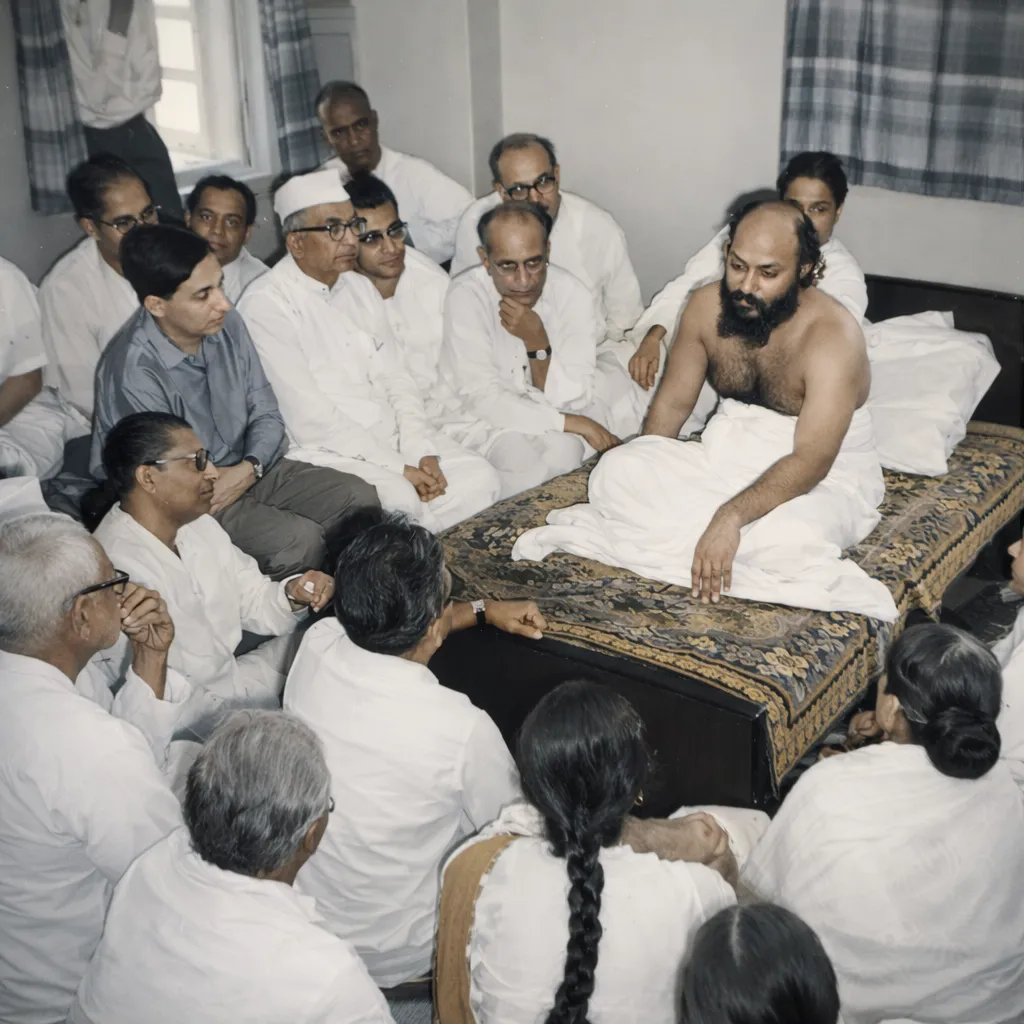
Like making perfume from flowers, meditation blends love and awareness until both ‘me’ and ‘God’ fade, leaving a quiet, kind knowing.
From the Discourses
Passages where Osho speaks to this question — each links to the complete discourse.
Osho, you say there are only two paths—devotion and knowledge. But you teach neither devotion nor knowledge; you teach meditation. So is meditation beyond both devotion and knowledge?
Meditation is the essence of knowledge and devotion. Meditation is the distillation of both. What the devotee calls love, what the knower calls awareness—meditation is the distilled essence of awareness and love. Think of it this way: some flowers are of devotion and some of knowledge; pressing both, you make a perfume—that perfume is meditation. Meditation is the devotee’s devotion, the knower’s awakening. One wing of meditation is devotion, the other wing is knowledge. Meditation is the quintessence. Come through devotion and you will arrive at meditation; come through knowledge and you will arrive at meditation. In the ultimate sense, the treasure that falls into your hands is called meditation. Understand. Devotion means: the devotee disappears, God remains. Knowledge means: God disappears, the knower remains, the self remains. That is why Mahavira and Buddha, the highest peaks of knowledge, did not accept a God; they declared there is no God.…
Osho, you have said that meditation is an inner journey. Is devotion also an inner journey? What is the fundamental difference between the inner journey of meditation and that of devotion? Please explain with compassion.
This is the path of love; here the Other is essential. From the union of two arises variety; the stream of rasa flows. A man alone cannot give birth to a child; a woman alone cannot give birth either. For a child to be born, the meeting of these opposites is necessary. Yes, a man can paint alone, a woman can sculpt alone—but they cannot give birth. For devotion, two are needed. Devotion is the unity that happens between two. Knowledge is the experience of the One. In the end, only One remains; thus both, ultimately, lead to the same place. But knowledge assumes the One from the very beginning; knowledge is nondual. Bhakti fundamentally accepts duality. The heart of bhakti is large: it says, let us accept the two; then we will unite them. Bhakti has trust in union. The faith that a bridge can be built between two—that…
Beloved Osho, shankaracharya teaches metaphysics and at the same time he sings the songs of govinda. Is there any interrelation between knowledge and bhakti, devotion?
You can fly in this sky if you make them both your wings. No bird can fly with one wing, no man can walk with one foot, nor can a boat be rowed with one oar; both the oars are needed. There is no contradiction, and those who have told you that there is a contradiction are wrong. They made this error because they did not know this great harmony. They were either mind-dominated people who possessed only dry thoughts and logic and never experienced the dance of the heart, or they were heart-dominated people who could dance but did not have any understanding. It will be a fortunate moment when you can dance with understanding. That moment will be fortunate when you can love with understanding. And never refuse anything which existence has given you, because if you do so you will become disabled to that degree. You are…
Osho, just as the sage Shandilya calls knowledge (jnana) and yoga the helpers of devotion (bhakti), do the exponents of knowledge and yoga likewise regard devotion as their helper, or not?
The devotee’s vision is more generous than the vision of the knower and the yogi. Because the source of devotion is the heart. The heart is vast; it can include even what is opposed to it. The heart does not worry about coherence; the heart cares about music. Jnana and yoga are not the ways of the heart; they are the ways of the intellect. The intellect is very narrow. The intellect chooses. Then the intellect worries about coherence, not about music—there must be logical consistency. So in Mahavira’s utterances there can be no room for devotion. His is the path of pure thought: samyak jnana, right knowledge. There only what exactly suits knowledge will be accepted. Knowledge selects, sifts; it is orderly; it has a blueprint. The devotee is not so narrow. He does not get flustered by a little inconsistency. The logician, the philosopher, is consistent—but the poet…
Osho, are the deaths of meditation and of love different? Are their processes different as well?
Death is one and the same—whether through meditation or through love. But the processes, the paths, the methods that lead to that death are different. Through meditation, the same thing happens: you disappear. Through love, the same thing happens: you disappear. The dissolving happens in both cases, but the ways are very different. In the first stages of meditation, you do not vanish. At that stage, what is false in you is burned away and what is true is preserved. The inauspicious is removed; the auspicious is kept. Impurity is burned; purity is protected. Thus on the path of knowledge or meditation one begins to be purified. One does not disappear; one becomes refined, yet one remains. In the final leap, the refinement reaches a point where even purity appears impure. Where mere being appears impure, there, in the last jump, the meditator snuffs himself out. The devotee snuffs himself…