
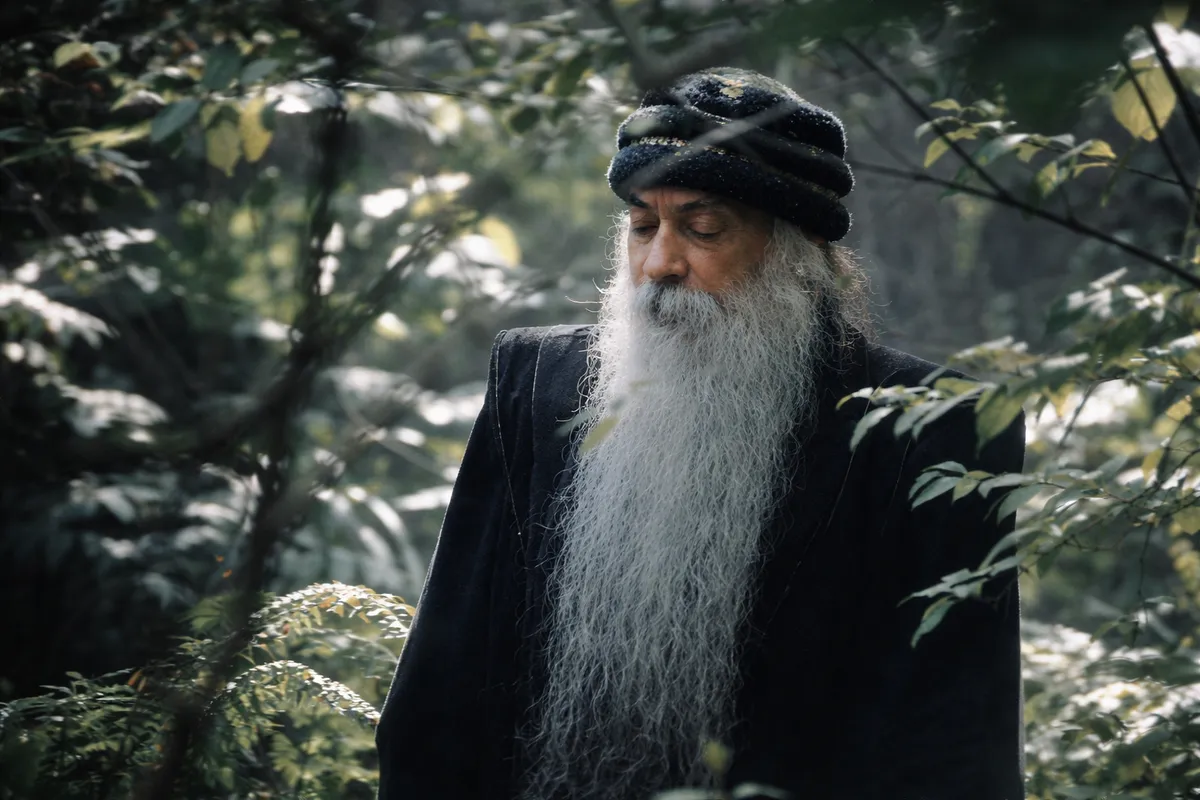
Devotion comes after love grows pure and open; love is the flower, devotion is its scent.
From the Discourses
Passages where Osho speaks to this question — each links to the complete discourse.
Osho, is love the parent of devotion, or is devotion the parent of love? Is love the bud and devotion the flower? Or is love the beginning and devotion the end? Or are they different?
The bud and the flower are both one and different. The beginning and the end are joined, and yet apart. A bud can remain a bud; to become a flower is possible, not inevitable. A seed can remain a seed; it could have become a tree, but it is not necessary that it will. The seed is separate—it has its own existence—and it is also the possibility of the tree. But a tree can be only if there is a seed, first. And a tree can be only if the seed disappears, second. First it must be, and then it must die; only then can the tree be. If there is no love, there is no possibility of devotion. And if love remains only love and does not go beyond, then too there is no possibility of devotion. If love stops at love, devotion will never be born. And if…
Osho, why do you liken devotion to love? Is there no other apt analogy?
I know why this question has arisen in you. For centuries your so‑called religious people have condemned love—called it base, impure, a sin. Hence you feel, “Wouldn’t some other analogy be better?” Somewhere within you there is condemnation of love—rejection, fear. I understand you—and I understand your so‑called saints as well. But the one who fears love has not understood love; the fear has arisen out of ignorance. The one who is afraid of the courtyard has not understood it. The courtyard had walls—and it had the sky; he focused on the walls and forgot the sky. I want you to focus on the sky and forget the walls. The walls are there and will remain. Man is encased in the wall of body; as long as you have a body, there will be walls. How will they disappear? You cannot get rid of even your own wall—how will you…
Osho, to cross the ocean of becoming and dissolve into the Supreme Self, which should one rely on—insensate devotion, foolish devotion, or blind devotion?
So drop this worry—whether insensate devotion, foolish devotion, blind devotion, or deranged devotion. Drop it; devotion is enough. And in devotion all these labels will take care of themselves. Become a devotee once, and “blind” you will automatically be—meaning: the whole world will call you blind. You will not become blind; rather, you will gain eyes. You will begin to see what ordinary eyes cannot see. The invisible will become visible; the imperceptible will come within perception. That which no one has ever touched will be felt as touch. But the world will call you blind. The world will not be able to accept it—because the world is blind, and the blind call you blind. H. G. Wells has a story: somewhere in Mexico there is a valley where children go blind within three months of birth. The story is based on fact. The climate, the food—something there ruins the…
4. Suppose you are gradually being deprived of strength or of knowledge. At the instant of deprivation, transcend.
5. DEVOTION FREES. But either way one goes on worrying about the future. Buddha said, "There is no heaven and no afterlife." And he said, "There is no soul, and your death will be total and complete; nothing will survive." People thought he was an atheist. He was not, he was just trying to create a situation in which you can forget the tomorrow and can remain in this very moment, here and now. Then meditation follows very easily. So if you are thinking of death -- not the death which will come, or is to come later -- fall down on the ground and lie dead. Relax and feel, "I am dying, I am dying, I am dying." And not only think it, feel it in every limb of the body, in every fib of the body. Let death creep in. It is one of the most beautiful meditations.…
Osho, in the Gita there is, in many places, a call for a wisdom free of attachment and possessiveness for the attainment of the Supreme, and alongside it, a call for love and devotion as well. Are love and devotion possible without attachment and clinging?
Only then are they possible. If love carries attachment, it becomes moha—infatuation. If love is free of attachment, it becomes bhakti—devotion. Love stands between the two: moha and bhakti. If love falls into attachment, it turns into moha; if it is freed from attachment, it becomes bhakti. Love is in the middle. Understand it rightly: love is not a fixed state, it is a transition. If you do not move in time, love sinks downward and becomes moha. If you move swiftly, love rises and becomes bhakti. Love in itself is a journey; not a static condition, but a passage—the journey between moha and bhakti. And if you have loved anyone—anyone at all—you will have known both possibilities. If you have loved your son, if you are a mother and have loved your son; or you are a wife and have loved your husband; or a husband and have loved…