
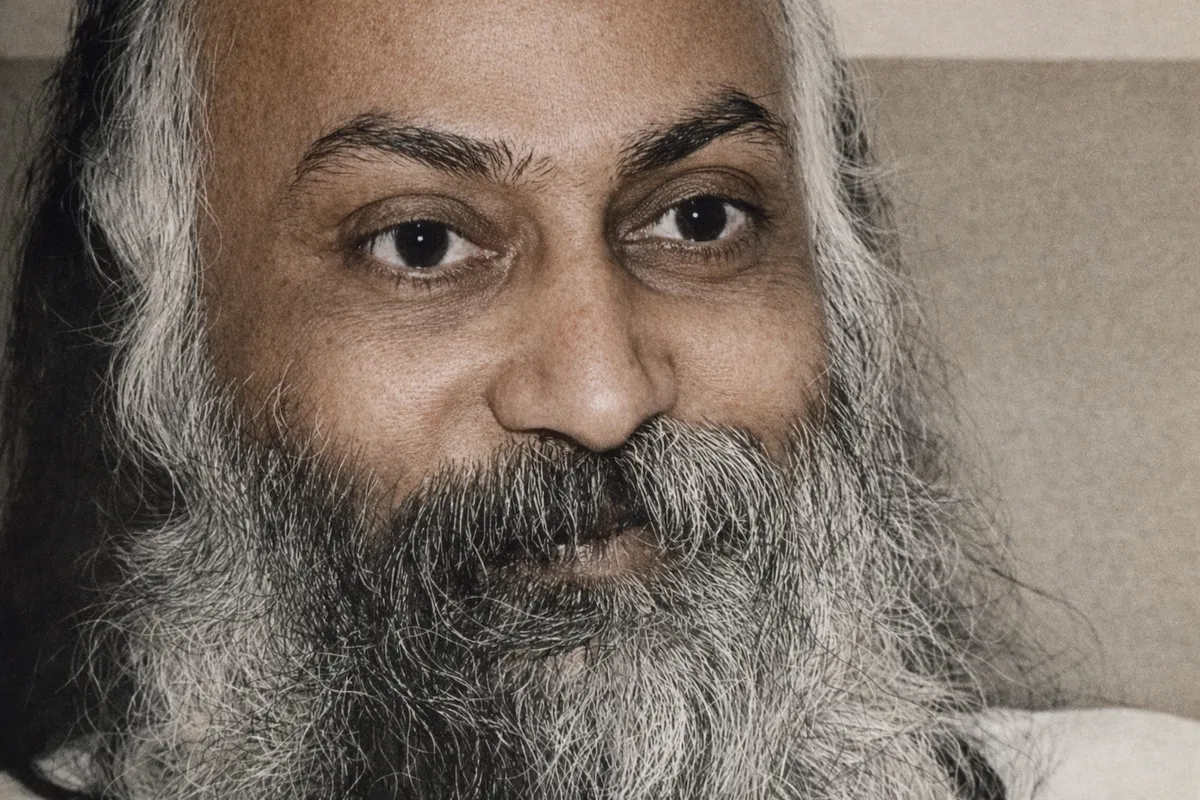
Just sit with the master and feel; your heart learns more from the silence than from words.
From the Discourses
Passages where Osho speaks to this question — each links to the complete discourse.
Osho, even in your Hindi discourses seventy to eighty percent are Western sannyasins who do not know Hindi at all. It is surprising that you still speak with the same alertness, ease, and depth, as if the whole assembly understands the language. Does this not create any difficulty for you? Please be gracious and explain how this is possible.
Chinmaya! It is not a matter of language here; it is a matter of feeling. And those who understand the language—do they really understand? Mere comprehension of words does not make you understand. What is being said may be expressed through language, but it is not confined to language. It is communicated by means of words, but it is not of the words. Only when you connect through the heart, through feeling, will you understand. Many must wonder: those who do not understand Hindi—how could they be understanding? They may not grasp what I am saying, but they do understand what I am. And that is what is valuable. Not what is said, but where it is said from. My silence is the valuable thing. From that silence the words arise. Words are like ripples on a lake. Ripples are not the whole of the lake. The lake can be…
Osho, when you are giving a discourse, if I gaze at your face the words are not heard; and if I listen to the words, a kind of restlessness is felt. Why is this so?
Words are not of much value. Even if the words are not heard, it is all right; even if they are heard, there is no real gain. If you look toward me, it becomes meditation. If the meditation becomes right, if the wire is connected, the words will stop being heard—because to hear words, a restless mind is needed, an agitated, unquiet mind. In that moment—when the connection is made—the soundless will begin to be heard; that is the real satsang. It is not of much value that you hear what I say. If you can hear what I am, only then does it have value. Speaking is just a pretext; words are only devices. The arrival is into the soundless; the awakening is in silence. If this is happening, then drop all concern for words; just keep looking at me. Let the flame be joined. Forget that I am…
Beloved Osho, the master speaks, and the disciples listen. What is it that happens, and remains unsaid?
Yoga Chinmaya, the master speaks, the disciple listens -- yet there is much which the master does not speak, and the disciple listens. In fact, that is the whole secret of disciplehood. If you only listen to that which is said, you are a student. You listen to the words, you miss the wordless. The moment you start listening to the wordless, you are initiated into disciplehood. The master is speaking. Naturally he has to use words, but he is also leaving gaps in between. He is also using wordlessness. He is saying something, and he is also meaning something which cannot be said -- but it can be heard. If the disciple is silent, he will hear the words and he will also hear the wordlessness; he will hear what is being said, and he will hear also what is not being said and yet is transferred. You are…
Beloved Osho, is it enough to go to your discourses without understanding the words? My japanese girlfriend does not speak any english but enjoyed your lectures very much. She wrote to me that she will not learn english because it is too dangerous for her to understand what you say. Can the non-verbal communication between master and disciple really be the ultimate, or should I develop all the abilities that existence gave me and learn english?
Mind is nothing but memory, and memory is not understanding. This has to become as clear as possible to you. Memory is a totally separate mechanism; even a very stupid person can have a very good memory. Intelligence is a totally different phenomenon. More often, the intelligent people don't have good memories. Their whole energy is involved in intelligence. The mechanism of memory does not get enough nourishment. But a person who has no intelligence, all his energies go into his memory systems, and there have been such strange cases of memory, almost unbelievable, but the people were simply idiots. It happened in the time of the emperor Akbar, in India, and it happened again in the times of a British governor-general, Curzon. The Curzon case is very famous, and perhaps there has never been such a complicated examination of a villager's memory, who had no intelligence. And Curzon is…
When I am with you I am speechless. If eel my mouth and throat become inappropriate and almost lose their function. Yet language is my best implement also my best weapon and without it I feel crippled. Am I as foolish as I feel to be squandering these chances of talking to you?
Your gestalt has to change. That is the difference between a student and a disciple: a change of gestalt, a change of attention, of focusing, a shift. The student listens to the word; the disciple listens to the gap between two words. The student reads the lines; the disciple, between the lines. If to a student I give an empty book, he will not be able to understand it. But if to a disciple I give an empty book, THE NOTHING BOOK, he will preserve it as a treasure. In the Sufi tradition there is a book called THE BOOK OF THE BOOKS. Nothing is written in it; empty pages, almost three hundred empty pages. You go on reading, but you can never finish it. It has been passed from one generation of masters to another. It has been lovingly preserved, worshipped, because it says nothing, but it shows much.…