
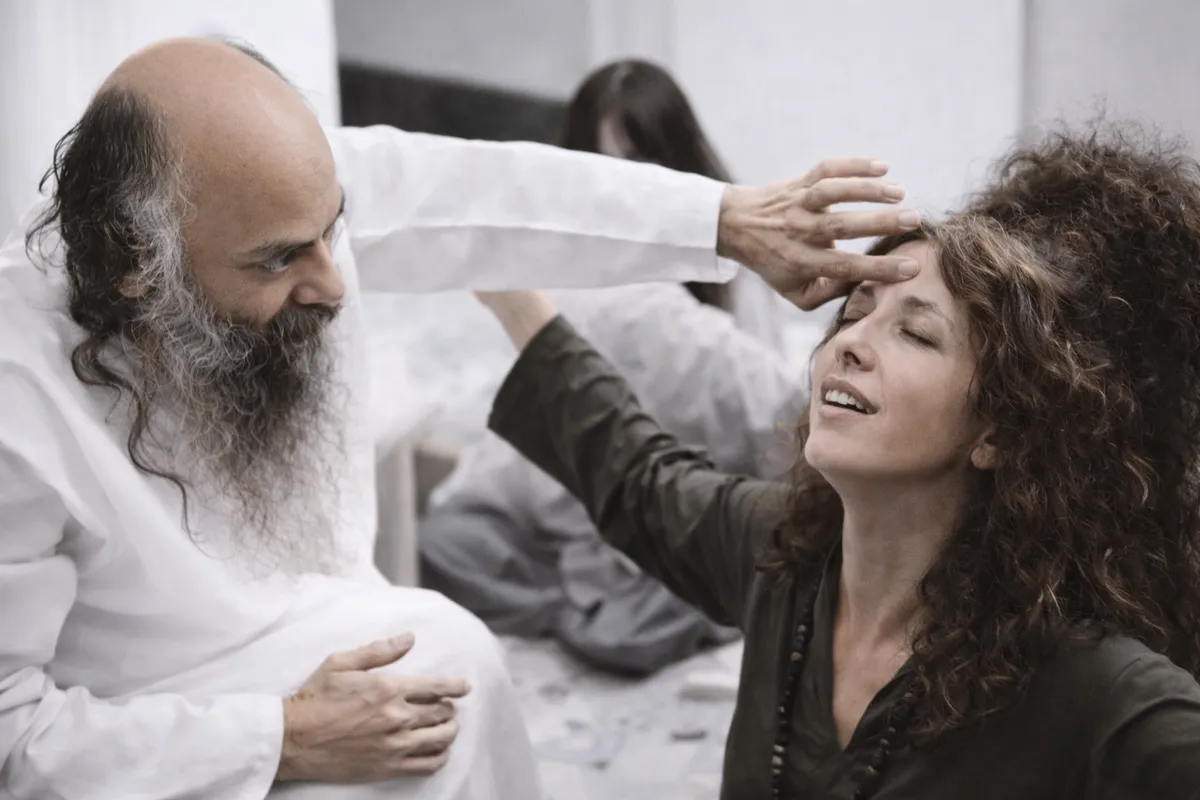
Switching brains won’t make you awakened; only your inner awareness changes you, and the brain follows that.
From the Discourses
Passages where Osho speaks to this question — each links to the complete discourse.
Beloved Osho, if the brain of an enlightened man was transplanted into an ordinary man, would he start behaving like an enlightened man? Would he experience enlightenment?
No, because the brain has nothing to do with enlightenment. If you put the enlightened man's brain into some unenlightened man's body, he will not behave like the enlightened man. He will simply behave the way he had been behaving. Perhaps for a few days he will be in a little difficulty, but soon he will get adjusted. The brain has to be adjusted to the soul, not vice versa.
Beloved Osho, you spoke of transplanting the brain of geniuses like einstein into the body of a young man. But if einstein wanted to be a plumber instead of a scientist, and we transplanted his brain, have we not done something against his wishes? He could be stuck on earth for another seventy years, possibly against his choice. Can you say something about this?
He became aware that it is not LSD that creates paradise. LSD does not create anything, it is simply a magnifying glass. So the same flower looks more beautiful, a thousand times more beautiful; the same fragrance is now so dense and overpowering. But a man who is miserable, a man who is continuously down in the dumps, will find himself in the darkest hole ever. That's why Aldous Huxley wrote a book and named it HEAVEN AND HELL. It is a book about LSD. Your soul remains unaffected. When LSD has run out of your physical system, you are back home, the same miserable person you have been before, or the same joyous person you have been before. But the experience of two or three days under LSD changes many of your ideas. Aldous Huxley himself was so much impressed that he thought all the mystics who have experienced…
Osho, what is the difference between surrender and blind imitation?
So be careful: the freedom you allow yourself, allow the other too. You have no right to judge another as blindly credulous or as a surrendered being. Drop that concern. You cannot judge anyway—how will you enter another’s heart? How will you know? Think only about yourself. See within whether, up to now, you have lived by blind belief or by surrender. Decide only there; leave worrying about others. Otherwise, all your judgments will be wrong. Jesus said: Judge not; do not set yourself up as a judge in relation to another. To the friend who has asked: if you are asking for yourself, good. Drop worrying about others. Look within and see: whatever I have been clinging to till now—have I ever staked my life to hold it? Have I meditated for it? Have I loved for it? Or am I just clutching what culture, society, civilization handed me?…
Beloved Osho, in the sixties and seventies neurologists became very interested in an area of the brain stem called the "reticular formation." it is said that this is the area that filters input into the brain while we are asleep. Thus, a mother sleeps through all sorts of noises, but wakes the instant her child cries -- this function was said to be achieved by the reticular formation. It seems that during sleep there is one element within us which remains awake. Does witnessing have any relationship to this phenomenon? Does witnessing belong to a part of the brain?
It is recorded that Buddha never changed his posture in sleep; he would sleep in the same posture the whole night. His disciple, Ananda, was puzzled. Many times he would wake up and look, and he could not believe how Buddha managed. In sleep you cannot manage to keep the same posture. People cannot even manage the same posture while they are awake; there is so much restlessness that they have to turn this way and that. But in sleep you are unconscious... One day Ananda finally asked, "How do you manage the same posture the whole night long?" Buddha said, "You will understand one day when you become enlightened. I will give you the answer but it will be difficult for you to grasp it. I simply rest, I don't sleep. Since the day I became awakened, sleep has disappeared." Other things may be disturbed in the bodies of…
When one becomes empty of all thoughts, empty of all plannings, empty of all desires, what transformation will happen in one's outer life and one's inner life? How will he behave? How will he see things? How will he live in the world? Please say.
IT depends, it depends on the individual. There cannot be any dogmatic statement about it because each individual is so unique. When Basho becomes enlightened he starts singing poetry, poems; Buddha has never done that. When Krishna becomes enlightened he starts dancing, singing; Mahavir has never done that. When Mahavir becomes enlightened he keeps silence for many years, remains absolutely silent, not a ripple is allowed; Meera has not done that. When she becomes enlightened, she dances from village to village, she sings the glory of God. It is very difficult to make a dogmatic statement. There have been people who renounced life when they became enlightened and went to the Himalayas, moved as far away from the society as possible. There have been people who became enlightened and came back to the world, even if they had been in the Himalayas, and started living with people again. There have…