
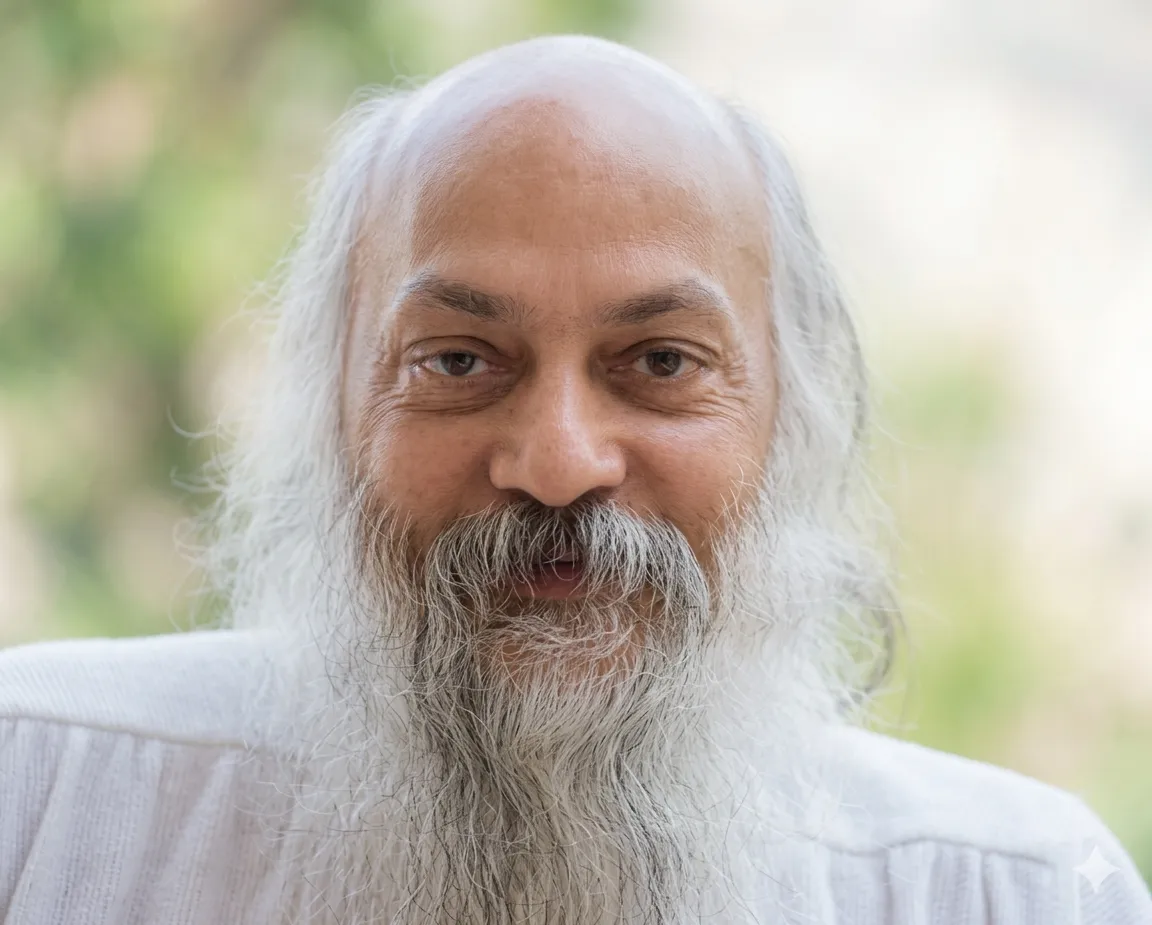
According to Osho, austerity isn’t a technique to reach meditation; meditation itself is true austerity. When awareness deepens, non-essentials fall away on their own—then fasting or renunciation “happens” effortlessly and joyfully. Forced austerities only feed ego and suffering. So don’t ‘do’ tapas; awaken awareness. Let simplicity arise as a natural byproduct, not a goal.
Don’t force hard practices; just meditate, and the wish to drop unnecessary things will come naturally.
From the Discourses
Passages where Osho speaks to this question — each links to the complete discourse.
How helpful is austerity in practicing meditation?
In my view there is only one austerity: create awareness. Break the stupor. Dissolve the mind’s whirl and alternatives. Bring about unmodified, thought-free samadhi. And as a consequence, the changes that come will be visible to others as “austerity.” Take Mahavira, for example. People beat him, struck him, tormented him. We think, “How much he endured! What an ascetic!” We imagine because we put ourselves in his place: if people beat us and we had to refrain from striking back, how hard it would be—what austerity! As for Mahavira, he would only be astonished: “What pain must these poor souls be in that they have become bent on beating?” There was a monk in Uttar Pradesh whom many people revered; great kings would serve him. A certain king gifted him many golden vessels—an entire sackful. The hut had not even a latch. At night a thief came to carry it…
A friend has asked: Osho, is austerity needed in spiritual practice or not?
What I am telling you—purification of body, purification of thought, purification of feeling; emptiness of body, emptiness of thought, emptiness of feeling—this is austerity. What do people think austerity is? A man standing in the blazing sun—“he is doing austerity!” Someone lying on thorns—“he is doing austerity!” Someone sitting hungry—“he is doing austerity!” Our concept of austerity is extremely materialistic, very physical. For us, austerity means tormenting the body. If someone inflicts pain on the body, we say he is practicing austerity. But austerity has nothing to do with bodily torture. Austerity is something wondrous; it is something altogether different. A man is fasting. We think he is practicing austerity. He is merely starving. And I would even say he is not fasting at all; he is simply without food. Being without food, not eating, is one thing; being in upavasa is quite another. Upavasa means dwelling near the divine.…
1. Kriya-yoga is a practical, preliminary yoga, and it is composed of austerity, self-study and surrender to god. 2. The practice of kriya-yoga reduces misery, and leads towards samadhi.
3. MISERIES ARE CAUSED BY: LACK OF AWARENESS, EGOISM, ATTRACTIONS, REPULSIONS, CLINGING TO LIFE AND FEAR OF DEATH. 4. WHETHER THEY BE IN THE STATES OF DORMANCY, ATTENUATION, ALTERATION OR EXPANSION, IT IS THROUGH LACK OF AWARENESS THAT THE OTHER CAUSES OF MISERY ARE ABLE TO OPERATE. What is the trouble with man? The trouble is that he thinks that for enjoyment certain conditions have to be fulfilled first; this is the trouble. To enjoy life in fact no conditions are to be fulfilled; it is an unconditional invitation. But man thinks that certain conditions have to be fulfilled first; only then can he en. joy life. This is the complex mind. The simple mind feels that one has to enjoy whatsoever is available. Enjoy it! No conditions are to be fulfilled. And the more you enjoy this moment, the more capable you become of enjoying the next. The capacity…
Verse (Sanskrit): देवद्विजगुरुप्राज्ञपूजनं शौचमार्जवम्। ब्रह्मचर्यमहिंसा च शारीरं तप उच्यते।। 14।। अनुद्वेगकरं वाक्यं सत्यं प्रियहितं च यत्। स्वाध्यायाभ्यसनं चैव वाङ्मयं तप उच्यते।। 15।। मनःप्रसादः सौम्यत्वं मौनमात्मविनिग्रहः। भावसंशुद्धिरित्येतत्तपो मानसमुच्यते।। 16।। Transliteration: devadvijaguruprājñapūjanaṃ śaucamārjavam| brahmacaryamahiṃsā ca śārīraṃ tapa ucyate|| 14|| anudvegakaraṃ vākyaṃ satyaṃ priyahitaṃ ca yat| svādhyāyābhyasanaṃ caiva vāṅmayaṃ tapa ucyate|| 15|| manaḥprasādaḥ saumyatvaṃ maunamātmavinigrahaḥ| bhāvasaṃśuddhirityetattapo mānasamucyate|| 16|| Translation: Reverence for gods, the twice-born, teachers, and the wise; purity and straightforwardness. Continence and non-violence—this is called austerity of the body. ।। 14।। Speech that causes no agitation, truthful, pleasing, and beneficial. And the devoted practice of self-study—this is called austerity of speech. ।। 15।। Serenity of mind, gentleness, silence, self-mastery. Purity of heart—this is called austerity of the mind. ।। 16।। Now the sutra: “And also, O Arjuna, the worship of the gods, twice-born, teachers and the wise; purity, simplicity, celibacy, and nonviolence—this is called austerity of the body.
You can fast much—but your fasting should go to fill someone’s belly. You can become utterly poor—but that has no value. Your poverty should become a means to enrich someone; then the circle is complete. And then the tumult of the senses quiets as it never can through mere suppression. Sacrifice, self-study, austerity, and simplicity of heart along with purity of body and senses. Yajna (sacrifice) is the name of a scientific process. We know its outer form; but the outer is symbolic. Through outer symbol something inner is being conveyed. Yajna is a technique, a method—how to kindle the inner fire and how to burn myself to ashes in that fire. Life is a play of fire. You too are a form of fire. Food is digested, blood formed, blood runs, the heart beats, breath moves—fire’s play. If the body loses fire, everything is lost.