
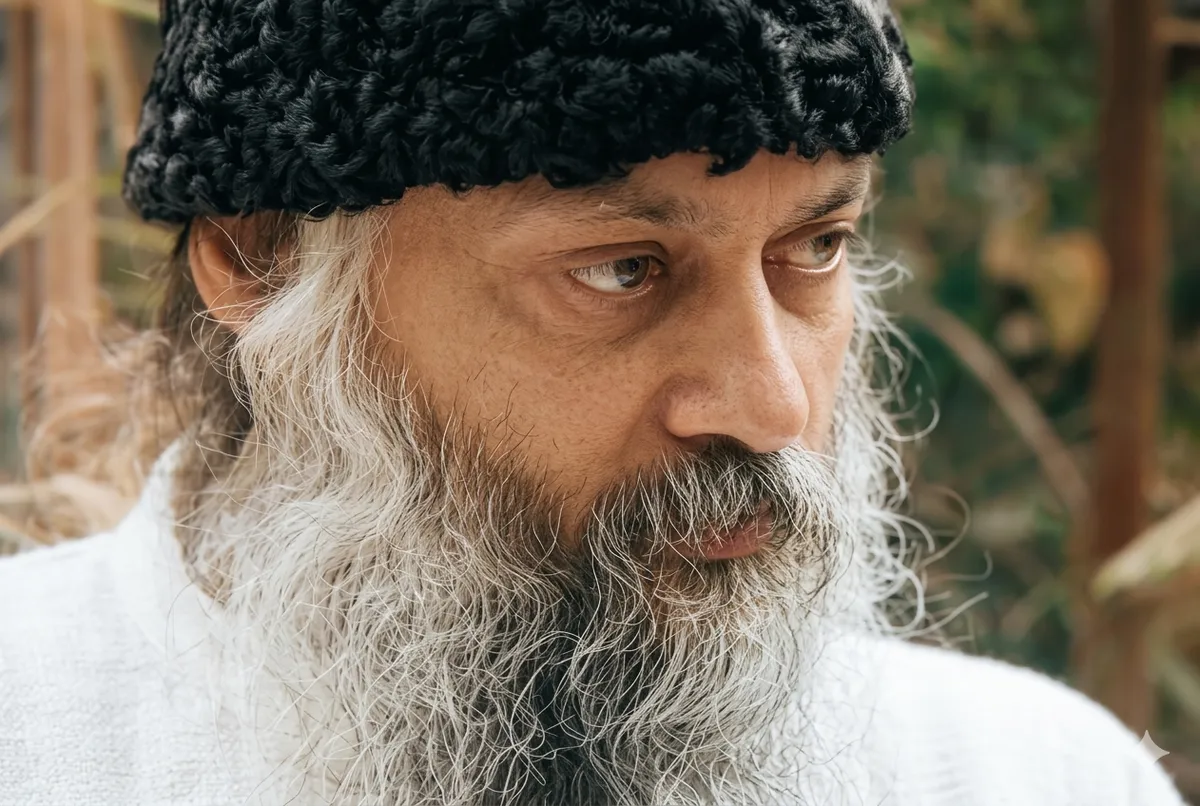
Give everything inside you—the good and the bad—to the master; by hiding nothing, you move beyond your inner tug-of-war.
From the Discourses
Passages where Osho speaks to this question — each links to the complete discourse.
Osho, yesterday you said that jealousy is included in respect. I have immense respect for you, but the jealousy inherent in it keeps poisoning it, and I feel guilt and pain. Does reverence transcend this poison-laced respect?
It needs a little explaining—it's a delicate point. Whenever you respect someone, you do so because you see in that person something you do not have. You respect because you glimpse in the other something you would also like to possess. A beggar respects an emperor because he, too, longs to be an emperor. So on the one hand he respects, and inside he also envies. Because he is not yet an emperor but wants to be. You have attained what he wants to attain. He respects you as skillful, successful: “I stand far back in the line; you have gone ahead to where I should have been.” So you are powerful, clever, intelligent, strong—he respects you. But inside a fire of jealousy also burns—if he gets the chance, he would like to be in your place and push you aside. And if the beggar gets that chance, he will…
तीसरा प्रश्न: ओशो, आपने कल कहा, आदर में ईर्ष्या सम्मिलित है। आपके प्रति मुझमें अपार आदर है, लेकिन उसमें निहित ईर्ष्या उसमें जहर घोलती रहती है और मैं ग्लानि और पीड़ा का अनुभव करता हूं। क्या श्रद्धा इस विष-भरे आदर का अतिक्रमण करती है?
भिखारी सम्राट का आदर करता है, क्योंकि उसकी भी आकांक्षा है कि सम्राट हो। तो एक तरफ आदर भी करता है, भीतर ईर्ष्या भी करता है। क्योंकि सम्राट अभी वह है नहीं, सम्राट होना चाहता है। तुम हो गए हो, तुमने वह पा लिया है जो वह पाना चाहता है। इसलिए तुम्हें आदर भी करता है कि तुम कुशल हो, सफल हो, मैं पंक्ति में बहुत पीछे खड़ा हूं, तुम आगे पहुंच गए हो, तुम उस जगह पहुंच गए हो जहां मुझे होना चाहिए था। इसलिए तुम शक्तिशाली हो, होशियार हो, बुद्धिमान हो, बलशाली हो, तुम्हारा आदर करता हूं। लेकिन एक भीतर ईर्ष्या की आग भी जलती है--अगर मुझे मौका मिले तो उस जगह मैं होना चाहूंगा, तुम्हें हटाना चाहूंगा। और जब मौका मिल जाएगा इस भिखारी को तो यह सम्राट को हटा कर धक्का दे देगा, सिंहासन पर बैठ जाएगा।
Beloved Osho, yesterday you explained that pranayam is the method which expands the bio-energy and pratyahar is to return to the original source. First it is expansion, then it is return to the source. Why is it so?
Because life is made of contradiction and there is no other way for life to exist. Breath goes out, then goes in -- did you ever ask why it is so? When the breath has to go in then why is it taken out? But if the breath remains in and does not come out then the result will be death and not life. If the breath remains out and does not go in, even then it will be death and not life. Life is movement, movement between two opposites. It is like the flowing of a river between two banks. Breath goes out, goes in; comes in then goes out. Every moment it is pranayam and every moment it is pratyahar. When breath goes out it is pranayam; when the breath goes in, it is pratyahar. If your consciousness gets used to this type of rhythm, if this type…
Beloved Osho, to be disobedient and to surrender seem to me polar opposites. Please explain how the two can be lived.
They are not polar opposites. Just a little awareness.... Be disobedient to your ego -- that is the meaning of surrender. If you want to be disobedient to the person you are surrendering to, then they are opposite, polar opposites. Then why surrender? Surrender simply means you trust the person more than your ego, you trust the person more than your own mind. Surrender happens only in a situation where you have found someone whom you can trust more than you can trust yourself. Then disobey your ego. But people never think in that way. They never think of disobeying their ego, they are always disobeying others. And they don't understand that disobeying others may be just obeying their own ego. This is what has happened with J. Krishnamurti. For his whole life he has been a teacher of thousands of people, telling them to disobey, to be rebellious, not…
So to me, surrender and will are not opposites. Surrender is the final crescendo. So nothing to be worried about. With me, opposites are not opposites but complementaries -- that has to be always remembered. Whenever you are creating some division and thinking in terms of opposites, always remember that my insistence is that there are no opposites, everything is complementary. It is only great will that makes it possible for surrender to happen. They are not against each other. So don't create any conflict and don't start thinking, 'What is my way: will or surrender?' Wherever you are and whatsoever you are, learn to accept it. If there is will, good -- you have to grow your will. One day when a grown-up will is there, a mature will is there, you will see -- now the ripe will wants to fall like a ripe fruit.
Osho, I doubt my surrender. Does complete surrender have to be done by the disciple alone, or does it happen in the disciple with the master’s support? Please guide us in this direction.
Everyone doubts surrender, because you try to do surrender by thinking it through. Whatever you do by thinking and rethinking will carry doubt. If there were no doubt, why would you be thinking at all? Then surrender is a leap—a quantum leap. Then you don’t do it by thinking. Then surrender is like a kind of madness, an ecstasy, a state of being possessed... a revolution of trust happens! But such a revolution happens to one in a hundred; ninety-nine do it by thinking. So when you do it by thinking, what you have thought and decided—though it may be a majority decision—is parliamentary. You thought a lot and found: sixty percent of the mind testifies for surrender, forty percent does not. You say, “All right, now a decision can be taken.” But it is parliamentary. That forty percent that was not willing can at any time break off some…
पांचवां प्रश्न: ओशो, मुझे अपने समर्पण पर शक होता है। क्या पूरा समर्पण शिष्य को ही करना होगा, या कि गुरु के सहयोग से वह शिष्य में घटित होता है? कृपया इस दिशा में हमें उपदेश करें।
समर्पण पर शक सभी को होता है, क्योंकि समर्पण तुम सोच-सोच कर करते हो। जो तुम सोच-सोच कर करते हो, उसमें शक तो रहेगा। शक न होता तो सोचते ही क्यों? तब समर्पण एक छलांग होता है--क्वांटम छलांग। तब तुम सोच कर नहीं करते। तब समर्पण एक पागलपन जैसा होता है, एक उन्माद की अवस्था होती है। तुम ऐसे भावाविष्ट हो जाते हो...एक श्रद्धा की क्रांति घटती है! लेकिन ऐसी क्रांति तो कभी सौ में एक को घटती है; निन्यानबे तो सोच कर ही करते हैं। इसलिए जब तुम सोच कर करोगे, तो वह जो तुमने सोचा है बार-बार, वह जो तुमने निर्णय लिया है, वह चाहे बहुमत का निर्णय हो, लेकिन है पार्लियामेंट्री। तुमने बहुत सोचा, तुमने पाया: साठ प्रतिशत मन गवाही है समर्पण के लिए, चालीस प्रतिशत गवाही नहीं। तुमने कहा, अब ठीक है, अब निर्णय लिया जा सकता है। लेकिन यह पार्लियामेंट्री है। वह जो चालीस प्रतिशत राजी नहीं था, वह कभी भी कुछ सदस्यों को फोड़ ले सकता है। …