
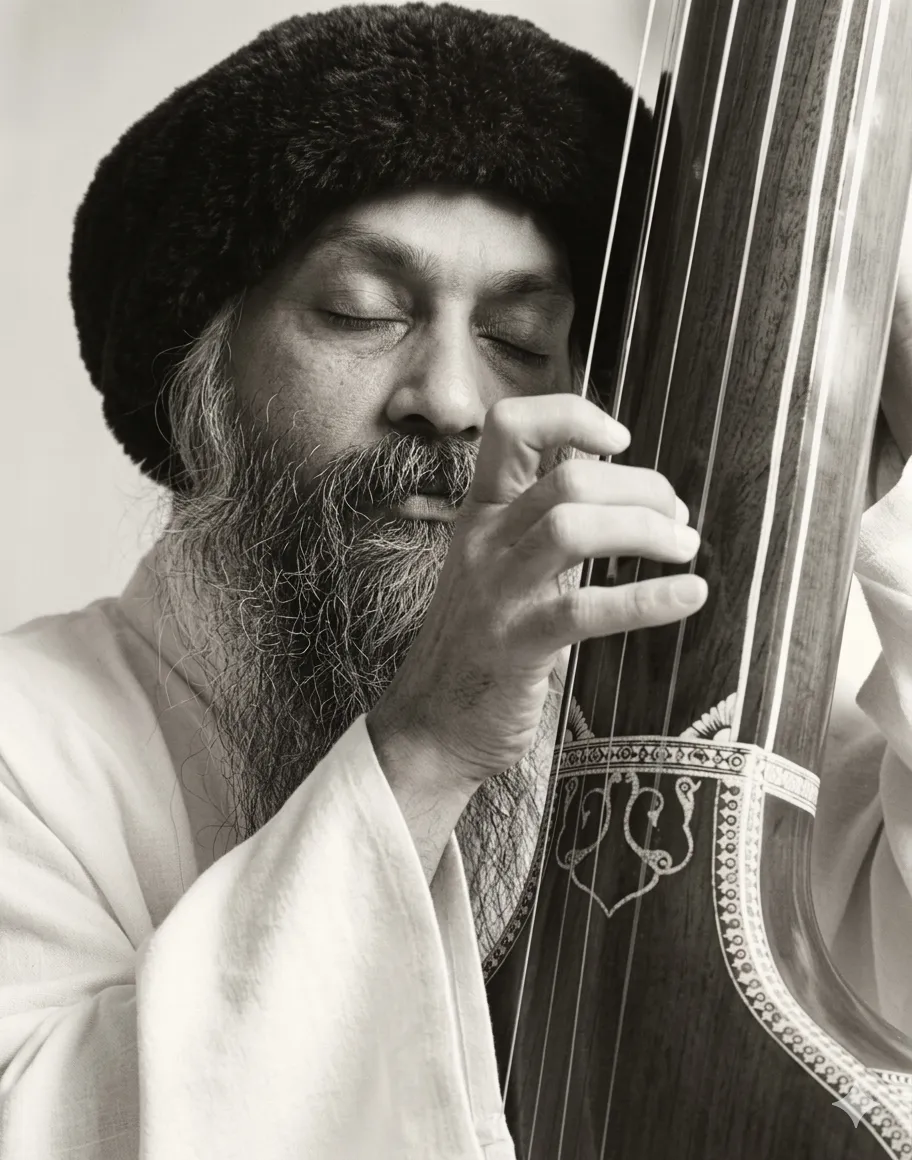
You’ll know me if my words make your life and yourself look clearer, not because of titles or proofs.
From the Discourses
Passages where Osho speaks to this question — each links to the complete discourse.
How can I see you, how can I recognize you, Osho?
An ancient saying: When the sun rises we know this, not by staring at it, but because we can see everything ELSE clearly. HOW DO YOU RECOGNIZE THE SUN? You don't stare at the sun -- you look at the trees, you look at the people... you look all around: everything is so clear. Because everything is so clear, you know the sun has risen. The only way to see me is if I can help you to see clearly around yourself. That's what I am doing here: making things clear, giving you a clarity, sorting things out, putting things in their right places, giving you vision and insight. The day you can see things clearly -- your desires, your greed, your anger, your rages, your violence, your misery -- the day you can see that it is you who are creating all this hell, the day you can see…
Question: BELOVED OSHO, WHY IS IT SO DIFFICULT TO RECOGNIZE YOU? Prem Cordula, it is a simple phenomenon: you can recognize only that which comes within your experience. How can you recognize something which you have not experienced? What I am saying to you and what I am being to you is something utterly unknown to you -- not only unknown, but much of it is unknowable too. Recognition needs some experience within you to coincide with my experience. Those who are falling in tune with me, recognize me, and only they can recognize; it is not for all. It is only for the disciples to have a glimpse of recognition and it is only for the devotees to be absolutely certain of the recognition. But many of you have come here only as students searching for more knowledge, and I am imparting being, not knowledge.
Beloved Osho, although nothing is really clear to me, how can it be so clear to me that the truth is in you? I don't know it, but I see it in your eyes. I feel it in your being.
It is one of the most fundamental questions. One does not know what truth is. But when one comes across it, a few things become clear: that whatever he has believed up to now was not truth, because it has not given him this depth in the eyes, this silence in his presence, this authority in his words, this poetry to his life. The false is barren. So although you do not know what is true, when you come across truth, you immediately know what is false. And if you understand what is false, a vague insight into truth starts arising in you. Because the truth that you see in my eyes is also in your eyes, just asleep. You have never awakened it. Let the false go, and your eyes will have the same truth. Your words will have the same music, your presence will have the same charisma.…
Question: OSHO, WILL I ONLY RECOGNIZE YOU WHEN I AM ENLIGHTENED? RECOGNITION IS POSSIBLE even before enlightenment, but it will remain vague; it will remain hidden behind a mist. Just as in the early morning, a winter morning, you can see that somebody is coming, but who he is you cannot exactly say. Something you can figure out, that a man is coming or a woman, but the mist is thick and it is difficult to figure out who the person is exactly. This type of recognition is possible; without it there will be no possibility of a Master and a disciple. How does one become a disciple? A vague recognition, a fragrance that has touched you, a love that has moved your heart, something of the beyond. It is a feeling, it is not knowing. You cannot be absolutely certain about it; it is mysterious.
Osho, even after seeing you again and again it still feels as if I have not seen! How can I see so that the image truly descends?
And you will find that same irritation in every human being. Everyone is irritated. Look closely; there often aren’t even clear reasons for the irritation! Even on a day when there is no obvious cause for sorrow in your life, still there is a vexation. It feels as if something is missing. Something was to happen that is not happening. You cannot grasp it clearly; the cause slips from your fist—why am I annoyed, why am I irritated? It seems unreasonable. And since we cannot tolerate the unreasonable, we find some pretext. The husband snaps at the wife—why is the bread burnt today? Why isn’t the water cool? The wife snaps at the children—why did you come late from school? Children tear their books. Irritation passes from one to another. And the real cause is only this: even if there were no cause for sorrow in your life, you would…
दूसरा प्रश्न: ओशो, उस दिन आपको गोली मारने की बात सुनते ही मैं रोती रही। ऐसे तो मैं कभी जिंदगी में किसी की मौत पर भी नहीं रोई! अब तो सिर्फ आपकी मौत की बात सुनते ही कांप उठती हूं। क्यों? कृपया समझाइए।
जरा प्रेमियों को तो देखो: लड़ते-झगड़ते ज्यादा हैं, प्रेम वगैरह कहां! धीरे-धीरे उसी लड़ने-झगड़ने को प्रेम समझने लगते हैं। फिर किसी दिन वह लड़ना-झगड़ना न हो तो खाली-खालीपन लगता है, तलब पैदा होती है। पत्नी मायके चली जाए तो एक-दो दिन अच्छा लगता है, फिर तलब पैदा होती है। तलब किस बात की? तलब इस बात की कि कोई झगड़ा न कोई झांसा। घर में बैठे हैं बुद्धू की तरह। अब उसी अखबार को कितनी बार पढ़ो! पत्नी होती तो कोई रंग निकलता। बात में से बात उठती। थोड़ा घर में शोरगुल रहता। थोड़ी आवाज होती। थोड़े बर्तन बजते। …