
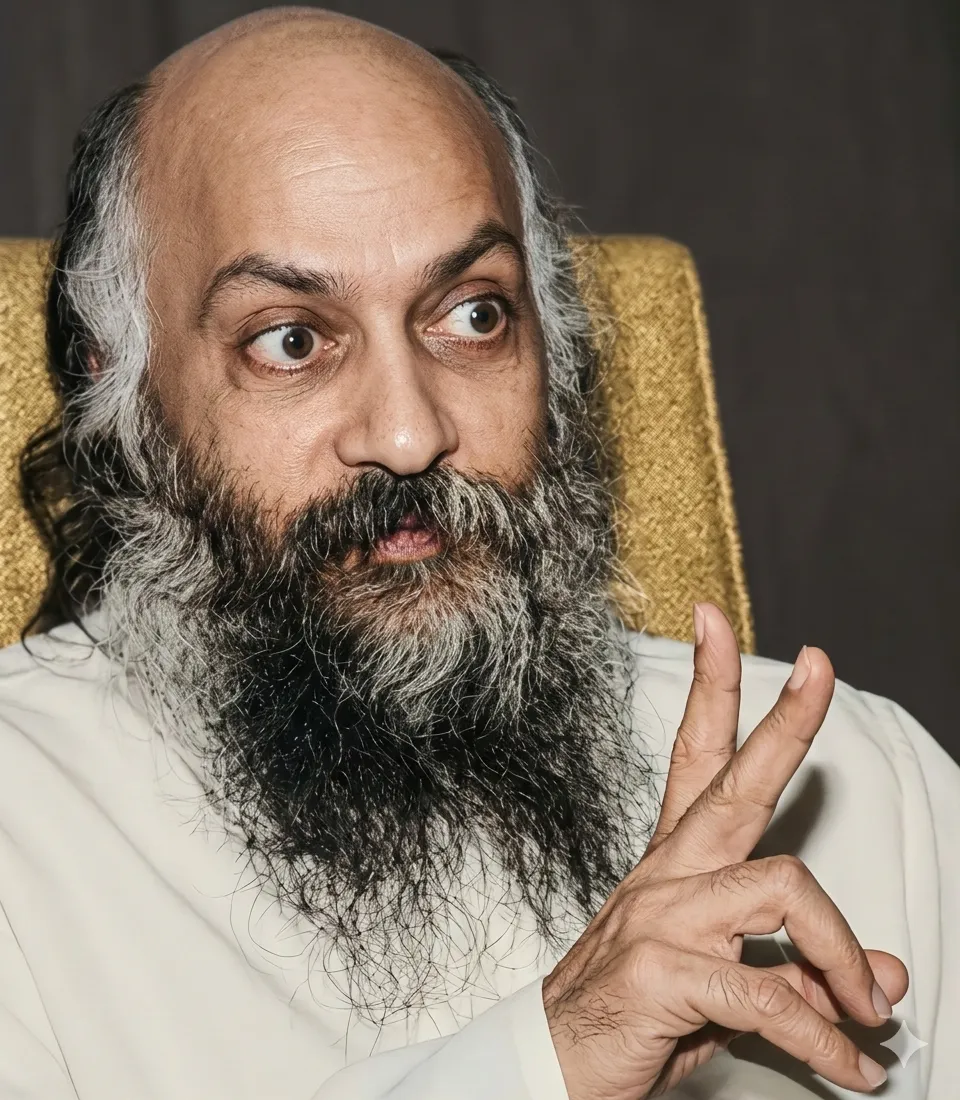
It's like you're dreaming you're far away while you're actually home; stop clinging to the dream, wake up, and you'll see you're already there.
From the Discourses
Passages where Osho speaks to this question — each links to the complete discourse.
Today you said that the way to enlightenment is long and arduous, and also that it is here and now, now or never. As it is herenow, how can it be long and arduous?
That's why it is long and arduous -- because you are not here-now. You are far away from here now. You will have to come, you will have to journey. When I say truth is not far away, I mean TRUTH is here-now -- I don't mean you are not far away from truth. You ARE far away from truth. Truth is not far away from you, God cannot be far away from you. God exists in you as you. God exists as eternity, not as past or future. God simply is. How can God be far away? There is not place for him to be far away. He is all over the place. He is everywhere... in your breathing, in your heartbeat. But you are not here. God has not gone away: you have gone away from him. You have to understand this. For example, in the night you…
Osho, are surrender and enlightenment simultaneous events? If yes, then what does it indicate when even a surrendered disciple has to pass through years and years of practice?
A neighbor got tired of hearing this. A joke occurred to him: he will not take less than a hundred—there is no risk. So he put ninety-nine rupees in a pouch and, while Mulla was praying “I won’t take less than a hundred,” climbed up onto the roof and dropped the pouch through the thatch. The pouch fell. Mulla said, “Fine. First I’ll count. I never take less than a hundred.” He opened the pouch, counted—there were ninety-nine. He said, “Ah, You are quite the trickster—you deducted one rupee for the pouch. No problem.” Now the neighbor was worried. He had only intended a prank. But Mulla was saying, “You’ve cut one rupee for the pouch—no harm, it’s business, it makes sense.” If such a God even comes, wearing a peacock crown and standing at your door, understand an actor has slipped away from a play. Or a circus performer…
Beloved Osho, what is enlightenment? Have the experience and the idea of enlightenment evolved with time?
So nirvana is just like darkness. The light is put off and your reality is all there, with all its beauty, benediction, blessing. But there is no word in English to translate nirvana. Jainas use the word moksha. Moksha means absolute freedom, ultimate freedom, freedom from all fetters. And the biggest fetter is the ego. Other fetters are just parts of the ego: greed, lust, ambition, anger. All that is thought to be sin in other religions, in Jainism is thought only to be a fetter. But the root, the main root of the whole tree of your slavery, is the ego. So cut the main root and all other roots will die of their own accord. Don't bother to cut small roots, branches, leaves, because they will come again. Cut the main root and the whole tree will die. And when all your fetters fall, what remains? The unfettered…
Osho, seekers have always observed that God-realization is an extremely arduous event. But enlightened ones like you have always emphasized that the divine can happen here and now. Is saying this again and again a challenge and a way to make people try—a method, a device?
He began to beg. Twenty years passed. He forgot. If someone begs for twenty years, to keep remembering “I am a prince” would be impossible, painful; it would make begging difficult. So it is only fitting that he forgot. He had to forget, otherwise how could he beg? A prince—and he begs? Door to door, standing with a begging bowl at thresholds! Begging outside hotels and restaurants, asking for leftovers! A prince! He had to forget the prince entirely, had to consign it to oblivion. That chapter was closed. As if it had been some dream, some story read, a film seen—what did it have to do with him? After twenty years, when the emperor—his father—grew old, he became anxious: there was only one son! He alone was the heir. He told his ministers: Go find him, and wherever he is, bring him back. Tell him his father has forgiven…
Beloved Osho, it has always been the observation of seekers that the realization of godliness is a very arduous phenomenon. But enlightened ones like you always emphasize that it can happen right here, right now. Is saying this again and again a provocation? And a method or device to arouse thirst in us?
Don't laugh, because most people are just like Chinmaya. Don't think that your laughing proves that you are different than Chinmaya. Chinmaya at least got up the courage to ask -- you didn't even ask. This is the only difference. You are just like him. If you haven't become God by the time the Ashtavakra Gita discourses are over, then know: there is no difference, you are just like him. But if while listening you wake up and become God, then just the shadow of the whip has worked. "It has always been the observation of seekers that the realization of God is a very arduous phenomenon." The seeker is off track from the very beginning. The very meaning of seeker assumes that God has to be sought, that he has lost God somewhere. The seeker accepts that he has lost the divine somewhere. What a strange idea. He has…