
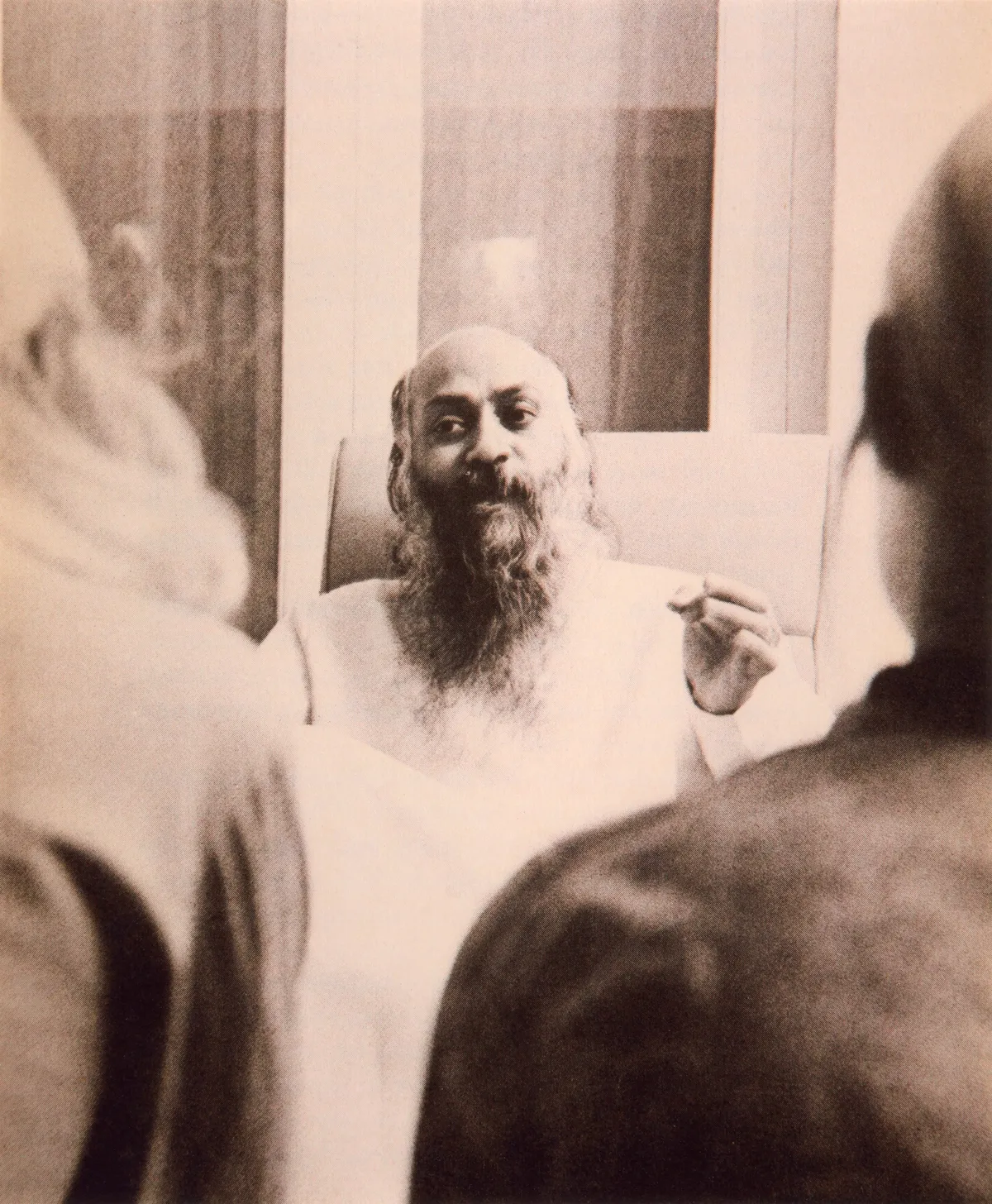
Real worship isn’t rituals; it’s staying near a true teacher so you remember the Divine and live it.
From the Discourses
Passages where Osho speaks to this question — each links to the complete discourse.
Osho, does worship have no value at all? And if it does have value, then why oppose it?
But this is exactly your condition at the crossroads of life. From where do you come? Who are you? Where are you going? What is the purpose of your being? No—there is not even the leisure to think of such things. Worship means: to sit near someone, in someone’s presence, where these matters are pondered, contemplated, meditated upon; where life’s fundamental questions pierce your very being like arrows. Therefore worship—lest you forget! You asked: Does worship have no value at all? It has value; but what you take to be worship has no value. What is your worship? You go to the temple, hastily ring the bell, knock your head before a stone idol, and run! You have done this so many times—what has it given you? Worshipping stones, you often become stone-like. Naturally so. You become like what you worship. So choose your object of worship carefully, for the…
Beloved master, we have dropped the word "work" because of its ugly connotations. Please say something about the word "worship" and its connotations.
"So just remember that their intention was good, although they did not care about your individuality, your freedom, your choice. They had taken it for granted that you are their possession. Forgive them, they are dead. Don't be angry and don't be sad. Start." He said, "You really mean that I can start?" I said, "I really mean it. And I know a musician, I will introduce you." He lived fifteen years more and died a very contented man, although he never became a famous musician. Nobody ever heard that he is a celebrity as far as music is concerned. His music remained not very developed, because Indian music particularly needs tremendous effort: eight to ten hours' practice every day, a lifelong discipline; only then can you create those subtle nuances. It is not jazz; that, any idiot can do. It is said that if the Indian musician does not…
Osho, I have been worshiping for years, yet nothing has come of it. I have done pilgrimages, fasts, journeys—everything—but fruitlessly. Will I go on living like this without purpose, and die without purpose too?
The crown of fire kept preening itself, the road kept gazing for the dawn; but the lamp’s ardor came apart, the oil of love ran out, the flame shivered. The lamp, distressed, began to plead, and the clay began to call: If one store of oil runs dry, a new stream of love is needed! If a string snaps again and again, the lute needs a new string! The bird flew, straw in its beak, with an unshakable vow of love; but angry storms grew restive, scattered the straw, crushed the nest. The bird was plundered, night closed in, yet the dawn began to call: If a nest is broken and torn, the branch needs a new adornment. If a string snaps again and again, the lute needs a new string! The life-breath lingered in the realm of dreams, the eyes remained given to sleep; then suddenly the heart throbbed,…
Osho, even with a living master present, in our country the dead are worshipped. Is this our misfortune, our foolishness, or our downfall?
Satya Prem! Neither misfortune, nor foolishness, nor downfall. It has always been so. This has been man’s way. It is built into the very mode of human being. It is an inevitable part of man’s unconsciousness. You can worship the dead; with the living you have to be transformed. Worship won’t do. Worship is a trick to avoid, a device, a politics. The most cultured way to avoid someone is to worship him. Offer a couple of flowers at his feet and be free—and remain exactly as you were. And you even take the inner pleasure of feeling you did something. In fact you did nothing. The flowers belonged to the trees; they were already dedicated to the divine. You plucked them and placed them on a stone idol or on a scripture. All flowers are already at the feet of the divine. All the birds’ songs are prayers unto…
Osho, are you in favor of hero-worship? Does hero-worship bring understanding or exaggeration?
Third, I oppose it because hidden within the feeling of worship is the notion that someone else will do something for me. That through worship, something will be done for me. If I worship Rama, Rama will do something for me. If I call out to Christ, Christ will do something for me. In this world, no one can do anything for anyone else. And those who get the idea that someone else will do something for them become deprived of what they themselves could have done. They fall into deep laziness and negligence. All devotees, all worshipers, ultimately fall into inertia; they themselves do nothing. They say, “There is God, there is the guru, there is the tirthankara, the avatar—when he does it, it will happen.” Unknowingly, what they could have done becomes impossible, because their mind clings to a prop: someone will do it. Fourth and finally, I…