
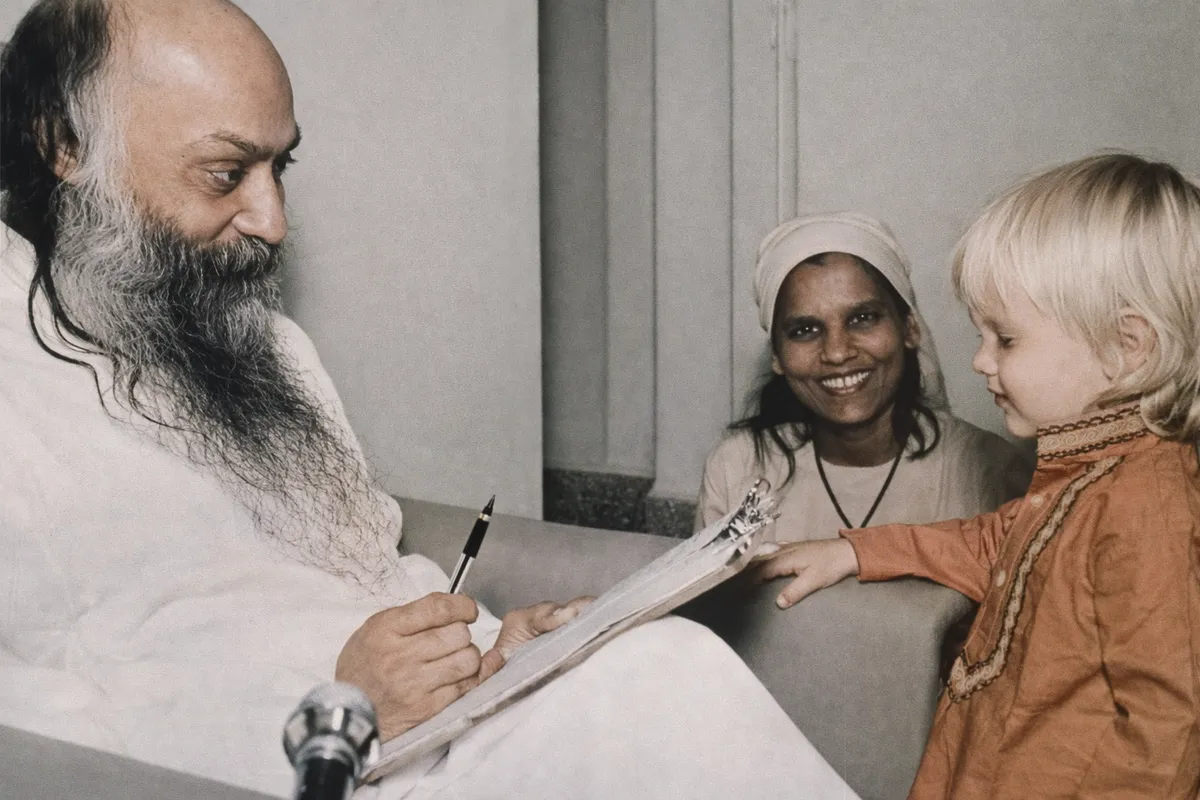
At first your busy mind hates being put aside, so don’t fight it—just gently watch it; once you awaken, it will cooperate and serve you.
From the Discourses
Passages where Osho speaks to this question — each links to the complete discourse.
Question: Maneesha has asked: OUR BELOVED MASTER, LAST NIGHT I SAW FOR THE FIRST TIME THAT THE MIND NEED NOT BE INIMICAL TO MEDITATION. DOES WHAT YOU SAID ABOUT THE MIND ACCEPTING ENLIGHTENMENT ALSO APPLY TO ITS ACCEPTANCE BEFORE ENLIGHTENMENT, OF, FOR EXAMPLE, WITNESSING? CAN THE MIND ACKNOWLEDGE THAT WITNESSING IS OFTEN MORE USEFUL THAN THINKING, AND SO JUST STEP ASIDE IN THOSE MOMENTS WITHOUT THROWING A TANTRUM? Maneesha, it is impossible. Enlightenment has to be first. As an experience mind can understand it, and seeing its gracefulness in action can become a friend to it. But before enlightenment mind can only believe, it cannot become a friend. Mind can only believe that there is enlightenment. At the most the belief is possible -- but belief is of no use. The mind has to experience enlightenment in function, not as a belief but as activity.
But Osho, as I understand it, there are certain subjects like chemistry, physics, or medicine where positive values are essential. What are your views about that?
Einstein was doing an experiment. He had failed seven hundred times, yet every morning he came into the laboratory laughing, ready to begin again. The young assistant with him was exhausted. “Is this old man mad? Seven hundred failures—and again he starts fresh!” The youth was tired; he said, “We should drop this now. How many times have we been defeated?” Einstein said, “Defeated? You’re crazy—each time we have won.” “Where have we won? Every experiment has failed.” Einstein answered, “In seven hundred directions we have searched, and we now know truth is not there. We have succeeded seven hundred times. Truth is being endlessly eliminated into nearness. Suppose truth will reveal itself on the seven hundred and fifteenth attempt; then fourteen more eliminations are needed. Then only that will remain; it cannot escape. Where will it go? We have searched seven hundred paths and found it absent. That much…
Osho said that there was no need to try to still the mind, to stop the thoughts. He said that just as the traffic goes by and one remains on the sidewalk, unaffected, just a watcher, so one should simply witness the thoughts as they went by. We are not our thoughts, and recognising that we are the witness is enough. The very acceptance of the thoughts makes one more relaxed. The relaxation helps to create a distance, to separate oneself. To evaluate a thought as good or bad means that you are attached to your thoughts -- so one should not put labels on them.] ... put yourself aside, sit under a tree, and just watch the traffic. Soon, one day, the traffic disappears and the road is empty. Suddenly there is an interval and in that interval is meditation. But that interval cannot be created or cultivated.
Beloved Osho, you have told us that the mind becomes more and more quiet if we meditate regularly. Last year, when I was living in europe outside of a commune, thoughts became stronger and stronger during my meditations until I began to dread sitting. Now that I am with you again, this problem has gone away. But I wondered: how can one be a sannyasin for ten years, meditating every day, and have a mind which becomes more and more noisy?
Scientists say there is no reason for the body to die for at least three hundred years. It is just an old hypnosis, autohypnosis, which has made the idea prevalent that you have only seventy years to live. It goes so deep in your consciousness that by the seventieth year you start thinking you are sinking, you are gone. And anyway by the time you are retired at the age of sixty there is nothing to do. Death seems to be a relief, not a danger. We have not been capable enough and human enough to provide a situation where our old people can have some dignity, some self-respect, some pride. We have not been able to find dimensions where they can contribute to the world. And they are experienced and certainly capable of contributing enough -- enough for their self-respect, enough for them to live and not to feel…
Osho, for a few days my heart settles into meditation; then for a few days worship and bhajans flow. But I cannot concentrate anywhere. I am troubled by this state. Kindly guide and train me.
About three years later he was found in Paris learning painting. Reduced to a beggar’s state. His friends rushed there. “What have you done? You had everything—everything was fine.” He said, “That was the obstacle—everything was fine. But there was no exhilaration. Nowhere any surge. Everything ran fine, and I ran it fine—but no stream of rasa was flowing. “All my life I longed to be a painter. I never wanted to be a broker. That success was accidental. Now I am happy. I have nothing. I paint; if paintings sell, I manage food and clothes. I have not even a roof of my own. I live in a friend’s room. But I am not going back. I am happy.” And the friends saw that the man was filled with a strange energy, a strange aura. His body had thinned, but there was a light. He said, “Tell my wife…