
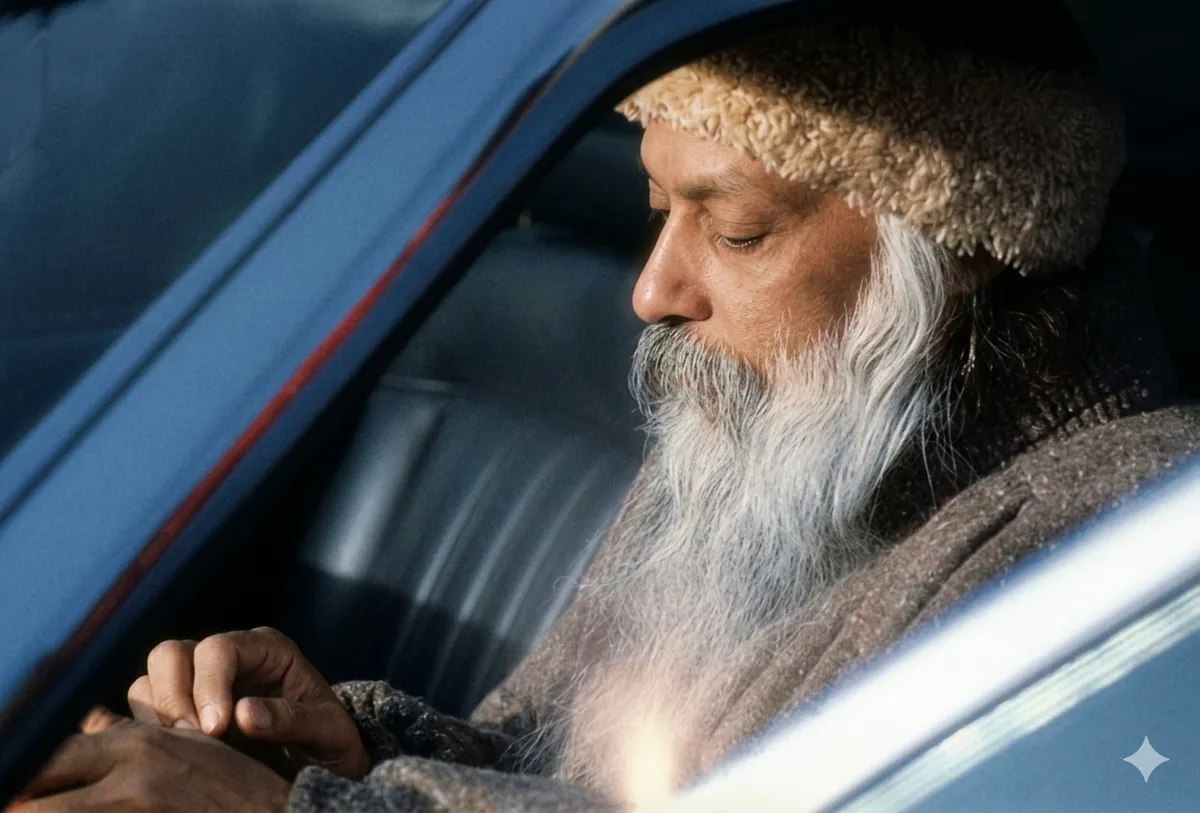
God is formless, and your deep love gives God a face inside you.
From the Discourses
Passages where Osho speaks to this question — each links to the complete discourse.
Osho, it is said, “bhaktya anuvritya.” Then devotion must be to a form. The sun is manifest with form in the sun realm; in the same way, why is God not with form?
Who said God is not with form? All forms are his. God has no form of his own. You are looking for God’s own form; that is why the question arises as to why God is not with form. In the tree, God is a tree; in the bird, a bird; in the waterfall, a waterfall; in a man, a man; in a stone, a stone; in a flower, a flower. If you look for God’s particular form, you will go on missing. The one to whom all forms belong cannot have a form of his own. Now this is quite a curious thing. It means: the one of whom all forms are, he himself can only be formless. It sounds a bit upside down: the one who has all forms is formless! How could the one of whom all names are, have a name of his own? The one…
Osho, even now many devotees and saints have direct visions of Krishna. For twenty-four hours I too see nothing but Krishna. So does the formless God take a form for devotees—is this true?
And when, through Islam, he came to the very experience he had attained through prayer and worship of Kali, he said, “Alright, this path too arrives at the same.” This path too takes one there. Those who walk on this path will reach the same place as those who walk by other paths. Then Ramakrishna conducted experiments in about six religions. And when through all of them he reached the same samadhi, he declared: The paths are different, but the mountain peak is one. From different paths—even paths that sometimes go in opposite directions—one arrives at that one peak. So do not be hasty. Be compassionate toward the other. Do not try to hurt the other. Keep only this one attention: that your whole energy is engaged in your own experiment. And slowly, slowly, your consciousness becomes one with your own feeling. There is only one art for bringing God…
Osho, whenever the feeling of remembering God wells up within, some form or other also rises—mostly Sri Krishna or Sri Vishnu or Shiva. But I am assured by your saying that all forms lie within the limits of the mind and are imaginations. So please tell me: during the day, or at the time of meditation, whenever a strong urge for the remembrance of the Lord arises, what should be its form? They are—so in what form should I experience them?
“I had thought the ruins of love were all in vain; They turned out to be towns I had taken for desolations. I had taken every glance as too heavy for a tender nature; It was right before my eyes—yet how could I understand? Little did I know He himself would emerge as an equal partner; I had taken every heartbeat to be my own tale. Life turned out to be exam upon exam unending; I had thought life to be nothing but stories. The chronicle of my own being stood before me, Which till today I had taken for the tales of others.” What you have taken as “the other” is not other. But since you do not yet know yourself, the other appears as other. When you come to know yourself, the other is no longer other. “The chronicle of my own being stood before me, Which till…
This seems impossible. Can you jump from form to formlessness? The form will only take you to another form. If you ask Krishnamurti he will it is not possible. How can you jump from the form to the formless? How can you jump from the word to the wordless? All jumps are from form to formlessness, because in a deeper sense, form is the opposite of formlessness. Form is a part of formlessness, and an indivisible part. It may seem separate to us -- because of our limited vision. In fact form and formlessness are indivisible. When we stand on the seashore and look at the sea, we feel that they are separate, and that this shore and the opposite shore, far across the sea, are also separate.
A friend has asked, Osho, why should we be religious when neither the beginning nor the end is known, and there is no trace of God or soul? The enlightened ones speak of truth—if that truth is real, why can’t they make everyone experience it?
No one is telling you to be religious—at least Lao Tzu would not. The so-called religious people have created so much disturbance that it is better you do not become one of them. Lao Tzu does not say, “Be religious.” He simply says: be what you are. You may ask, why should I be what I am? Because that is the only thing you can be. There is no way to be anything else. Yes, you can try to be something else—and in that trying your life can be wasted. You may then say, why not waste life? No one can stop you. And precisely for this reason even the enlightened ones are defeated and cannot give you the knowledge of truth—because you say, why should we know the truth? What can the enlightened do? They can speak. They can try to awaken in you the thirst for the joy…