
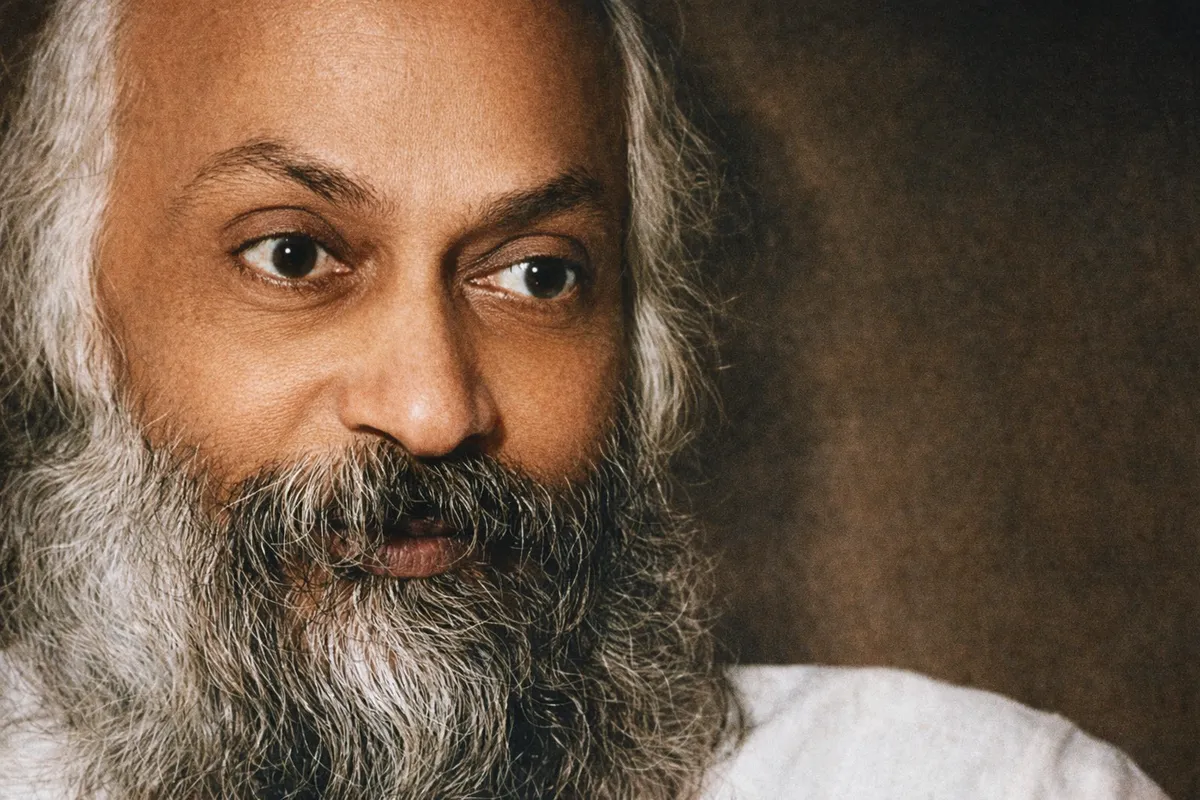
According to Osho, meditation doesn’t begin as akarma; it culminates in it. Through deliberately intense activity in breath, body, and mind (Dynamic Meditation’s first three stages), tension peaks, creating the inner condition for effortless relaxation. The fourth stage is true nondoing—no practice, only letting go—where personal boundaries dissolve and the individual overlaps with the cosmic. Thus, meditation is active-to-silent: activity ripens into actionless awareness.
First move like a storm, then rest so deeply that doing stops by itself and you melt into everything.
From the Discourses
Passages where Osho speaks to this question — each links to the complete discourse.
Question: but doesn't meditation mean akarma, no activity?
The fourth stage of Dynamic Meditation is just akarma, no activity, but the first three stages are active. The first, second, and third stages are of intense activity. In the first stage, your vital body, your breathing, is in intense movement, in extreme activity. By being in extreme activity in your vital body, in your prana-sharira, in your breathing, the second step becomes possible: you become intensely active in your physical body. And in the third stage, after being totally active physiologically, it becomes possible to be active in the mental body. So in three bodies -- the physical, vital, and mental -- you create a climax of activity, a climax of tension. You become more and more tense. Your whole existence becomes a whirlwind, a whirlpool. The more intense it becomes, the greater the possibility of being relaxed in the fourth stage. The fourth stage is total relaxation. It…
Meditation is always passive; the very essence of it is passive. It cannot be active because the very nature of it is non-doing. If you are doing something, your very doing disturbs the whole thing; your very doing, your very "activeness," creates the disturbance. Non-doing is meditation, but when I say non-doing is meditation I do not mean that you need not do anything. Even to achieve this non-doing, one has to do much. But this doing is not meditation. It is only a stepping stone, only a jumping board. All "doing" is just a jumping board, not meditation. You are just on the door, on the steps.... The door is non-doing, but to reach the non-doing state of mind one has to do much. But one should not confuse this doing with meditation. Life energy works in contradictions. Life exists as a dialectic: it is not a simple movement.
What is dynamic meditation?
In the second step so many things are possible -- something different will happen to each individual. One person will begin to dance, another person will begin to cry. One will become naked, another will begin to jump and yet another will begin to laugh. Anything is possible. Move from within, move totally, and then you can proceed to the third stage. The third stage is reached as a result of an inherent sequence. In the first stage, the body electricity, or you can call it Kundalini, is awakened. It begins to revolve and move. Only then can the body be in a total letgo, not before. Only when the inner movement has begun are outer movements possible. When the catharsis of the second stage is brought to a peak, to a climax, the third ten-minute stage begins. Begin to repeat vigorously the Sufi mantra: Hoo! Hoo! Hoo! The energy…
So first: now, when we sit for meditation—our entire language is the language of doing. We even say, We will do meditation. It is wrong to say, for there is no possibility of doing in meditation. But our entire language—human language—is the language of doing; we have no language for non-doing. In Japan, about a hundred and fifty years ago, there was a great monastery, a vast ashram. Some five hundred bhikshus practiced there. The emperor became eager to see it and went. The ashram spread far and wide in the forest; cottages were scattered. The head monk began to show them: In this cottage our monks cook; in this cottage they study; in this cottage they sing—here they do this, there they do that; here they bathe. In the middle stood a large building—the monk said nothing about it.
THE HUMAN MIND IS EFFORT-ORIENTED, action-oriented, obsessed with activity -- because the more active you are, the more your ego can be fulfilled, the more you can say 'I'. All activity is basically food for your egoistic personality. Meditation is not an effort, it is not an activity. Rather, it is a deep surrender. It is to be in nonactivity. Basically, just to be is meditation -- not doing anything, not desiring anything, not hankering to go somewhere; just being here and now, simply being here and now. That's what I call meditation. But it is very difficult to conceive. Even to contemplate it is difficult. The mind cannot conceive of anything that is not an effort. The very language of the mind, the very framework, the very structure, is based on effort: to do something, to achieve something, to go somewhere.