
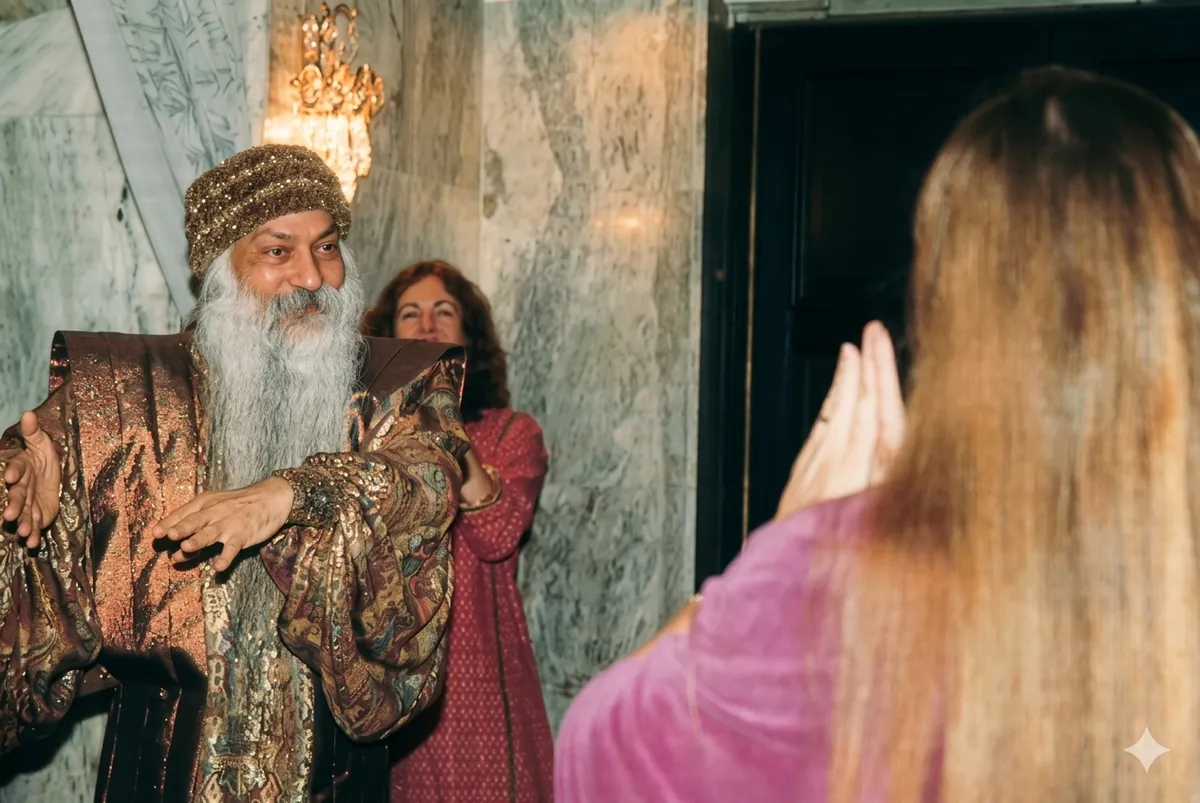
Secret knowledge won’t wake you up; being simple and watching like a curious child will.
From the Discourses
Passages where Osho speaks to this question — each links to the complete discourse.
Beloved Osho, does knowledge of the esoteric play any role on the path of awareness?
No. No knowledge -- esoteric or otherwise -- plays any role on the path except that of hindrance. Innocence helps, knowledge hinders. Be a child -- full of wonder, without knowing anything. One Indian saint was very much respected in India. There were only two men in India who were called mahatma. One was Mahatma Gandhi -- `mahatma' means `the great soul' -- and the second was Mahatma Bhagwandin. This second man used to stay with me whenever he passed the city I was living in. I used to go for a morning walk, for a night walk, and he was also very much in love with going for a walk. He was an old man, but immensely knowledgeable; he knew the names of all the trees -- Latin names, Greek names -- all the flowers. He was almost a walking encyclopedia. I told him, "You have wasted your whole…
Osho, why are you so much against philosophy?
And I can understand your question: this is how every child is being brought up, for centuries. Your question is relevant. You say, "I LOVE YOU. BUT IF YOU ARE NOT A PERSON, THEN HOW CAN I LOVE YOU?" We have been told that we can love only persons. The truth is just the opposite: you cannot love the person. Persons can only fight, persons can only be in conflict, because wherever two egos are, there is conflict, a CONSTANT war -- sometimes hot, sometimes cold, but the war continues. Sometimes the warriors are tired so they maintain a certain peace. Whenever they are back again and their energy is there again, they start fighting. You can see it happening with all kinds of lovers -- a continuous fight, a kind of intimate enmity, together and yet not together. Why is this fight there? -- because of two egos. Two…
Socrates says at the very end of his life "I know only one thing, that I know nothing." That is the moment he becomes a wise man, that is the moment he regains his childhood. He has rediscovered his innermost wonder, again his eyes are full of wonder. And the moment your eyes are full of wonder, existence becomes mysterious. It happens simultaneously: if your eyes are full of knowledge, existence is demystified -- and a demystified existence has nothing in it, just bare facts: geography, history, chemistry, physics, ;etcetera, etcetera -- all only facts, and you gave lost in those facts something which was really precious, you have lost the wonder, the awe. Just watch a small child looking at a rose flower: he stands there in such awe. That is true religiousness.
Beloved Osho, full with the sweetness of your fragrance as I walk this path with you, I feel that to trust and wait is all that is needed of me.a wondering comes up in me as to whether some knowledge about esoteric subjects -- for example, chakras, collective unconsciousness, energy fields -- could be helpful along the way or not. Osho, is such knowledge useful? Or will whatever is needed come to me throughexperience, in its own time?
And each individual has differences, and differences come in such small things that you cannot conceive. For example, in the East people sit on the floor. In cold countries people cannot sit on the floor; the chair is absolutely necessary. Naturally, their backbones, their spines will have a different shape than those of the people who sit on the floor, and the experiences of their kundalini will be different. There are people who eat only one time a day. For thousands of years they have never eaten more often than that. In South Africa there are tribes which eat only one time in twenty-four hours. When they came across American missionaries, there was such laughter... "These idiots are eating five times! Breakfast -- and there is no fast at all, and they are having `break-fast.' And the whole day, something or other, and then coffee break and tea break, and…
Osho, say something more about self-knowledge. That's my whole interest and inquiry.
But both are being half true. And remember: a half-truth is far worse than a total lie. At least the total lie has one quality about it: it is total -- the quality of totality. And one thing is beautiful about a total lie: it cannot deceive you long -- because it is such a lie, even the stupid person will be able to see sooner or later that it is a lie. But the half-truth is dangerous -- even an intelligent person can get lost into it. And then there is the third way: the way of the mystic. He accepts both, and rejects both. That is my way. He accepts both because he says, "On one plane both exist -- the knower and the known, the subject and the object, the inner and the outer. But on another plane, both disappear and only one remains -- which is…