
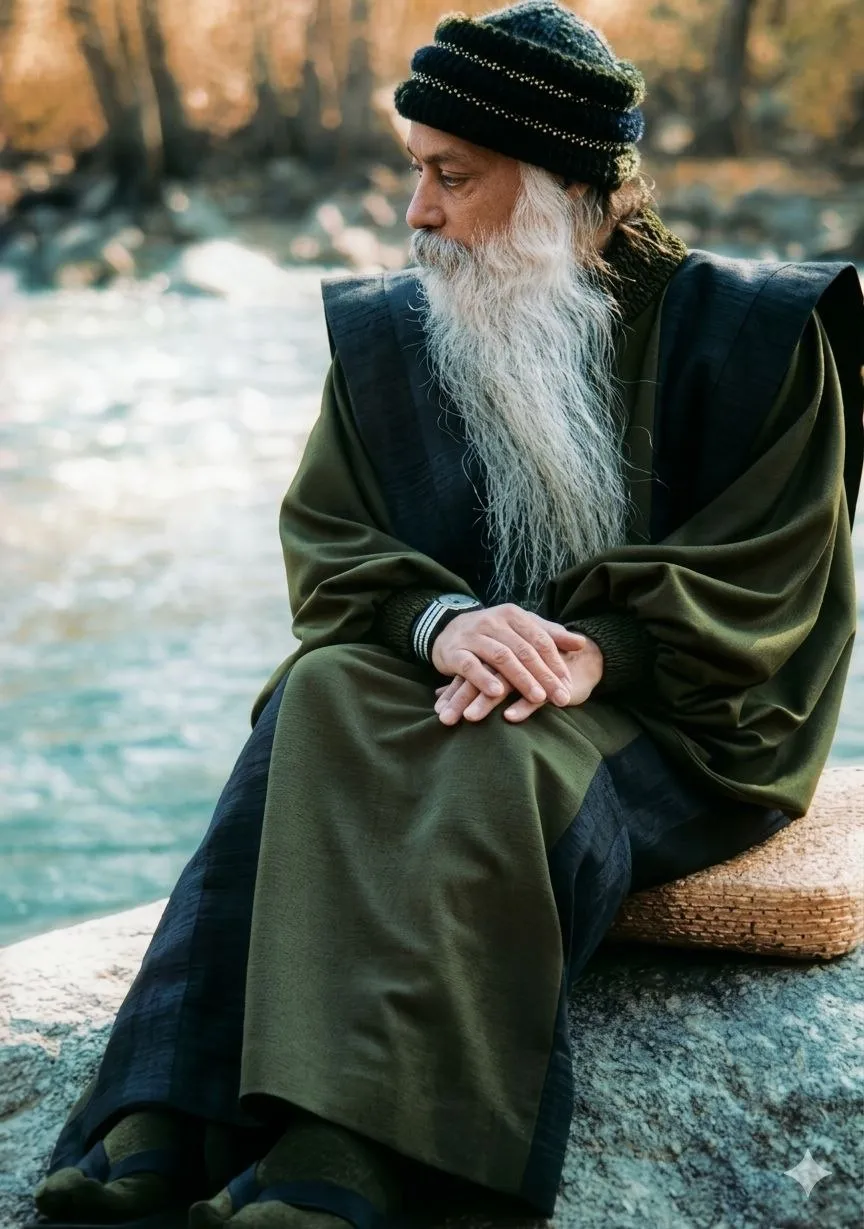
Most art vents inner turmoil, but when the turmoil ends through meditation, peaceful, uplifting art is born.
From the Discourses
Passages where Osho speaks to this question — each links to the complete discourse.
Isn't it that every piece of art, and all poetry, arises out of a contradiction, out of the battle between yes and no? Doesn't the end of this fight in us mean silence?
Not all poetry, not all painting, not all music, not all art, arises out of contradiction. But ninety-nine percent arises out of contradiction. That's why ninety-nine percent of art is a little pathological. Picasso is pathological, so is Vincent van Gogh. You will always find your poets, your painters, a little ill somewhat eccentric, bizarre, nuts. Now psychologists say that if you get nuts to paint, that helps them to become normal. It has been tried all over the world -- 'therapy through art' they call it. If a madman is given paints to paint with, by painting he throws his madness out. If he goes on painting, after a few weeks you will find he is turning to normal. Something has been catharted out of him through art. Sigmund Freud had this attitude, that all art is pathology. Not all -- I will not agree with him to that…
Beloved Osho, since you first spoke about subjective and objective art, the artist and the mystic, a deep reflection has been triggered in me. I'm confused concerning meditation and doing. I have always felt my art to be my meditation, but is it still not a doing? I notice the difference when sitting in vipassana. Must art and sculpture even, fade away into non-doing? Can creativity on the material plane be truly meditative? Will my art remain solely subjective until the ego agrees to commit suicide?
Deva Darpana, the distinction between the subjective and the objective art is basically based on meditation. Anything that comes out of the mind will remain subjective art, and anything that comes out of no-mind, out of silence, out of meditation, will be objective art. This definition is simple and will destroy your confusion. Whether you are creating something -- you may be a sculptor, you may be a carpenter, you may be a painter, a poet, a singer, a musician -- all that has to be remembered is that it is coming out of a silence within you, that it has a spontaneity. It is not prearranged, preprogrammed, pre-thought. As you are creating something you go on being surprised yourself -- you have left yourself in the hands of existence. Now your hands are not your own hands. They are simply following what the existence longs for. You are not…
What about art and enlightenment? When you are creating a poem, a painting sculpture, music, you can feel very close to the meditative state. Yet, it is not pure nothing-ness -- because it has an end, a goal. It also enhances the ego. Won't you ultimately have to transcend this kind of creativity?
ART DEPENDS ON YOU. If you are pathological, your art will be pathological. If you are enlightened, your art will be enlightened. The art carries your quality. If you go to Ajanta, Ellora or Khajuraho, you will find a totally different kind of art. If you listen to classical music, you will find a different quality of art. If you listen to modern music, a different kind of art will be found there. If you see Picasso's paintings, they ARE pathological. Something is ill -- something is ill in Picasso and something is ill in the world that Picasso is going to represent in those works of art. Never keep a Picasso painting in your bedroom, otherwise you will have nightmares. It is very representative of this society. The society is ill, neurotic, but the art depends on you. The art does not descend out of the blue, it comes…
Osho! You say the poet is close to the seer. Yet it is surprising that even poets and artists with such sensitive hearts—who have set out in life seeking satyam, shivam, sundaram—hesitate to come here. You say meditation deepens sensitivity. Then what are these poets and artists afraid of? Are meditation and creation not possible together?
Arun Satyarthi! The poet is certainly close to the rishi. Poet means: one who has begun to receive glimpses of the Divine. Rishi means: one who has become one with it. Poet means: one who has seen, from afar, the snow-white peaks of the Himalayas. Rishi means: one who has made his home upon those peaks. Between the poet and Truth there is a slight distance; the rishi is one with Truth. But without being a poet no one becomes a rishi. Though not all poets become seers, all seers are bound to be poets. One can choose to cling to the glimpses, to revel in them. The poet is showered by a drizzle; the rishi is drenched in a cloudburst. The poet, you can say, lives by ponds and pools; the rishi is merged into the ocean—he becomes the ocean. Yet a poet may mistake his pond for the…
Osho, meditativeness and science are difficult to reconcile. Yet painting a picture, writing a poem, and solving a scientific problem all bring the same joy. The same joy! Why is it so difficult to be meditative and a scientist? Why has there never been a society in which the inner and the outer sciences, the science of gentleness and love and the science of aggression and death, live in harmony?
Mahavira, twenty-five centuries ago, used to make each of his statements with a 'perhaps'. If you asked him, "Is there a God?" he would say, "Perhaps." In those days it was not understood at all -- because how can you say, "Perhaps"? Either God is or is not. It seems so simple and so logical: "If God is, God is; if he is not, he is not. What do you mean by 'perhaps'?" Now it can be understood. Mahavira was using the same language in religion that is being used by Albert Einstein in physics. Albert Einstein calls it the theory of relativity. Mahavira has called his philosophy exactly the same: SAPEKSHAWAD -- the theory of relativity. Nothing is certain, everything is flexible, fluid. The moment you have said something, it is no longer the same. Things don't exist, Mahavira says, but only events. That's what modern science is saying,…