
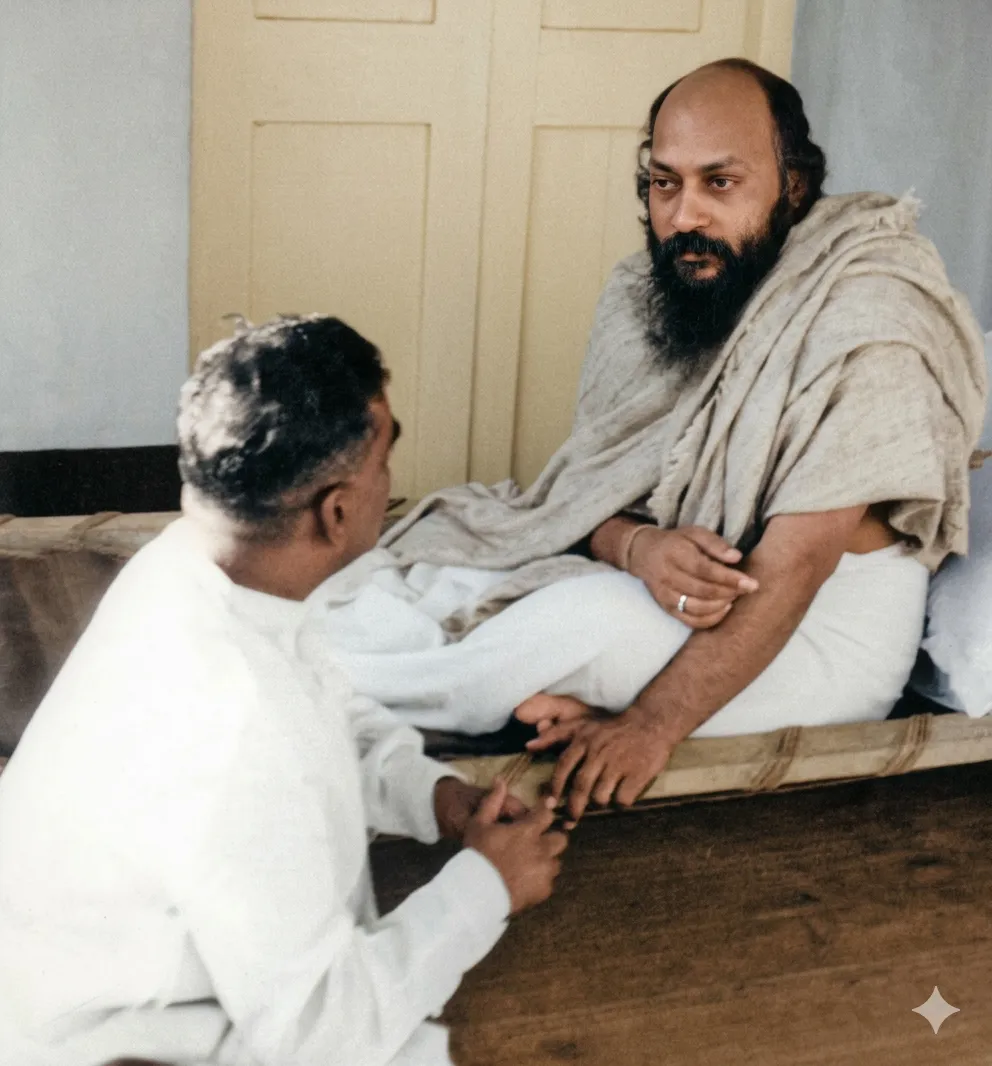
Character starts inside you when you see clearly, and then it shows outside in how you act with others.
From the Discourses
Passages where Osho speaks to this question — each links to the complete discourse.
Does this mean that character comes from society, or that character comes from right vision?
Character arises from right vision, but it will manifest in society. There are these two aspects in it, aren’t there?
प्रश्न: इसका मतलब चरित्र समाज से आया या सम्यक दर्शन से चरित्र आया?
चरित्र तो आएगा सम्यक दर्शन से, लेकिन प्रकट होगा समाज में। ये दो बातें हैं उसमें न!
Question: Osho, about what you have been saying on the Jain perspective, it seems to me that two-thirds of it everyone could agree with, but there is one-third with which agreement is difficult. The first thing you say is about samyak-darshan (right vision). Anyone who has read even a little scripture knows that without right vision, character has no meaning; whatever happens without right vision cannot be called character at all. This view is very clear. And it is also clear that character has no meaning other than self-abidance: to be established in the soul is precisely what character means. On these two points I find myself in agreement with you. But between having right vision and being fully established in the self, in that interval your view seems to me different from the traditional view.
One thing can be right in one situation and can be wrong in another situation -- the same thing. If by a small lie you can save a man's life then how will you decide what is right and what is wrong? You can tell just a small lie, that 'I was not there, I and you were there,' but that can save a human life which may have infinite potential, infinite possibilities, which may blossom. The man may become a Buddha -- who knows? Tomorrow is unpredictable, so is it right to say a lie or wrong? In this situation it is perfectly right to tell a lie, in other situations it would not be right to tell lies. Who is going to decide? -- because ultimately. You have to encounter the situations. You cannot go on carrying the Bible and the Koran and the Vedas and consulting them.
Osho, you said the Indian mind has been held up on the basis of personal character. But if someone of lax character—say a thief or an adulterer—utters a truth, isn’t it better if the same words come from the mouth of a person of character? Wouldn’t that prove more effective in society?
Two things. First, what do we mean by character? It is what I have just said about morality. The one you call a man of character, I call merely a man made virtuous by force. He is suppressed. Whatever you call bad, he has pushed down inside. It is all there; it has not gone anywhere. The one you call virtuous—yes, if he has cultivated nonviolence on the surface, then violence is present within. On the surface he has cultivated forgiveness; inside, anger is there. Because your method of producing character is repression. So the so‑called man of character is inwardly as characterless as the other man who appears characterless to you on the outside. In fact, I hold that generally the one we call characterless may be more simple, straight, and clear; while the one we call virtuous is very cunning, complex, and conniving, because he has to manage…
ओशो, भारतीय मानस व्यक्तिगत चारित्र्य के आधार पर स्थगित हो गया है, ऐसा आपने कहा। मगर चारित्र्य शिथिल व्यक्ति ने, समझिए कोई चोर और व्यभिचारी ने कोई सत्य का उच्चारण कर लिया, इससे बेहतर यह नहीं कि चारित्र्य संपन्न व्यक्ति के मुख से यदि वही बात निकले तो वह ज्यादा समाज में प्रभाव उत्पादक सिद्ध होगी?
… जिस-जिस को आप बुरा कहते हैं, उसने अपने भीतर दबा रखा है। वह सब उसके भीतर मौजूद है। वह कहीं चला नहीं गया है। जिसको आप चरित्रवान कहते हैं। हां, वह सिर्फ, अगर वह अहिंसा उसने साध ली है ऊपर से, तो भीतर उसके हिंसा मौजूद है। ऊपर से क्षमा साध ली है, भीतर क्रोध मौजूद है। क्योंकि आपकी जो प्रक्रिया है चरित्र को पैदा करने की, वह दमन की है। तो चरित्रवान जो व्यक्ति है वह भीतर से उतना ही चरित्रहीन है जितना कि दूसरा चरित्रहीन बाहर से आपको चरित्रहीन दिखाई पड़ रहा है। बल्कि एक मेरी और मान्यता है कि सामान्यतः जिसको हम चरित्रहीन कहते हैं, वह ज्यादा सरल, सीधा और साफ हो सकता है। लेकिन जिसको हम चरित्रवान कहते हैं, वह बहुत कुटिल, जटिल और कनिंग होता है। क्योंकि उसको दोहरे व्यक्तित्वों को सम्हालना पड़ता है पूरे वक्त।
Osho, why don't you give your disciples a certain mode of conduct? Isn't a moral character necessary for a spiritual life?
Mahendra Singh, that's why I don't give my people ANY code of conduct. I give them eyes to see, a consciousness to reflect, a mirrorlike being to be able to respond to any situation that arises. I don't give them detailed information about what to do and what not to do; I don't give them ten commandments. And if you start giving them commandments then you cannot stop at ten, because life is far more complex. In Buddhist scriptures there are thirty-three thousand rules for a Buddhist monk. Thirty-three thousand rules! For every possible situation that may ever arise, they have given a ready-made answer. But how are you going to remember thirty-three thousand rules of conduct? And a man who is cunning enough to remember thirty-three thousand rules of conduct will be clever enough to find a way out always; if he does not want to do a certain…