
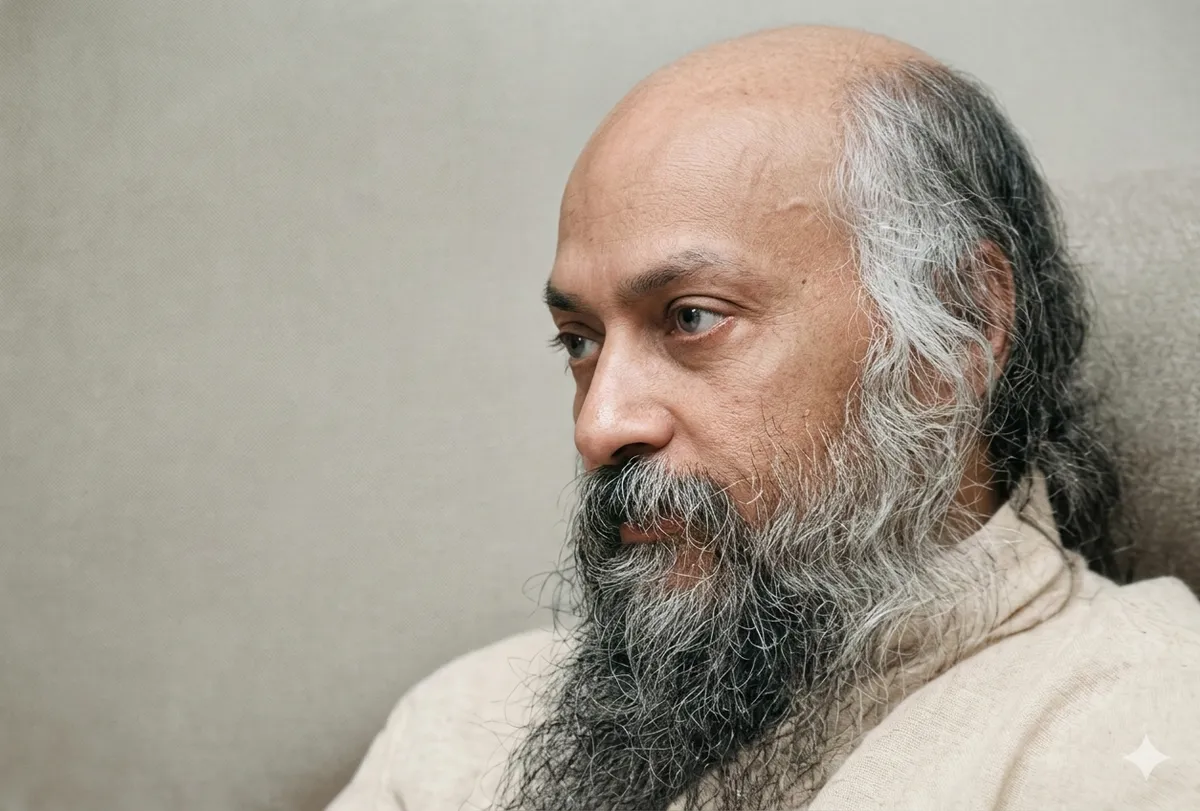
Deep down, your thinking and your feelings share the same root; they only look different on the surface.
From the Discourses
Passages where Osho speaks to this question — each links to the complete discourse.
Osho, do mind and heart, thought and feeling, ever become one?
Many times they do. And when they become one, a very significant event occurs. Yes, he is asking whether, sometimes, mind and heart—thought and feeling—become one. They do. In the very depths they are one; only on the surface are they separate. Just as the branches of a tree are separate above and below they become one in the trunk. In the same way, thought is a branch of our being, and feeling is also a branch of our being. Only on the surface do they appear separate; deep within they are one. And the day we come to know that thought and feeling are one, that day science and religion are no longer two. That day science has a boundary, and there is also a realm of transcendence where religion begins. Krishna is a man of dharma. And I am speaking of him as a man of dharma, as…
ओशो, तो क्या कभी मन और हृदय, विचार और भाव एक नहीं हो जाते?
कई बार एक हो जाते हैं। और जब वे एक हो जाते हैं तब बड़ी महत्वपूर्ण घटना घटती है। हां, वह यह पूछ रहे हैं कि कभी-कभी मन और हृदय, विचार और भाव एक नहीं हो जाते? हो जाते हैं। बहुत गहरे में तो एक होते ही हैं। बहुत ऊपर ही अलग-अलग होते हैं। जैसे वृक्ष की शाखाएं ऊपर अलग-अलग होती हैं और नीचे पीड़ में एक हो जाती हैं। ऐसा ही विचार भी हमारी एक शाखा है, हमारे होने की। भाव भी हमारी एक शाखा है, हमारे होने की। ऊपर ही ऊपर अलग-अलग होते हैं, बहुत गहरे में तो एक होते हैं। और जिस दिन हम यह जान लेते हैं कि विचार और भाव एक हैं, उस दिन विज्ञान और धर्म दो नहीं रह जाते। उस दिन विज्ञान की एक सीमा हो जाती है, और एक अतिक्रमण का जगत भी हो जाता है जहां धर्म शुरू होता है। कृष्ण धर्मपुरुष हैं। और मैं उन्हें धर्मपुरुष की तरह ही बात कर रहा हूं। और जैसे वे मुझे दिखाई पड़ते हैं वैसी मैं बात कर रहा हूं। उसमें आप उन्हें वैसा मान कर चलेंगे, ऐसा आग्रह जरा भी नहीं है। …
Osho, all the saints have called the heart the doorway to spiritual experience, and the mind the domain of thought and intellect. What is the difference between heart and mind? What is the difference between heart and soul? How can this difference be made clear? How to recognize it?
There is also danger with love. It is difficult to make a man into a soldier; to make him a soldier you must kill his love completely. Otherwise, when he takes a gun in hand to kill an enemy, his heart will say: “He too has a mother, just as you do. He too has a wife. As your wife wept bitterly when she bid you farewell, his wife must also have wept. He too has small children, and you are about to make them orphans. He too has an old father who has no other staff to lean on in his old age. What are you doing? And why? This man has done nothing to you. For a job paying a mere hundred rupees you will kill a man; and he too, for a pittance, has a gun pressed to your chest!” If even a ray of love arises…
प्रश्न: ओशो, हृदय को सभी संतों ने अध्यात्म अनुभव का द्वार कहा है और मन को विचार और बुद्धि का। हृदय और मन में क्या फर्क है? हृदय और आत्मा में क्या फर्क है? इस फर्क को कैसे स्पष्ट करें? कैसे पहचानें?
और फिर प्रेम के साथ खतरा है। किसी आदमी को सैनिक बनाना मुश्किल है; सैनिक बनाने के लिए जरूरी है कि उसके प्रेम की बिलकुल हत्या कर दी जाए। नहीं तो वह गोली जब हाथ में लेगा किसी दुश्मन को मारने के लिए, तो उसका हृदय कहेगा--इसकी भी मां होगी, जैसी तुम्हारी मां है। और इसकी भी पत्नी होगी। और जैसे ज़ार-ज़ार तुम्हारी पत्नी रोई थी तुम्हें विदा करते वक्त, इसकी पत्नी भी रोई होगी। और इसके भी छोटे-छोटे बच्चे होंगे, जिन्हें तुम अनाथ करने जा रहे हो। और इसका भी बूढ़ा पिता होगा, जिसके बुढ़ापे में इसके सिवाय और कोई लाठी का सहारा नहीं है। तुम यह क्या कर रहे हो? और किसलिए कर रहे हो? और इस आदमी ने तुम्हारा कुछ भी नहीं बिगाड़ा है। सिर्फ सौ रुपट्टी की नौकरी और आदमी, और इसकी जिंदगी...और यह भी बेचारा सिर्फ सौ रुपट्टी की नौकरी और तुम्हारी छाती पर बंदूक कसे है!
Osho, you often tell us to listen to the heart rather than the mind. But how is one to know which voice is the mind’s and which is the heart’s? Please explain with compassion.
Renuka! The matter is absolutely straightforward. There is not the slightest confusion. The mind always points you outward; the heart always points you inward. When something within says, “Go out—earn money, gain position, prestige, ambition,” know it is the mind speaking, because these are not the heart’s longings. When something says, “Sit silently, close your eyes, dive within yourself, take a plunge into your own being, listen to your life-breath, step into the inner sound that is rising,” then know the heart has spoken. The inner journey is the heart’s message; the outer journey is the mind’s. There is no reason for mistake here. When hatred arises, know the mind has spoken; when love arises, know the heart has spoken. When thoughts surround you, know the mind has seized you; when waves of feeling rise, know you are in the heart. When negation arises—an urge to say “no,” when doubt…
Beloved Osho, your way is the way of the heart, and the outside world is the way of the head. Will it ever be possible that man can function from a blend of both head and heart, or must the two always remain totally divorced? Will it always be essential to make a conscious choice for one way or the other?
If you are talking to your wife, you must know it is impossible to talk, it is impossible to argue, it is impossible to come to a fair decision, because the woman functions through the heart. She jumps from one thing to another without bothering whether there is any relationship between the two. She cannot argue, but she can cry. She cannot be rational, but she can scream. She cannot be cooperative in coming to a conclusion. The heart cannot understand the language of the head. The difference is not much as far as physiology is concerned, the heart and the head are just a few inches apart from each other. But as far as their existential qualities are concerned, they are poles apart. My way has been described as that of the heart, but it is not true. The heart will give you all kinds of imaginings, hallucinations, illusions,…
Mind is always old. Even a one-day-old child has a one-day-old mind, because mind means the past. It accumulates the past; it is accumulative it goes on accumulating experiences and everything that happens. It is always old and it goes on becoming older and older. But the heart is always young; it never accumulates, it is non-accumulative. It lives in the moment. That's why the mind and the heart are never in agreement, they cannot be in agreement, because the mind talks about the past and the heart wants to live spontaneously, right now. The mind always gives advice, tries to be very wise, calls the heart a fool, mad, and all kinds of names, but the heart never becomes wise in that sense; it remains a fool.