
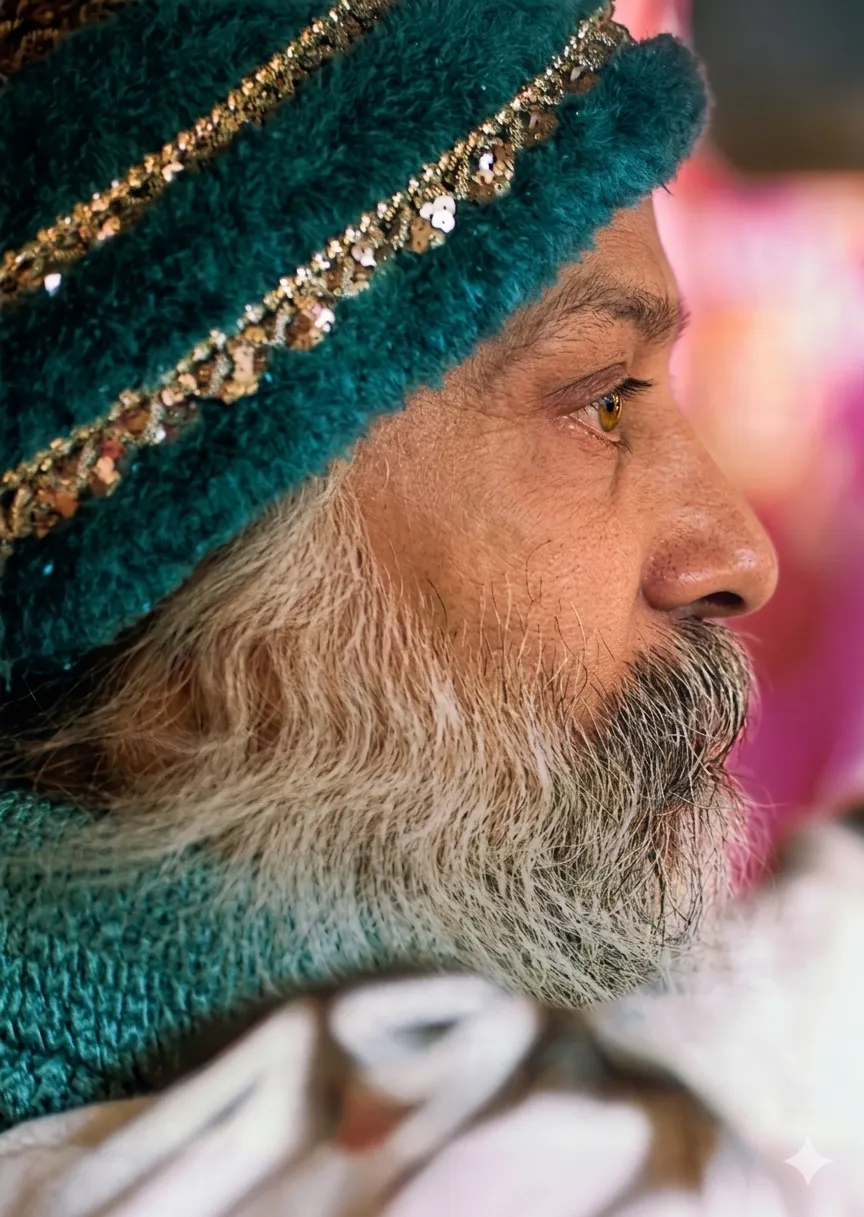
It’s okay to change what you say when you learn more or the situation changes—being truthful now matters more than never changing.
From the Discourses
Passages where Osho speaks to this question — each links to the complete discourse.
Osho, for some twenty years you have been speaking to us, and many of your statements contradict one another; yet, remarkably, to this day you have never taken back a single statement nor felt the need to revise any. And all your statements have now become public property. Are you doing this knowingly, and is there some secret behind it? And is there not the danger that, in time, people will doubt that all these statements could be from one and the same enlightened master?
That’s how a Muslim is a Muslim—he has grabbed the Qur’an’s statements. A Buddhist is a Buddhist—he has grabbed Buddha’s. A Jain is a Jain—he has grabbed Mahavira’s. I don’t want to leave statements behind for you to grab. I want to leave you in the statementless, the ineffable. I will say everything and take it all away. Give with one hand, remove with the other. One day you will understand that this empty state—when nothing remains in your hands—is the state of truth. The moment you grasp, you are grasped. The grasper is captured by what he grasps. The one who clings to statements becomes sectarian. The one who lives in the statementless is religious. Then he understands all statements and is possessed by none, defined by none. “Your many statements contradict one another. But surprisingly, you have never taken back a single statement.” There is no need to.…
Why are you not consistent in your statements?
I cannot be. The purpose of my statements is totally different than that of ordinary statements. I am not telling the truth, because truth cannot be told. Then what am I doing here? If you take my statements as true or untrue, you will miss the whole point. I am using the statements to awaken you. They are neither true nor untrue. They are either useful or useless, but they have nothing to do with truth. They have a certain utility. It is just as if you are fast asleep, and I start ringing a bell; there is nothing of truth or untruth in ringing the bell. To ask the question would be utterly irrelevant. But there is something useful in it: if it helps you wake up, it has been useful. Buddha is reported to have said, "Truth is that which has utility." Truth is a device. It does…
Osho, whatever you say seems to be right from the point of view of what you are saying at that moment. But it may be contradictory. You draw the listeners in one direction confirming a particular point, and at the same time you go via the back door to the opposite point. It is a spiral -- the listener hardly realizes what may be happening. Is this not fooling the listener -- unless he realizes that the real answer lies beyond your spoken words?
One sannyasin has done well. He has called my path VIA CONFUSIVA -- that's right. That's perfectly right. It is neither VIA NEGATIVA nor VIA POSITIVE -- it is VIA CONFUSIVA. If you can be so much confused that you drop ALL belief, out of that confusion will come clarity. When do you feel confused? When exactly? Whenever one of your beliefs is attacked -- you become suspicious: Now what to believe in? Whenever a doubt arises... but how is a doubt possible if there is no belief? The man of no-belief cannot doubt either. There is nothing to doubt. 13y destroying your belief I am destroying the very pos-sibility of doubt. Can you see the point? Doubt is a shadow of belief. It looks like the opposite -- it is not. Only believers can doubt. If you believe in God, doubt can arise. But if you don't believe in…
Osho, awakened ones, considering place, time, circumstance, and the era-appropriate psychology of people, have expressed the same truth in very different forms. To the point that they appear mutually quite disputatious and even contradictory. Is an absolute expression of the ultimate truths of life and existence not possible? Will the limits of the age and the condition of the people always continue to be imposed upon truth?
Expression will always be limited. Expression will always be relative. The speaker and the listener—both create the boundaries of expression. I will say only what can be said. You will understand only what can be understood. Truth is vast. If I go to see the ocean and you say to me, “On your way back, bring a little of the ocean,” I will not be able to bring the whole ocean. I may bring a little water from it. But in that water much will be missing. There will be no storm of the ocean, no waves. And that was the real ocean: that tumultuous roar and fierce thunder! Waves crashing against cliffs! Those surges rising and spreading for miles! That swell! None of that will be there. I will bring a vessel filled with a little ocean water. Still, there will be something! If you taste it, it will…
Question: OUR BELOVED MASTER, WHEN THE NOVICE MONK, GAO, FIRST CALLED ON YAKUSAN, YAKUSAN ASKED HIM, "WHERE DO YOU COME FROM?" GAO SAID, "FROM NANYUE." YAKUSAN ASKED, "WHERE ARE YOU GOING?" GAO REPLIED, "TO JIANGLING TO RECEIVE THE PRECEPTS." YAKUSAN THEN ASKED, "WHAT IS THE AIM OF RECEIVING PRECEPTS?" GAO ANSWERED, "TO ESCAPE BIRTH AND DEATH." YAKUSAN SAID, "THERE IS SOMEONE WHO DOESN'T RECEIVE THE PRECEPTS AND HAS NO BIRTH AND DEATH TO ESCAPE -- DO YOU KNOW?" GAO ASKED, "THEN WHAT IS THE USE OF THE BUDDHA'S PRECEPTS?" YAKUSAN SAID, "THIS NOVICE STILL HAS LIPS AND TEETH." AT THIS, THE NOVICE BOWED AND WITHDREW. DOGO THEN CAME FORWARD AND STOOD BY YAKUSAN, WHO SAID TO HIM, "THAT LIMPING NOVICE WHO JUST CAME, AFTER ALL HAS SOME LIFE IN HIM." DOGO SAID, "HE'S NOT TO BE ENTIRELY BELIEVED YET -- YOU SHOULD TEST HIM AGAIN FIRST.