
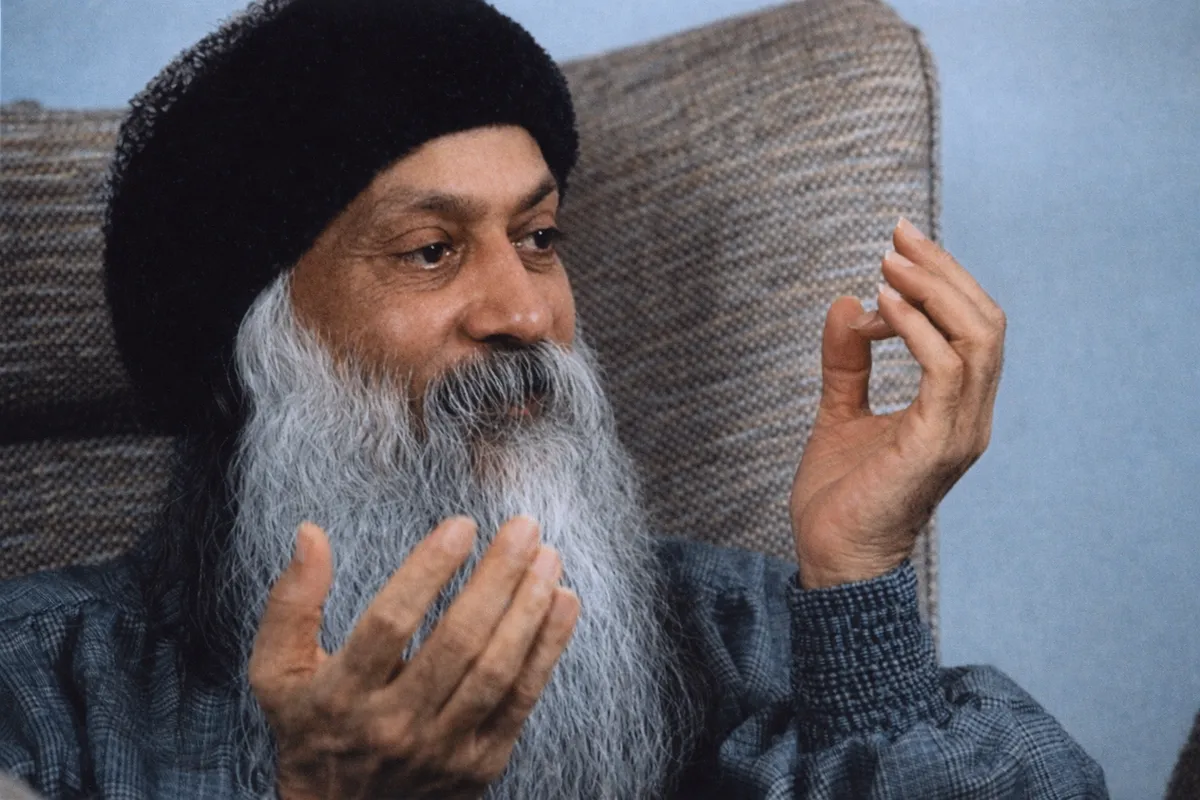
You can collect ideas without sannyas, but to truly learn you must surrender and bravely live the truth, not just talk about it.
From the Discourses
Passages where Osho speaks to this question — each links to the complete discourse.
Osho, can I not be your disciple without taking sannyas?
Narayandas Tiwari! You can be a student, not a disciple. And the difference between a student and a disciple is as great as the difference between a poet and a seer—no less. A student means: someone who will walk away with bits of information, who will gather a little trash of knowledge, whose memory will be a little more stuffed, who will learn to repeat a few fine sayings. But you cannot be a disciple without becoming a sannyasin. For the first prerequisite of a disciple is: to drop curiosity. And not only curiosity—to drop inquisitiveness as well, and to take up mumuksha. What is mumuksha? Curiosity is a childish thing; small children have it—they go on asking and asking. “Why this? Why that?” They drive you crazy. Whomever they latch onto, they make his life difficult. Because before one question is finished, they have already posed another. They don’t…
To be a disciple is a great art. One can even say the greatest, because Its requirement is the surrender of the ego Which is the hardest thing in life. One can do everything for the ego: One can climb mountains and go to the moon. Everything is easy if it is for the ego. But to drop the ego is really an uphill task It goes against our natural instinct. But it is the beginning of real spirituality. The first requirement for a disciple Is to surrender, to say to the master 'Now I am no more, only you are!' A total yes to the master, an absolute trust -- That's what makes a disciple. There are many students but very few disciples. And only disciples can be transformed Students can only be informed.
Osho, what is the first experience of samadhi like?
You will know only when it happens. It cannot be said; at most a few hints can be given. It is as if, in the dark, a lamp is suddenly lit. Or as if a dying patient, right at the edge of death, suddenly finds a medicine that works; life’s wave, life’s thrill spreads again—so it is. As if a corpse becomes alive—such is the first experience of samadhi. It is the taste of nectar. The experience of the ultimate music. But it will be only when it happens; and only then will you understand. You will not understand by my saying it. It is as with love. How can anyone explain it? To someone who has never loved, never known love, no matter how many explanations you offer—he will hear it all and still ask, “I haven’t understood; please explain a little more.” It is like explaining light to…
Osho, have you now stopped giving initiation into sannyas and making disciples? Will I be left deprived of becoming your disciple?
A disciple is not made; one has to become a disciple. When you love someone, do you first ask, do you seek permission? Love happens. Love obeys no command, no permission, no method, no ordinance. What is discipleship? It is the highest, deepest name for love. If you want to love me, how can I stop you? If tears fall in love for me, how can I stop them? And if you wish to plunge into what I call meditation, how can I hinder you? One who is to be a disciple cannot be stopped by anyone. That is why I have dropped the formality of “making” disciples—because now I want only those who are coming toward me from their own being, for no other reason. Now the whole responsibility is yours. Just as in the first grade we teach children: aa for aam (mango), ga for Ganesh. It used…
But the distinguished gentleman who has asked—their idea of sannyas, their desire to take sannyas—has wavered: how to take sannyas! Sannyas is not undertaken by the intellect. Surrender does not happen through the intellect. Sannyas and surrender are synonymous. And a disciple is one who is surrendered, who is sannyast—who is willing to go with the Master into the unknowable. And how will you cross the unknowable—how will you measure it with logic, weigh it on the scales of the intellect?
So neither was this a guru, that person of the Taittiriya Upanishad, nor was the one sitting before him to learn a disciple. This was a teacher, and that a student. He was repeating memorized bits; the other was memorizing them, so that tomorrow he too would become a teacher and make others memorize. The guru got angry at the disciple over something! A guru does not get angry with the disciple. That is impossible. A disciple does not get angry with the guru; that too is impossible. Leave aside the guru being angry—why, even the disciple does not get angry! This is the culmination of love. Where is there any entry for anger here? This is harmony in its ultimate form. Here, notes do not clash or fall apart. Here the rhythm is total, complete. But students do get angry; they flare up over trifles. Thousands of students have…