
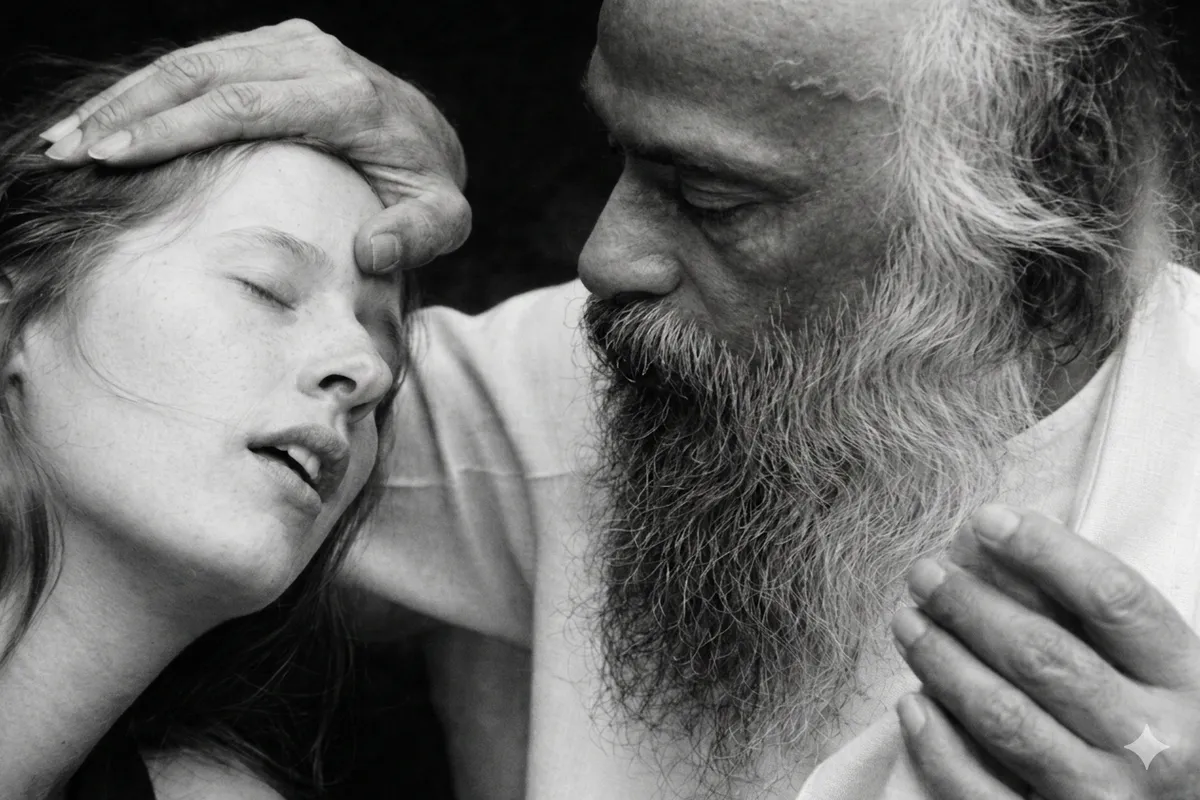
Everything is one stuff; sometimes it sleeps as matter, sometimes it wakes as consciousness, and focusing on consciousness helps it wake up more.
From the Discourses
Passages where Osho speaks to this question — each links to the complete discourse.
Osho, are the insentient and the conscious two separate things, or two forms of one and the same reality?
There is a mention in the life of Bhoj: an astrologer came, looked at Bhoj’s hand, and said, “You are most unfortunate. You will carry even your wife to the cremation ground, your sons too. You will have to take each member of your household to the cremation ground; after all of them, you will die.” Bhoj was furious. He had the astrologer handcuffed and said, “Lock him up. What a man—speaking such ill-omened words!” Kalidasa was sitting quietly, laughing. He said, “The astrologer speaks no ill omen; he simply lacks the art of saying it—his emphasis is wrong.” When Kalidasa said this, Bhoj asked, “What do you mean?” Kalidasa said, “Let me see your hand.” After looking, he said, “You are greatly blessed! Your life span is very long. Blessed—in the sense that neither your wife nor your sons will ever be saddened by your death. No one will…
Osho, is consciousness not matter?
No—no. In fact, if you understand what I mean: as I just said, there is something—when it is aroused it is called mind; when unaroused it is called soul. There is such a something; something is—there is no need for a name. Call it Brahman if you like, or call it something else—it makes no difference, because the trouble begins the moment you give it a name. There is something that appears to us in two forms—conscious and unconscious. There is a state where it is absolutely vibrationless; there it seems unconscious, it seems material. And there is another of its modes where it is filled with perfect vibration; there it appears conscious, it appears as consciousness. These are two different aspects of the same thing, two functions of the same reality. The conscious and the unconscious are not matter; rather, they are two functions of one and the same…
Osho, are mind, intellect (buddhi), chitta, and ego (ahamkar) distinct things—separate entities—or one and the same? And is the soul different from these, or is their aggregate itself called the soul? Among these, which is inert and which is conscious? And where exactly are they located in the body?
It’s like asking: is the father different, the son different, the husband different? No—the person is one. But before some he is a father, before others a son, before others a husband; before some he is a friend, before others an enemy; to some he appears beautiful, to others not; to some he is master, to others servant. If we had never visited that house and someone told us, “Today I met the master,” another said, “Today I met the servant,” a third said, “I met the father,” and a fourth, “The husband was at home,” we might think many people live there—some master, some father, some husband. The person is one. Our mind behaves in many ways. When it stiffens and declares, “I am everything; no one else is anything,” it appears as ego—ahamkar. That is one mode of the mind’s functioning. When the mind thinks—reasons—it is buddhi, intellect.…
Question: if consciousness can be determined fully, then what is the difference between it and the elements of matter? When nothing is to be done and only 'to be' is the sole aim what will not be the difference between such a state and abstruse tranquillity? What is the motive behind the existence of consciousness for our ego. What is the difference between the existence of a wooden chair and that of the existence of a no-thought mind?
When Aldous Huxley took L.S.D. for the first time, his experiences fortunately, turned out to be similar to your question. There was a chair in front of him. A little while after taking L.S.D., he noticed strange rays emitting from this chair. This chair that seemed ordinary, dead, was alive and scintillating with strange and uncommon colours! He was amazed. Never in his wildest imagination, he could have endowed this chair with such beauty and grandeur! He writes in his book about this experience. He was wonder-struck. That was the first time, he writes, he realised that a chair could be like this. It was not the ordinary chair that stood before him. It seemed as if diamonds flew out of it on all sides -- it seemed too precious to sit upon! It was more beautiful that all the stars and the suns put together! Huxley says he suspected…
Consciousness and unconsciousness are also not two things. There has been a great misunderstanding about it also. Atheists say that only unconsciousness exists, but they find great difficulty in explaining this. They feel difficulty because if there is only unconsciousness then from where does consciousness come? Then, an atheist like Marx has to say that it is a by-product. Consciousness is not any real thing. This has happened as a result of meeting and merging of the matter. It is not a thing, but an event. Charvak has to say that man's consciousness is like a betel man who makes betel by mixing lime, catechu etc. on the betel leaf and when you chew it, red color is produced. That red color is neither in the lime, nor in catechu, nor in the betel leaf, but it is produced by mixing all the three.