
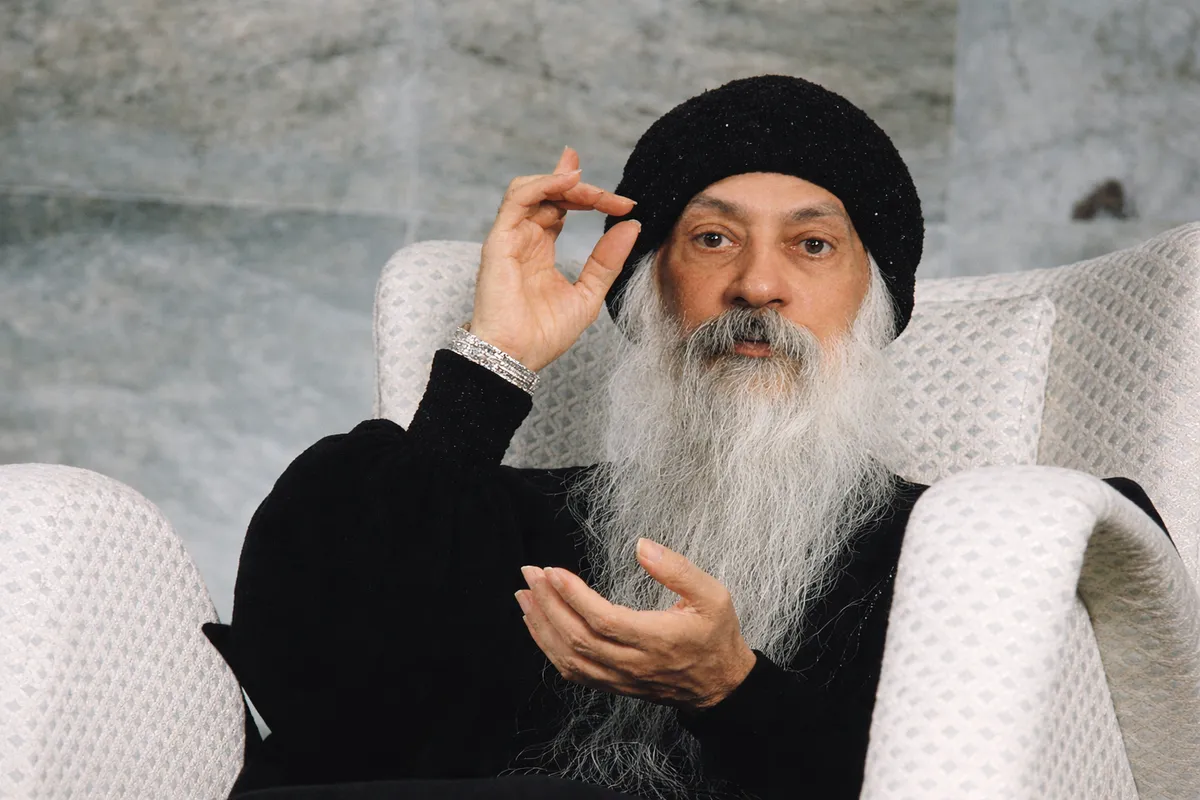
Words help you deal with people and things, but to know your inner self or God, be quiet and let go of words.
From the Discourses
Passages where Osho speaks to this question — each links to the complete discourse.
Osho, are all words useless?
Not all. How can all words be useless? Words are useful as far as the world is concerned, the outer; words are useless as far as you are concerned, the inner. When you start moving inwards you have to drop words. They are not needed. They are an unnecessary load on you, a disturbance, a noise. But when you go outwards and you meet people, you need language. When you are talking about things, you need language. Language is perfectly adequate for the world -- otherwise there would be great difficulty. If you go to the market and you want to purchase something, you will be in difficulty without words. And it will be an unnecessary wastage of time. Words are tremendously useful instruments. If you want to see it, one day go into the market and try to purchase things without words. Each small thing will take so much…
Osho, if silence has so much power, why does anyone speak at all? If silence has great power and silence is everything, then why are words spoken? Why does anyone speak?
Silence does have great power, but there has to be someone who can hear silence! Why does the need to speak arise? It arises because I see you heading toward a pit. I see that you will fall into it and break your arms and legs. I am standing here; I could say it to you from silence, but you don’t have ears to hear silence. So I shout, “You’ll fall into the pit!” In that, is my power lost? Is there any harm in that? No, no, no—nothing is lost. The one who has come to know power never loses anything. The one who has not known keeps losing everything. The one who has known never loses anything. In whatever form, to speak of the wordless we use words... That is exactly what I am saying: the difficulty is that if I write something like an autobiography, it will…
ओशो, जब मौन में इतनी शक्ति है तो फिर कोई कहता ही क्यों है? मौन में बहुत शक्ति है और मौन ही सब-कुछ है, तो फिर शब्द क्यों कहे जाते हैं? कोई क्यों कहता है?
मौन में तो बहुत शक्ति है, लेकिन मौन को सुनने वाला चाहिए न! सुनाने की जरूरत क्यों पड़ती है? जरूरत इसलिए पड़ती है, जरूरत इसलिए पड़ती है कि तुम्हें मैं देख रहा हूं कि तुम गड्ढे में जा रहे हो। तुम्हें मैं देख रहा हूं कि तुम गिरोगे गड्ढे में, हाथ-पैर तोड़ लोगे। मैं खड़ा हूं, मैं मौन से कह सकता हूं, लेकिन मौन से सुनने का तुम्हारे पास कान नहीं है। तो मैं चिल्ला कर कहूं कि गड्ढे में गिर जाओगे! उसमें अपनी शक्ति लूज हुई, इसमें कोई हर्जा नहीं है? न, न, न, कुछ लूज तो होती ही नहीं है। जिसको शक्ति का पता चल गया उसका कुछ कभी नहीं खोता। जिसको पता नहीं चला उसी का सब खोता रहता है। जिसको पता चल गया उसका कभी कुछ नहीं खोता। किसी भी रूप में निःशब्द को कहने के लिए शब्द का प्रयोग किया जाता है...।
The thirty spokes unite the one name; but it is on the axle that the use of the wheel depends. Clay is fashioned into vessels; but it is on their empty hollowness that their use depends. The doors and windows are cut out from the walls to form an apartment; but it is on the empty space within, that its use depends. Therefore, what has a (positive) existence serves for profitable adaptation, and what has not, serves for (actual) usefulness.
Freud has discovered a priceless truth. He says: "We also hate those whom we love." This was a startling discovery even for Freud himself. It was a terrible blow for all mankind especially for lovers. Lovers cannot believe they are capable of hatred towards those whom they love. The fact is, however, that all lovers know this within themselves, though they may not admit it. Therefore, Freud was resisted for a long time. Ultimately he could not be proven wrong. Gradually, the truth was accepted. Those whom we love we also despise, for love cannot stand without hatred. If you love somebody and you analyse it honestly, you will find yourself loving and hating alternately. You hate in the morning, love in the afternoon, hate in the evening and again love at night. Your love is periodical. The one you quarrelled with in the morning and decided it was impossible…
Osho, but the mantra-experts would say there is some other reason for its use?
Ask the mantra-scholars about that. What I am saying here is that the new arts are making uses that are absurd. Sculptures are being made of a kind you cannot call anyone’s statue. If you want to make a statue of “man,” it has to be made so that no one’s face appears in it—because if any face appears, it becomes someone’s; it is no longer of “man.” So if you want to make a statue of man, it must not have my face, not your face, not anyone’s face. The moment there is any particular face, it becomes some person’s and ceases to be “manhood.” So we make a statue in which there is no one’s face—such a statue can be made; we imagined it would be a statue of humanity, but it won’t remain even of a single human. What I am saying is: it will not become…
ओशो, लेकिन वह मंत्र-शास्त्री कहेंगे कि इसका कोई और कारण है उपयोग का?
वह मंत्र-शास्त्री से बात करनी चाहिए। मैं तो यहां यह कह रहा हूं कि नई कलाएं इस तरह के उपयोग कर रही हैं जो एब्सर्ड हैं। इस तरह की मूर्तियां बन रही हैं जिनको आप किसी की मूर्ति नहीं कह सकते। अगर आदमी की मूर्ति बनानी है तो ऐसी ही बनानी पड़ेगी कि उसमें किसी का चेहरा न आए, क्योंकि किसी का भी आ जाएगा तो वह किसी का हो जाएगा। आदमी का नहीं रह जाएगा। अब आदमी की अगर मूर्ति बनानी है तो उसमें मेरा चेहरा नहीं होना चाहिए, आपका चेहरा नहीं होना चाहिए, उसमें किसी का चेहरा नहीं होना चाहिए। उसमें कोई पर्टीकुलर चेहरा हुआ कि वह किसी आदमी का हो जाएगा, आदमियत का न रह जाएगा। तो हम एक ऐसी मूर्ति बनाएं, जिसमें किसी का चेहरा न हो—बन जाएगी ऐसी मूर्ति, लेकिन हम सोचते थे कि वह आदमियत की बन जाएगी, लेकिन वह एक आदमी की भी न रह जाएगी। जो मैं कह रहा हूं वह यह कह रहा हूं कि आदमियत की तो बनेगी नहीं, वह जो एक आदमी की बन सकती थी, वह भी नहीं बनेगी अब, अब वहां से भी विदा हो जाएगी, वह फेसलेस हो जाएगी। …
Why bring in the past? The present is so vast -- the past is so narrow. Why look from a hole in the wall when you can come out and look at the whole sky? So try not to use words, but if you have to, then be very choosey about them because each word has a nuance of its own. Be very poetic about it. Use it with taste, love, feeling. There are feeling words and there are intellectual words. Drop intellectual words more and more. Use more and more feeling words. There are political words and there are religious words. Drop political words. There are words which immediately create conflict. The moment you utter them, argument arises. So never use logical, argumentative language. Use the language of affection, of caring, of love, so that no argument arises.