
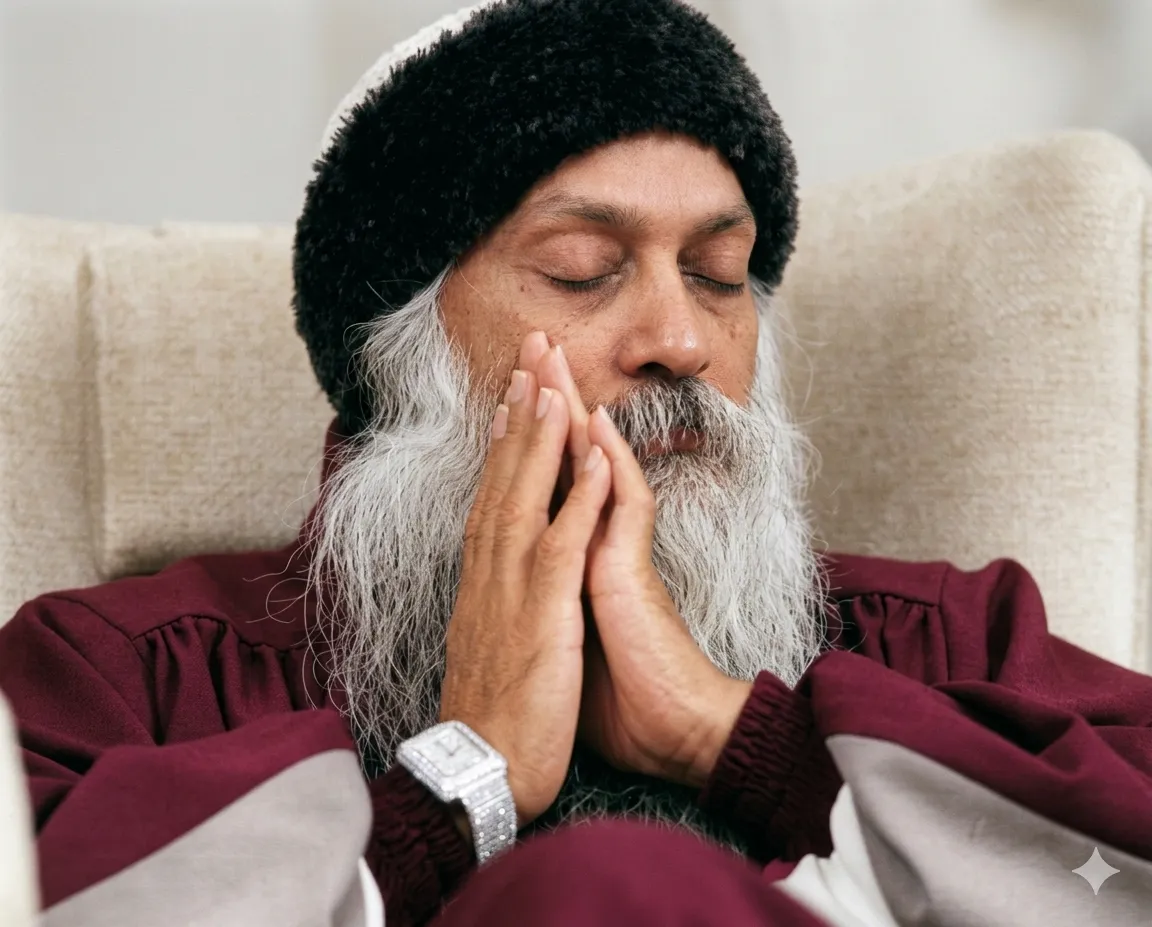
Osho's perspective on Prana
When Osho Spoke About Prana
Passages from the discourses where this theme comes alive.
Question: what is prana and how is it manifested in each of the seven bodies?
When the magnetic force is in you, when it is coming into you, you are great; when it has gone from you, you are just a nobody. And this is changing back and forth, just like day and night; the circle revolves, the wheel revolves. So even a person like Napoleon had his impotent moments and even a very cowardly person has his moments of bravery. In judo there is a technique to know when a person is powerless. That is the moment to attack him. When he is powerful you are bound to be defeated, so you have to know the moment when his magnetic power is going out and attack him then, and you should incite him to attack you when your magnetic force is coming in. This coming in and going out of the magnetic force corresponds to your breathing. That is why, when you have to…
A collection of sheaths composed of nourishing food, in the form of the physical body is called the annamaya kosh, or the food body. The fourteen kinds of winds, like the vital energy, et cetera, circulating through the food body, are called the pranayama kosh, or the vital body.
This physical layer is the first, is the primary layer -- the outermost. If you can be aware that you are unnecessarily the slave and need not be, then change your body habits consciously. By and by, change. Change the seat of power; be more in control. And give to the body all that is needed by it, but never fulfill any addictions. It will be painful in the beginning, but it is a bliss when you have reached beyond the body and have become the master. And when you are on the throne, it is one of the deepest blisses possible. Matter and energy are not two things. Matter is just energy, energy is just matter -- Two states of one thing. The second body is the vital. The vital body is the energy body, the electricity body, or whatsoever name we like to use for it -- the…
Osho, what is prana and what is apana? What does it mean to offer prana into apana, and to offer apana into prana? Please clarify this again.
What is within us is also part of the outside. Right now a breath is inside me. A little while ago it was with you, it was yours. A little earlier it was with a tree, it belonged to the tree. Before that, somewhere else. Now it is within me. Before I can even say it is inside me, it has gone out. If we dedicate what is within us to the outer world of prana, if we know it too as given back to the outside, then nothing remains inside—everything becomes empty. This is one kind of surrender: to offer the inner breath into that vast net of prana spread through the atmosphere, to pour it there as an oblation, to consign it there. Or we can do the reverse. The whole outer pranic cosmos is also but a part of my within, spread outwards. If we dedicate that…
प्रश्न: ओशो, प्राण क्या है और अपान क्या है? अपान में प्राण का हवन क्या है और प्राण में अपान का हवन क्या है? इसे फिर से स्पष्ट करें।
जो हमारे भीतर है, वह भी बाहर का हिस्सा है। अभी मेरे भीतर एक श्वास है। थोड़ी देर पहले आपके पास थी, आपकी थी। और थोड़ी देर पहले किसी वृक्ष के पास थी, वृक्ष की थी। और थोड़ी देर पहले कहीं और थी। अभी मेरे भीतर है। मैं कह भी नहीं पाया कि मेरे भीतर है, कि गई बाहर। जो हमारे भीतर है, उसको अगर हम बाहर के प्राण-जगत में समर्पित कर दें, जानें कि वह भी दे दी बाहर को, तो भीतर कुछ बच नहीं रह जाता। सब शून्य हो जाता है। एक समर्पण यह है। …
The buddha asked a monk: how do you measure the length of a man's life? The monk answered, "by days." the buddha said: you do not understand the way. The buddha asked another monk: how do you measure the length of a man's life? The monk answered, "by the time that passes during a meal." the buddha said: you do not understand the way. The buddha asked a third monk: how do you measure the length of a man's life? The monk answered, "by the breath." the buddha said: very well, you know the way.
THE BUDDHA ASKED A MONK: HOW DO YOU MEASURE THE LENGTH OF A MAN S LIFE? THE MONK ANSWERED, "BY DAYS. ... It is just like money: if you go to the market, it has value. If you simply sit alone with your money, it has no value. The value comes only when you relate with others, because the value is just an agreement between you and the others. That's why money has a beautiful name: it is called currency.'Currency' means: when money moves it has value; when it does not move it has no value. If you go on keeping it in your pocket always and always, it is meaningless. You can keep anything else instead of it; it will be the same. Money has value when it changes hands. From one hand to another -- then there is value. Value is in its being a currency, a moving force.
Profound Quotes on Prana
Explore our structured collection of meaning-mapped quotes regarding Prana.