
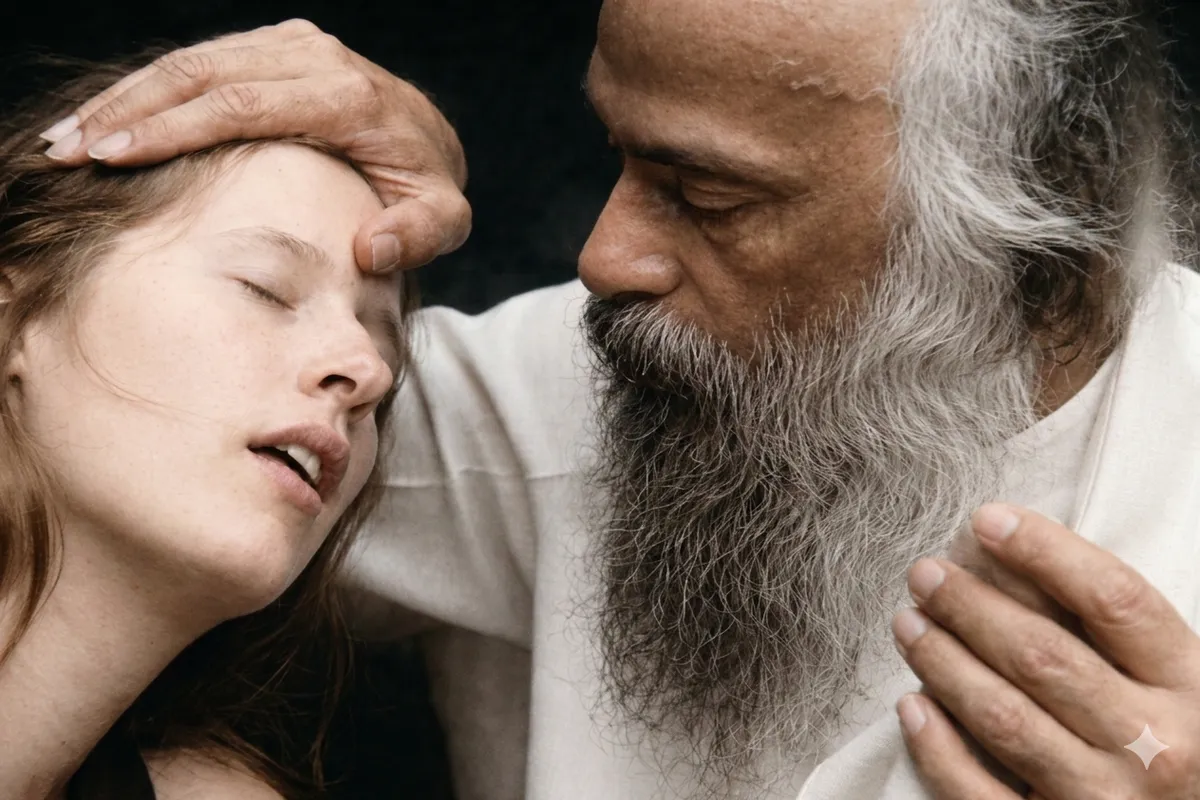
Osho's perspective on Philosophy and Poetry
When Osho Spoke About Philosophy and Poetry
Passages from the discourses where this theme comes alive.
Osho, why have we not been able to create a society which combines both polarities -- philosophy and poetry, science and religion? Is there a possibility of the total meeting of these polarities? Which land is more fertile for this meeting -- east or west? Is this meeting possible only in an individual, or can it exist simultaneously in the society also? In which way can meditation be useful for this meeting? What are the factors which can help man to grow in both the dimensions -- science and religion?
But we are all identified. We go on saying, "I cannot believe, I cannot have faith, because I am a sceptic." Or someone says, "I cannot doubt because I am a religious man." This shows that your consciousness has become fixed, stone-like. It is not river-like, moving, flowing. Flow? Move! So the second point: the mind has to be trained not to be identified with instruments. Then you can use them. You can use a sword -- but if you so are identified that your hand has become the sword, then how can you have a rose-flower in your hand? Then you will say, "It is impossible! How can I have a rose-flower in my hand? My hand is a sword!" And there is no relationship between a sword and a flower. You can take the sword, you can take a flower. If your hand is free from identification, only…
Osho, meditativeness and science are difficult to reconcile. Yet painting a picture, writing a poem, and solving a scientific problem all bring the same joy. The same joy! Why is it so difficult to be meditative and a scientist? Why has there never been a society in which the inner and the outer sciences, the science of gentleness and love and the science of aggression and death, live in harmony?
Mahavira, twenty-five centuries ago, used to make each of his statements with a 'perhaps'. If you asked him, "Is there a God?" he would say, "Perhaps." In those days it was not understood at all -- because how can you say, "Perhaps"? Either God is or is not. It seems so simple and so logical: "If God is, God is; if he is not, he is not. What do you mean by 'perhaps'?" Now it can be understood. Mahavira was using the same language in religion that is being used by Albert Einstein in physics. Albert Einstein calls it the theory of relativity. Mahavira has called his philosophy exactly the same: SAPEKSHAWAD -- the theory of relativity. Nothing is certain, everything is flexible, fluid. The moment you have said something, it is no longer the same. Things don't exist, Mahavira says, but only events. That's what modern science is saying,…
Osho, in this age of science it is said that poetry is counting its last days. But seeing the Ganges of poetry that flows through your discourses, it seems you are set on reviving poetry along with religion. Would you kindly tell us whether religion, poetry, and science can walk together?
For example, there is ecstasy in a person. You weigh him and ecstasy has no weight. The person’s weight will show on the scale. Today the person is ecstatic—still the weight will be the same; tomorrow he is unhappy—still the weight will be the same. So the scale will say ecstasy and sorrow do not exist, because they have no weight. Whether there is poetry in a person’s life or not, the weight will be the same. The scale will not distinguish between a man and a monkey. The scale knows only one thing: weight. Science has the scale; it is very gross. With it, some things simply slip away. You can weigh a flower, but how will you weigh the beauty of a flower? To see that beauty a sensitive heart is needed. It is not weighed on a scale; it is weighed on the heart. It is not…
दूसरा प्रश्न: ओशो, विज्ञान के इस युग में, कहते हैं, कविता अपने आखिरी दिन गिन रही है। लेकिन आपके प्रवचनों में प्रवाहित काव्य-गंगा को देख कर लगता है कि आप धर्म के साथ कविता को भी पुनर्जीवन देने पर तुले हैं। क्या बताने की कृपा करेंगे कि धर्म, कविता और विज्ञान क्या साथ-साथ चल सकते हैं?
… आदमी का जो वजन होगा आ जाएगा। आज आदमी मस्त है तो भी वजन उतना ही होगा तराजू पर और कल आदमी दुखी होगा तो भी वजन उतना ही होगा तराजू पर। तो तराजू तो कह देगा कि मस्ती और दुख होते ही नहीं, क्योंकि उनमें कोई वजन नहीं है। आदमी के जीवन में काव्य होगा तो भी वजन उतना ही होगा। काव्य-शून्य होगा आदमी तो भी वजन उतना ही होगा। तराजू आदमी और बंदर में फर्क नहीं करेगा। तराजू तो एक ही बात जानता है: वजन। विज्ञान के पास तराजू है; वह बड़ा स्थूल है। उससे कुछ चीजें चूक ही जाती हैं। फूल को तौल लोगे, लेकिन फूल के सौंदर्य को कैसे तौलोगे? उस सौंदर्य को तो कोई देखने वाला भावुक हृदय चाहिए। तराजू पर नहीं तुलता, हृदय पर तौला जाता है। परखनलियों में नहीं जांचा जाता, प्राणों में जांचा जाता है। …
It is the unknown, undiscovered, that goes on challenging you to progress, to evolution, to reach new heights, new peaks of consciousness. But if a day comes that all is known, everything is reduced into simple formulas, then there will be no romance, there will be no poetry, there will be no beauty, there will be no joy. There will be nothing left which is valuable. But fortunately the West is not right. The division between the known and the unknown is not complete. The East has a threefold division -- known, unknown, unknowable. It agrees with the West that the unknown can become known, but the unknowable will always remain unknowable. There will always be mystery around human consciousness. There will be always mystery around love, friendship, meditation, consciousness. We may be able to know all that is objective.
Is there a possibility of a total meeting between philosophy and poetry, science and religion?
outcomeProfound Quotes on Philosophy and Poetry
Explore our structured collection of meaning-mapped quotes regarding Philosophy and Poetry.