
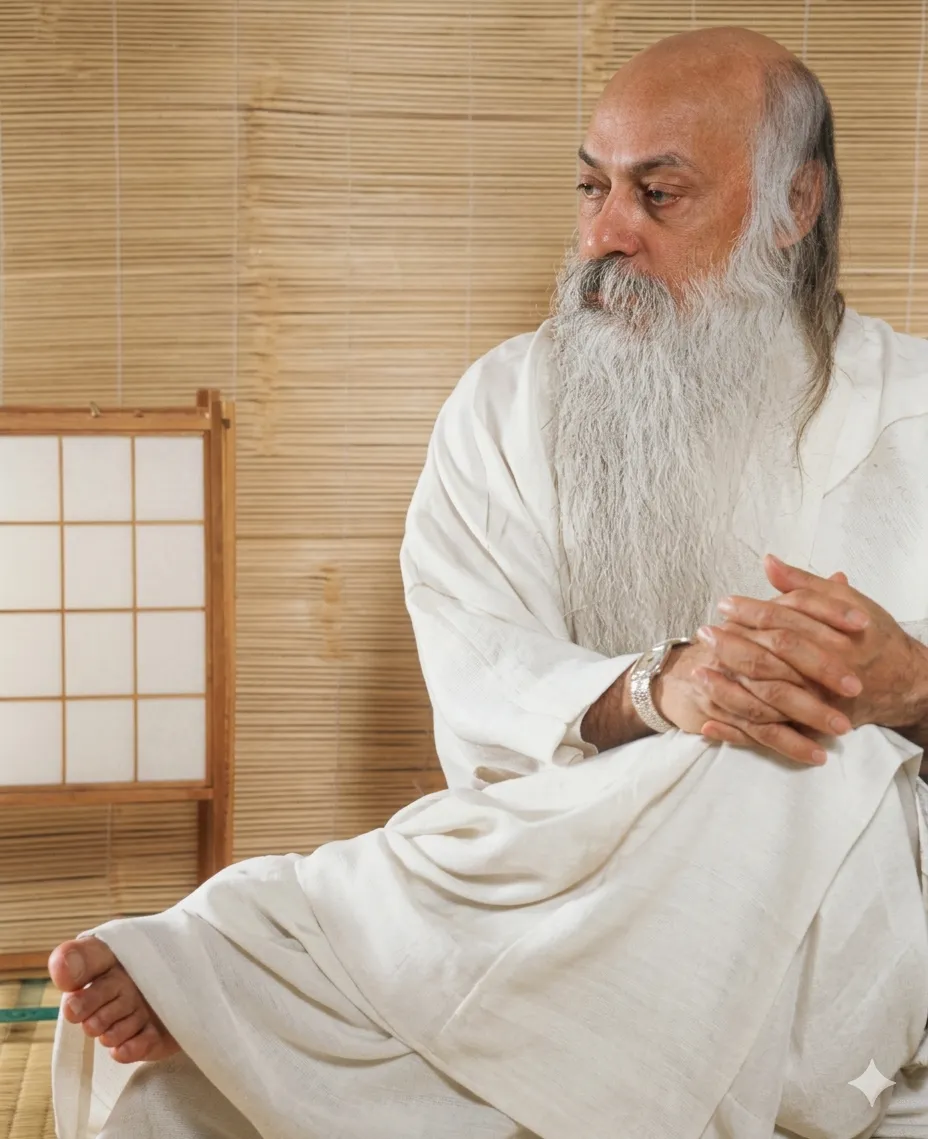
Osho's perspective on Nonattachment
When Osho Spoke About Nonattachment
Passages from the discourses where this theme comes alive.
What does asanga (nonattachment) mean—that to anyone...?
We are not with anything. We may be together—as we are sitting here; you are all sitting with me—but still I am alone and you are alone. We appear to be together, but who is truly with whom? There is a wife, a child, a mother, a father—everyone, all together—yet ultimately you are alone. The point is to deepen this sense. In every situation, in every situation. Even if wealth is close by, it is still outside us.
प्रश्न: असंग का क्या अर्थ है कि किसी को...
किसी चीज के संग नहीं हैं हम। साथ तो हैं--जैसे हम यहां बैठे हैं, आप सब मेरे साथ बैठे हैं, लेकिन फिर भी मैं अकेला हूं और आप भी अकेले हैं। दिख रहे हैं साथ, लेकिन साथ कौन है किसके? पत्नी है, बच्चा है, मां है, बाप है, सब हैं, सब साथ हैं, लेकिन फिर भी अंततः आप अकेले हैं। इसी भाव को गहरा करने की बात है। हर स्थिति में, हर स्थिति में। धन भी है पास में तो वह हमारे बाहर है।
[An elderly woman, the mother of a sannyasin who was also present, says: I turned my back on religion many years ago, so I've been saying no for a very long time.] That's very good! I was talking about you this morning! (Osho had talked about yea-sayers and no-sayers that morning in the discourse.) The religion to which you were saying no is not religion at all, and it is good to say no to it. Only religious people will say no to it. [The woman says: I've been calling myself a humanitarian.] Yes, that is a new name for it, but not as good as 'religion'. (a little chuckle) Because unless the human mind tries to reach beyond itself, it cannot grow. All growth comes to you only when you try to reach higher than your best. When you try for the impossible, then only the possible happens.
Osho, what is attachment? Why do we become so attached to things, ideas and persons? And is there freedom from attachment?
“So do one thing,” she told the courtesan. “I will pay you whatever you ask. Go to him at midnight. He meditates at midnight—has done so for thirty years. I want to know whether meditation has happened or not before I die. His hut door is only latched; no one ever goes there. Open it and go in. Whatever he says, notice every word and tell me. Go and embrace him—then come back and report. Before I die, I want to be sure that my service was not in vain.” The courtesan went. She opened the door. The monk was startled. He opened his eyes—he had been sitting in meditation—and shouted, “You wicked woman! Why are you here? Get out! What need have you to come at midnight?” But his tongue faltered; his body trembled. The woman had taken her money; she went right in. He cried, “Stay back! Why…
पहला प्रश्न: ओशो, आसक्ति क्या है? हम चीजों, विचारों और व्यक्तियों से इतने आसक्त क्यों हो जाते हैं? और क्या आसक्ति से छुटकारा भी है?
तो तू एक काम कर--उसने वेश्या को कहा--कि जो तुझे लेना हो उतने पैसे मैं दूंगी। तू आधी रात आज चली जा। वह फकीर आधी रात को ध्यान करता है। तीस साल से कर रहा है, अभी तक हुआ ध्यान या नहीं, यह मैं जानना चाहती हूं। मरने के पहले यह पक्का कर लेना चाहती हूं कि जिसकी सेवा की, व्यर्थ ही तो नहीं की। तो तू चली जाना भीतर। उसकी झोपड़ी का द्वार अटका ही रहता है, क्योंकि कोई कभी जाता ही नहीं। तू द्वार खोल लेना। और वह कुछ भी कहे, एक-एक बात का खयाल रखना, मुझे तुझे बताना पड़ेगा। और जाकर एकदम उसका आलिंगन कर लेना। वह क्या कहता है, क्या करता है, बस तू लौट कर मुझे बता देना। मरने के पहले मैं यह जान लेना चाहती हूं। वह वेश्या गई। उसने दरवाजा खोला। दरवाजा खोला तो साधु एकदम घबड़ाया। उसने आंख खोल कर देखा साधु ने। ध्यान करने बैठा था, एकदम चिल्लाया कि अरी दुष्ट स्त्री! …
Questioner: krishna says that by giving up desiring and attachment, which he calls niskamta and anasakti respectively, one is released from bondage and he attains to the supreme. But it is so difficult for ordinary men and women to be free of desiring and attachment. Please explain the significance of desirelessness and non-attachment and ways to achieve them.
In the first place try to understand the meaning of the word anasakti or non-attachment. It is unfortunately one of the most misunderstood words. Non-attachment is generally taken to mean aversion, but it is not aversion. Aversion is a kind of attachment -- the opposite of attachment. Someone is attached to sex and someone else is attached to its opposite -- brahmacharya or celibacy. Someone is attached to wealth; he is running after wealth, and someone else is attached to renunciation of wealth; he is running away from wealth. One person is obsessed with the idea of looking handsome; another person is obsessed with the idea of looking ugly. But those who are averse to sex, money or good looks appear to be non-attached because their attachments are negative. Attachment has two faces, positive and negative. You can fancy a thing so much that you madly run after it, you…
What does asanga (nonattachment) mean?
definitionProfound Quotes on Nonattachment
Explore our structured collection of meaning-mapped quotes regarding Nonattachment.